
We read your photo as:
What are the main categories of fibers, and how are they further classified with examples?
Chemistry
ScanSolve AI Answer
Step-by-step solution
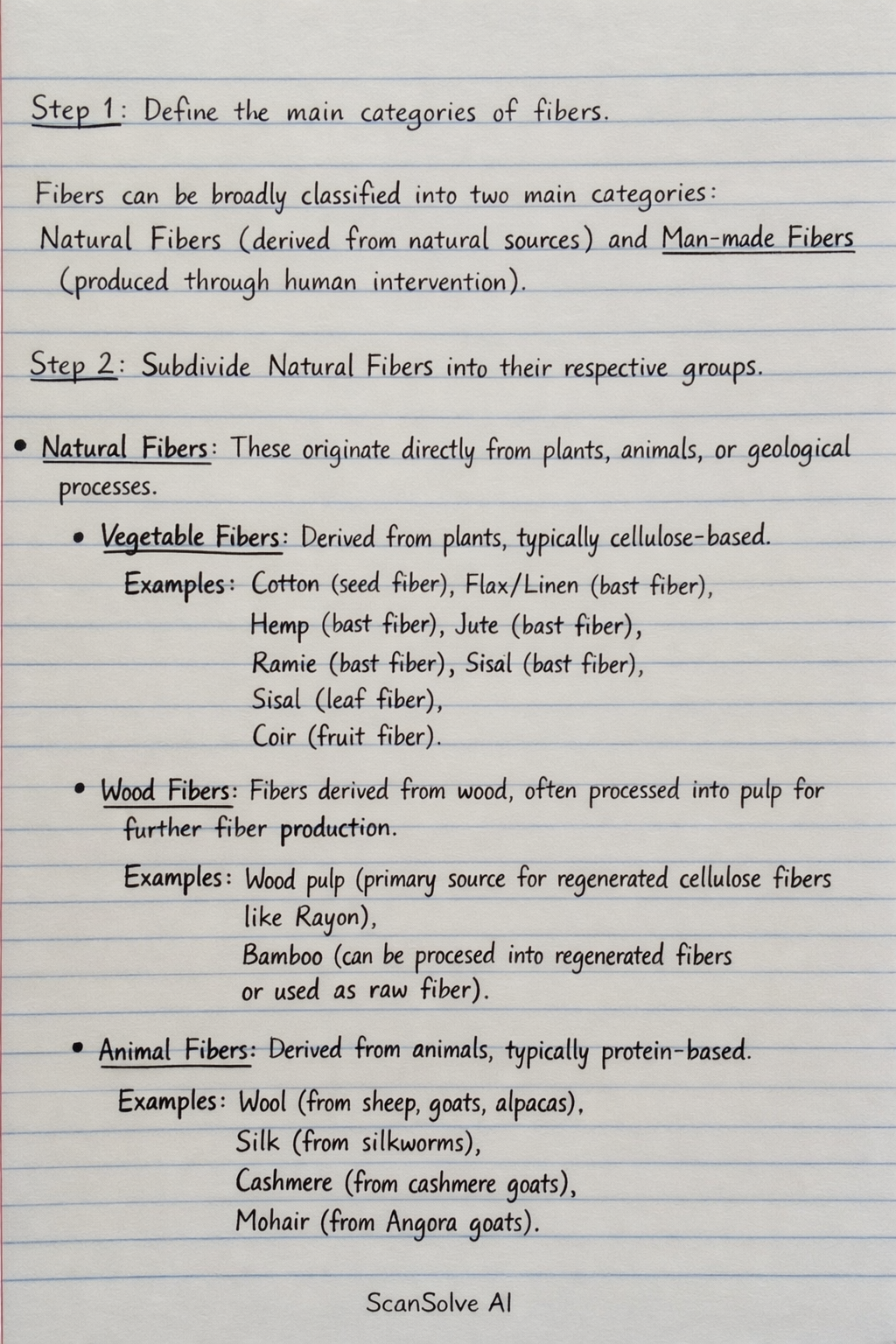
3 stepsDefine the main categories of fibers.
Fibers can be broadly classified into two main categories: Natural Fibers (derived from natural sources) and Man-made Fibers (produced through human intervention).
Subdivide Natural Fibers into their respective groups.
- Natural Fibers: These originate directly from plants, animals, or geological processes.
- Vegetable Fibers: Derived from plants, typically cellulose-based.
- Examples: Cotton (seed fiber), Flax/Linen (bast fiber), Hemp (bast fiber), Jute (bast fiber), Ramie (bast fiber), Sisal (leaf fiber), Coir (fruit fiber).
- Wood Fibers: Fibers derived from wood, often processed into pulp for further fiber production.
- Examples: Wood pulp (primary source for regenerated cellulose fibers like Rayon), Bamboo (can be processed into regenerated fibers or used as raw fiber).
- Animal Fibers: Derived from animals, typically protein-based.
- Examples: Wool (from sheep, goats, alpacas), Silk (from silkworms), Cashmere (from cashmere goats), Mohair (from Angora goats).
- Mineral Fibers: Naturally occurring inorganic fibers.
- Examples: Asbestos (historically used, but not in medical textiles due to health risks), Basalt fiber (from volcanic rock).
- Biological Fibers: Fibers produced by biological systems or derived from biological materials, often with specific applications in medical textiles.
- Examples: Collagen fibers (from animal connective tissue), Chitosan fibers (derived from chitin), Alginate fibers (from seaweed), Bacterial cellulose (produced by bacteria), Bio-engineered spider silk.
- Vegetable Fibers: Derived from plants, typically cellulose-based.
- Natural Fibers: These originate directly from plants, animals, or geological processes.
Subdivide Man-made Fibers into their respective groups.
- Man-made Fibers: These are produced by humans through chemical processes.
- Semi-Synthetic/Regenerated Fibers: Derived from natural polymers (like cellulose or protein) that are chemically processed and regenerated into fibers.
- Examples: Rayon (Viscose, Modal, Lyocell, Cuprammonium), Acetate (cellulose acetate), Triacetate (cellulose triacetate).
- Synthetic Fibers: Completely synthesized from chemical compounds (polymers).
- Examples: Polyester (e.g., PET), Nylon (Polyamide), Acrylic, Polypropylene (PP), Spandex (Elastane), Aramid (Kevlar, Nomex), Polyethylene (PE), Carbon fiber (often from synthetic precursors like PAN).
- Semi-Synthetic/Regenerated Fibers: Derived from natural polymers (like cellulose or protein) that are chemically processed and regenerated into fibers.
The comprehensive structural flow-chart for fibers is as follows:
- Fibers
- Natural Fibers
- Vegetable Fibers
- Cotton
- Flax/Linen
- Hemp
- Jute
- Ramie
- Sisal
- Coir
- Wood Fibers
- Wood pulp
- Bamboo
- Animal Fibers
- Wool
- Silk
- Cashmere
- Mohair
- Mineral Fibers
- Asbestos (historical)
- Basalt fiber
- Biological Fibers
- Collagen fibers
- Chitosan fibers
- Alginate fibers
- Bacterial cellulose
- Bio-engineered spider silk
- Vegetable Fibers
- Man-made Fibers
- Semi-Synthetic/Regenerated Fibers
- Rayon (Viscose, Modal, Lyocell)
- Acetate
- Triacetate
- Synthetic Fibers
- Polyester
- Nylon
- Acrylic
- Polypropylene
- Spandex
- Aramid
- Polyethylene
- Carbon fiber
- Semi-Synthetic/Regenerated Fibers
- Natural Fibers
- Man-made Fibers: These are produced by humans through chemical processes.
Was this helpful?
Still stuck on this one?
Ask a follow-up, and the answer starts from this question.
Got a different question?Ask your own question
More Chemistry Questions
QWhat are the main ways of classifying instruments? What is classification by function?QWrite on the classification and naming criteria of muscles with relevant examples.QTAKE HOME ASSIGNMENT 1HE3 & 4. (CLOTHING AND TEXTILES) Elaborate on how to carry out the following…QClassify carbohydrates and define polysaccharides. What bonds are in disaccharides? How are…QWhat are the four main types of data, and can you provide examples for each?
Handwritten Step-by-Step Solution
Get this as a handwritten image on WhatsApp — like a tutor wrote it for you.
Try on WhatsApp