
We read your photo as:
The provided text is a solution to a chemistry question about the reactions of ammonia with copper(II) oxide and lead(II) oxide. What was the original question?
ScanSolve AI Answer
Here are the answers to your questions:
-
-
a) Write an equation for the reaction that occurs in the combustion tube. (1mk)
-
b) State and explain the observations that were made in the combustion tube. (3mks) The black solid (copper(II) oxide) turned into a brown/pink solid (copper metal). This is because ammonia reduced the copper(II) oxide to copper metal.
-
c) Name gas Y. (1mk)
- Nitrogen
-
d) (i) State any changes in observations that would be made if lead (II) oxide was used instead of copper (II) oxide. (2mks) The yellow solid (lead(II) oxide) would turn into a grey/silver solid (lead metal).
-
d) (ii) Write an equation for the reaction between ammonia gas and lead (II) oxide. (1mk)
-
d) (iii) What property of ammonia is shown by the reaction in the combustion tube? (1mk)
- Reducing property (Ammonia acts as a reducing agent).
-
e) State two uses of ammonia. (2mks)
- i) Manufacture of fertilizers (e.g., ammonium sulfate, urea).
- ii) Manufacture of nitric acid. (Alternatively: used as a refrigerant or in the manufacture of explosives).
-
-
- a) Other than their location in the atom, name two other differences between an electron and a proton. (2mks)
- i) Charge: Protons are positively charged (), while electrons are negatively charged ().
- ii) Mass: Protons have a significant mass (approximately 1 atomic mass unit), while electrons have a negligible mass (approximately of a proton's mass).
- a) Other than their location in the atom, name two other differences between an electron and a proton. (2mks)
Still stuck on this one?
Ask a follow-up, and the answer starts from this question.
More Chemistry Questions
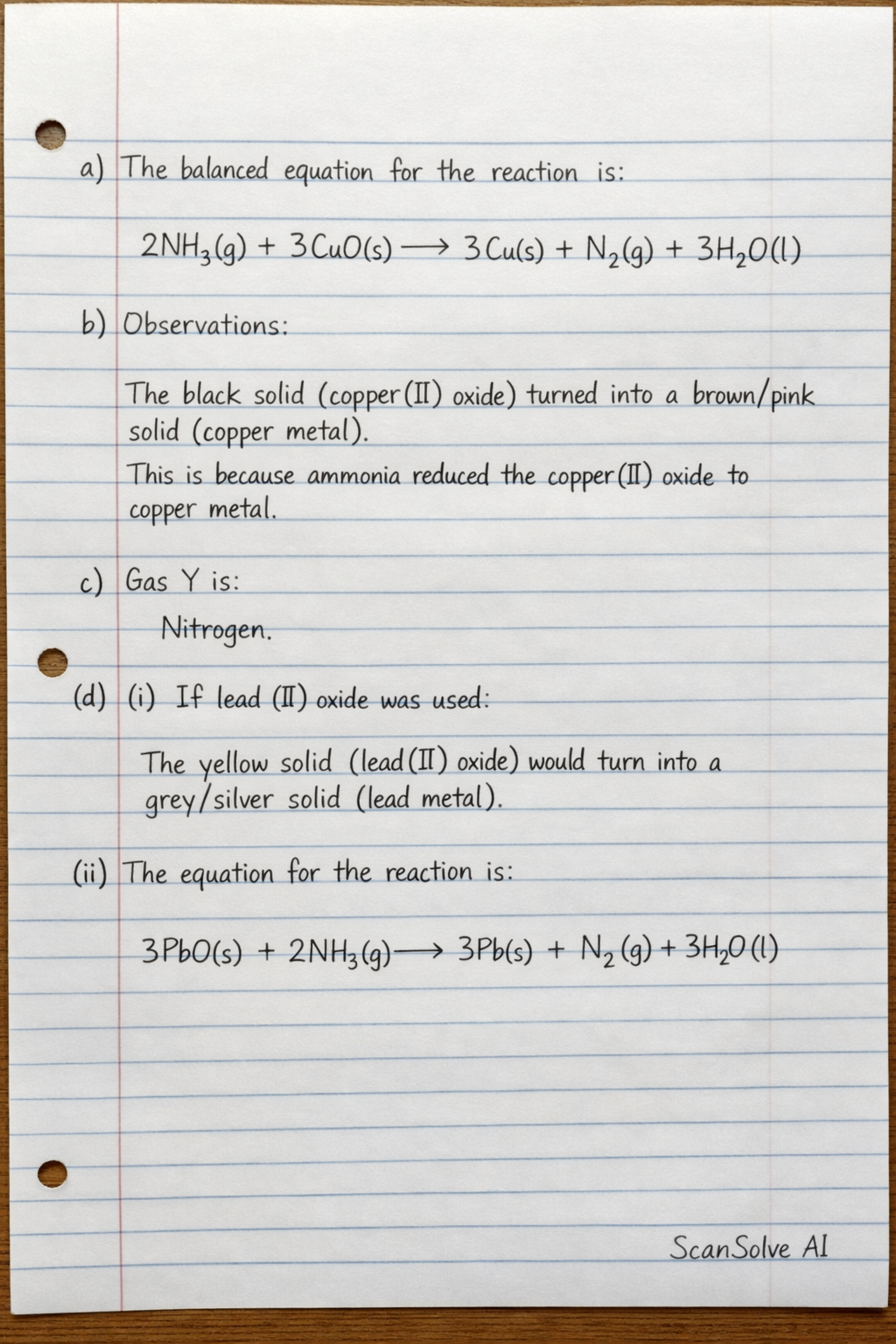
Handwritten Step-by-Step Solution
Get this as a handwritten image on WhatsApp — like a tutor wrote it for you.
Try on WhatsApp