
We read your photo as:
The rate equation for a reaction mechanism is determined by the slowest step (the rate-determining step).
Chemistry
ScanSolve AI Answer
Answer
The rate equation for a reaction mechanism is determined by the slowest step (the rate-determining step).
The given mechanism is:
- (Slow step)
- (Fast step)
- (Fast step)
The slow step is the first step:
For an elementary step, the rate law can be written directly from the stoichiometry of the reactants in that step. In this slow step, one molecule of reacts.
Therefore, the rate equation for the reaction is:
Was this helpful?
Try one yourself
A new problem that tests the same skill.
Still stuck on this one?
Ask a follow-up, and the answer starts from this question.
Got a different question?Ask your own question
More Chemistry Questions
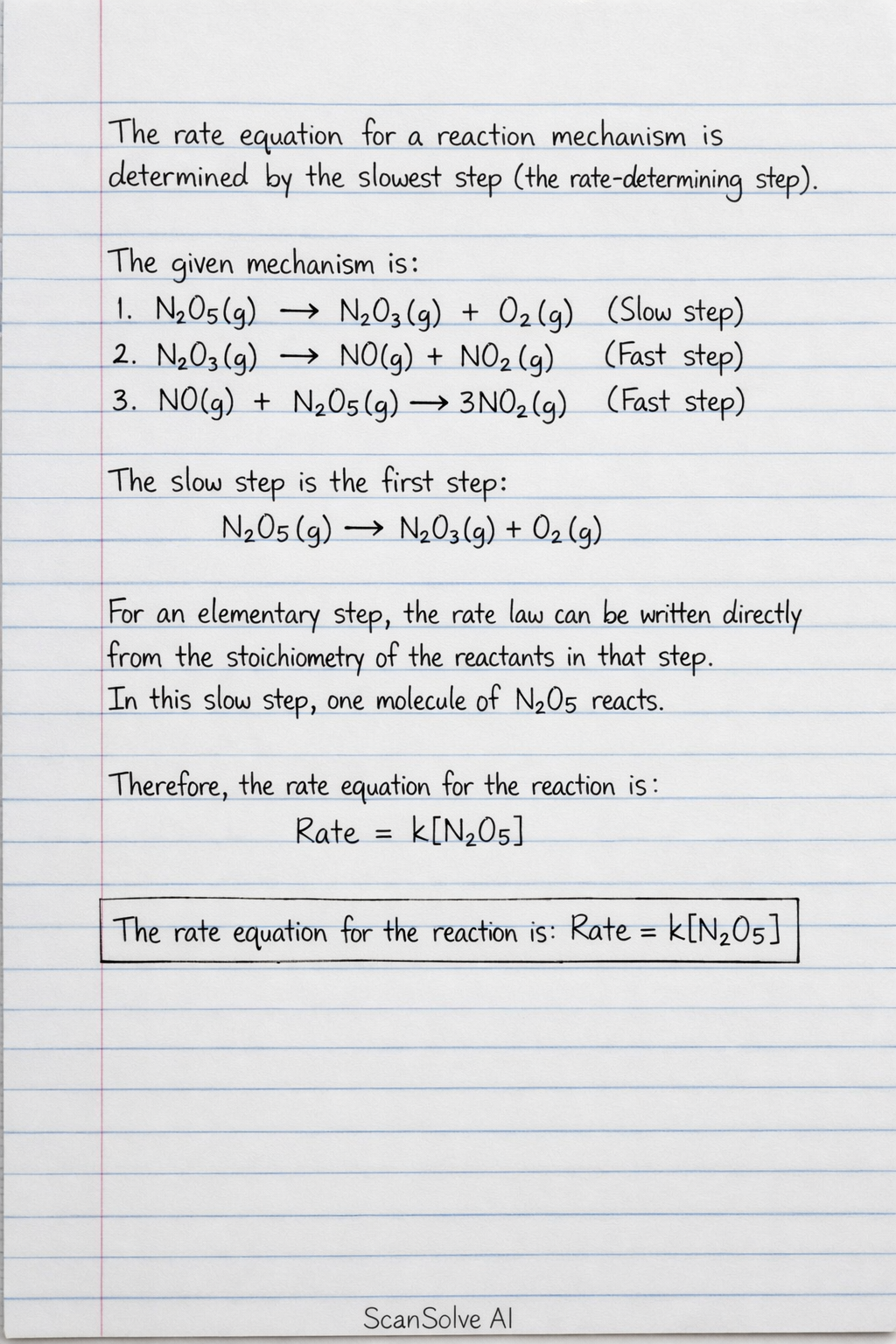
Handwritten Step-by-Step Solution
Get this as a handwritten image on WhatsApp — like a tutor wrote it for you.
Try on WhatsApp