
We read your photo as:
What is the shape of CCl4 molecule?
ScanSolve AI Answer
Answer
Step-by-step solution
27 stepsHere are the solutions to the questions:
- What is the shape of molecule?
Carbon (C) is the central atom, and it forms single bonds with four chlorine (Cl) atoms.
Carbon has 4 valence electrons, and it uses all of them to form 4 single bonds, resulting in 4 bonding pairs and 0 lone pairs around the central carbon atom.
According to VSEPR theory, a molecule with four electron domains and no lone pairs has a tetrahedral molecular geometry.
The correct option is B. $$ \boxed{\text{B. Tetrahedral}} $$16. A mixture of diamond and iron filings can be separated by
Diamond is a form of carbon and is non-magnetic.
Iron filings are magnetic.
Mixtures containing magnetic and non-magnetic components can be separated using a magnet.
This process is called magnetisation.
The correct option is C.- The percentage of oxygen in sulphur (IV) oxide is [S=32, O=16]
Sulphur (IV) oxide is .
Calculate the molar mass of
Molar mass of S = 32 g/mol Molar mass of O = 16 g/mol Molar mass of $SO_2 = 32 + (2 \times 16) = 32 + 32 = 64$ g/mol.Calculate the total mass of oxygen in
Mass of oxygen = $2 \times 16 = 32$ g.Calculate the percentage of oxygen
Percentage of oxygen $= \frac{\text{mass of oxygen}}{\text{molar mass of } SO_2} \times 100\% = \frac{32}{64} \times 100\% = 0.5 \times 100\% = 50\%$. The correct option is D. $$ \boxed{\text{D. 50.}} $$18. The metal that does not react with oxygen is
This question asks about the reactivity of metals with oxygen.
Metals vary in their reactivity, with some reacting readily and others being very unreactive.
Among the given options, silver (Ag) is a noble metal known for its low reactivity.
It does not readily react with oxygen under normal conditions, unlike aluminum (Al), magnesium (Mg), lead (Pb), and tin (Sn), which all form oxides.
The correct option is A.- The following are chemical changes except
A chemical change results in the formation of new substances with different chemical properties.
A physical change alters the form or appearance but not the chemical composition.
Step 14
- Fading of coloured cloth involves the chemical breakdown of dye molecules.
- Fermentation of glucose converts glucose into ethanol and carbon dioxide.
- Rusting of iron nails involves iron reacting with oxygen and water to form iron oxide.
- Slaking of quicklime involves calcium oxide reacting with water to form calcium hydroxide.
- Sublimation of solids is a phase change where a solid turns directly into a gas without passing through a liquid state (e.g., dry ice turning into carbon dioxide gas). No new chemical substance is formed. The correct option is E.
- The bond involved in the formation of a hydroxonium ion is that of
A hydroxonium ion () is formed when a water molecule () accepts a proton ().
The oxygen atom in water has two lone pairs of electrons.
The ion (which has no electrons) forms a bond by accepting both electrons from one of these lone pairs.
A bond formed when one atom donates both electrons to the shared pair is called a dative bond or coordinate covalent bond.
The correct option is B. $$ \boxed{\text{B. dative}} $$21. Reduction can be defined as
Reduction is one half of a redox (reduction-oxidation) reaction.
Common definitions of reduction include the gain of electrons, a decrease in oxidation state, the gain of hydrogen, or the loss of oxygen.
Among the given options, "addition of hydrogen" is a correct definition of reduction.
The correct option is B. $$ \boxed{\text{B. addition of hydrogen.}} $$22. Linear molecules have a bond angle of
A linear molecular geometry means that the atoms are arranged in a straight line.
For atoms to be in a straight line, the angle between the bonds must be .
Examples include and .
The correct option is E.- Which of the following ions has the same electronic structure as argon?
Argon (Ar) is a noble gas with atomic number 18.
Its electronic configuration is , meaning it has 18 electrons.
We need to find an ion that also has 18 electrons.
- (Fluorine, atomic number 9) has electrons.
- (Aluminum, atomic number 13) has electrons.
- (Sodium, atomic number 11) has electrons.
- (Magnesium, atomic number 12) has electrons.
- (Chlorine, atomic number 17) has electrons. The correct option is E.
- Which of the following elements is the most electronegative?
Electronegativity is a measure of an atom's ability to attract electrons in a chemical bond.
Electronegativity generally increases across a period and decreases down a group in the periodic table.
All the given elements (Astatine, Bromine, Chlorine, Fluorine, Iodine) are halogens (Group 17).
Within Group 17, electronegativity decreases as you go down the group. Fluorine is at the top of the group, making it the most electronegative element among the options (and the most electronegative element overall).
The correct option is D.
Try one yourself
A new problem that tests the same skill.
Still stuck on this one?
Ask a follow-up, and the answer starts from this question.
More Chemistry Questions
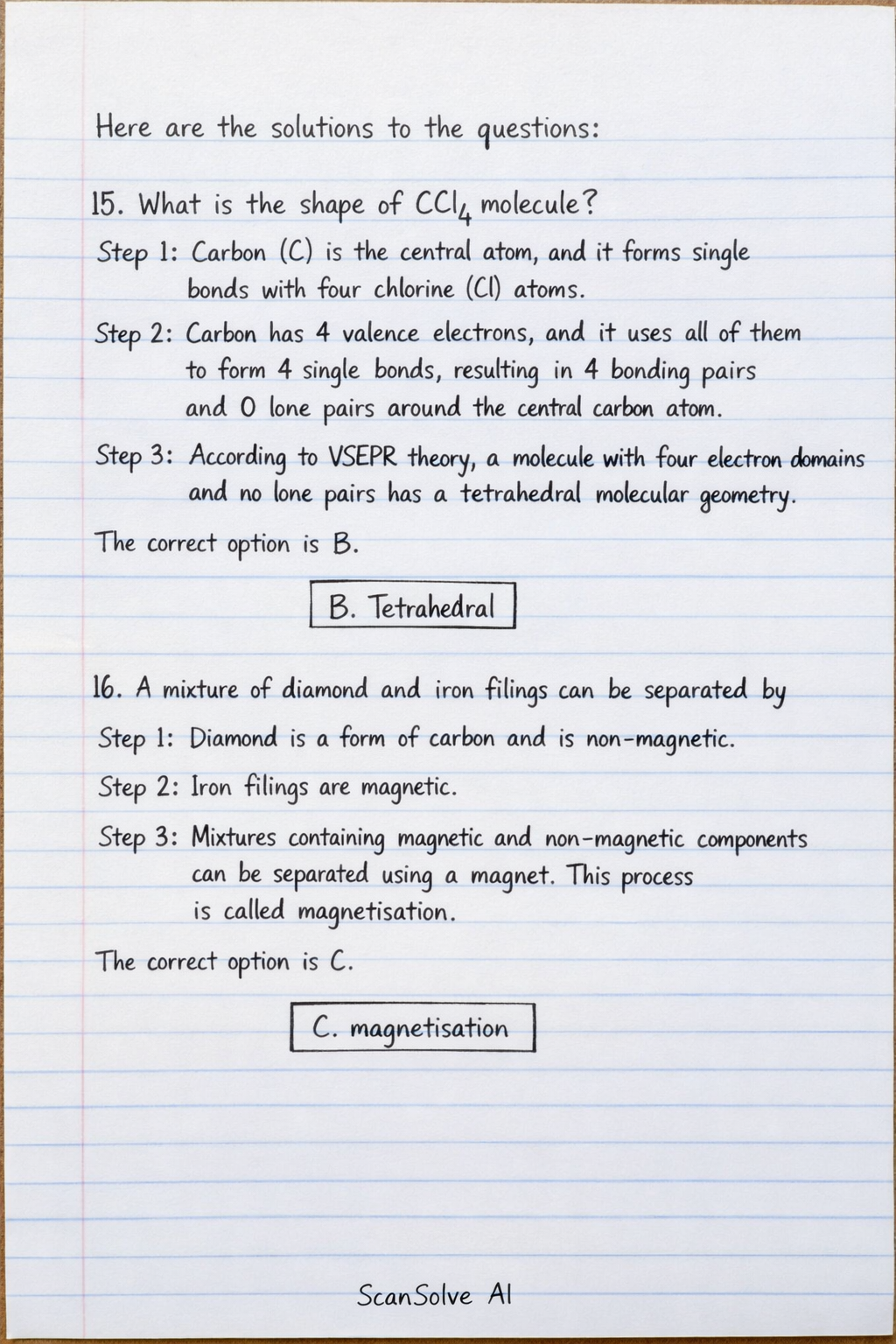
Handwritten Step-by-Step Solution
Get this as a handwritten image on WhatsApp — like a tutor wrote it for you.
Try on WhatsApp