
We read your photo as:
Draw the chemical structure for 3-methylcyclohexane.
Chemistry
ScanSolve AI Answer
Step-by-step solution
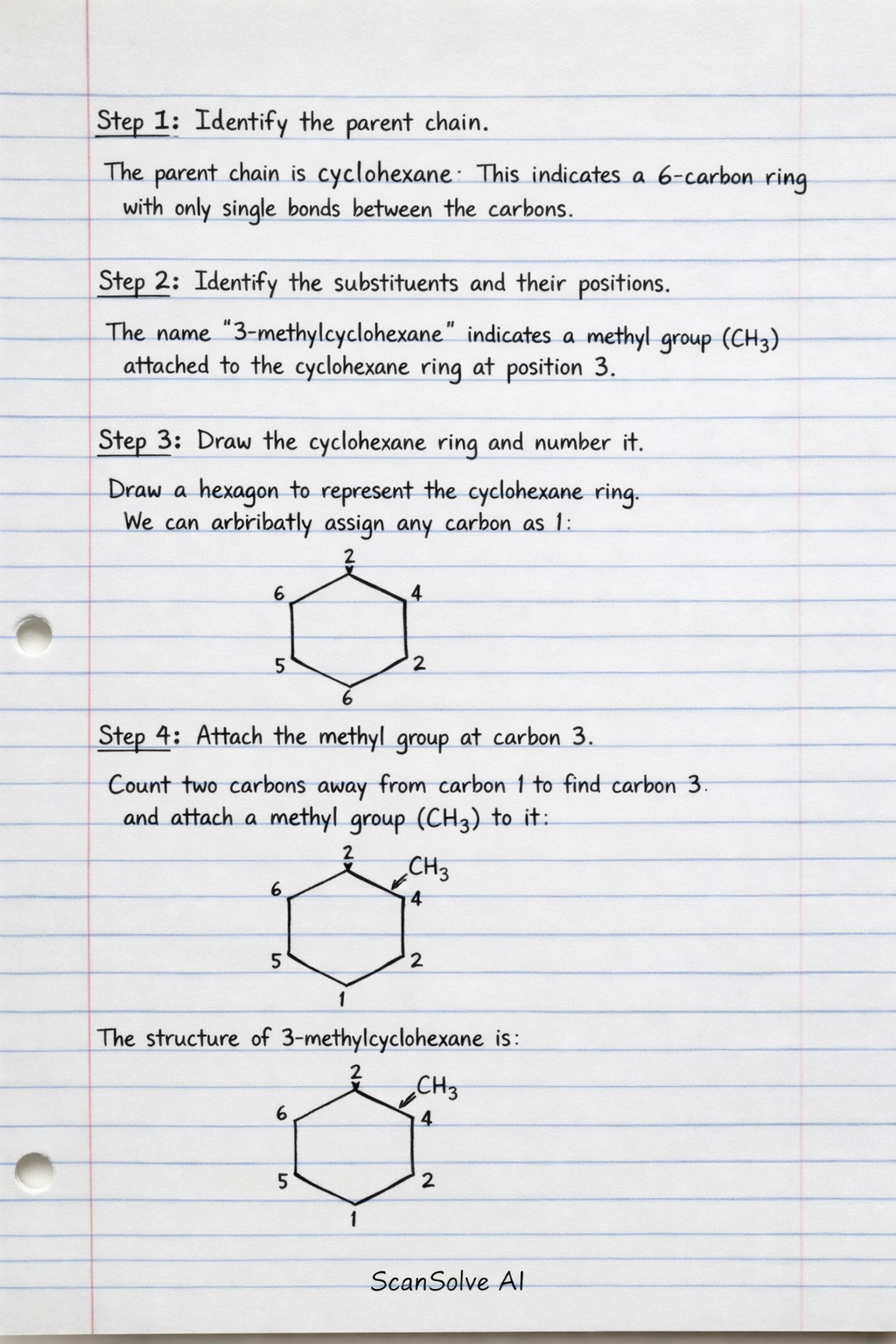
4 stepsIdentify the parent chain.
The parent chain is cyclohexane. This indicates a 6-carbon ring with only single bonds between the carbons.
Identify the substituents and their positions.
The name "3-methylcyclohexane" indicates a methyl group () attached to the cyclohexane ring at position 3.
Draw the cyclohexane ring and number it.
Draw a hexagon to represent the cyclohexane ring. We can arbitrarily assign any carbon as carbon 1.
Attach the methyl group at carbon 3.
Count two carbons away from carbon 1 (in either direction, clockwise or counter-clockwise) to find carbon 3, and attach a methyl group () to it.
The structure of 3-methylcyclohexane is:
\boxed{ \text{
    \begin{tikzpicture}[scale=0.8]
        \coordinate (C1) at (0,0);
        \coordinate (C2) at (1,0);
        \coordinate (C3) at (1.5,0.866);
        \coordinate (C4) at (1,1.732);
        \coordinate (C5) at (0,1.732);
        \coordinate (C6) at (-0.5,0.866);

        \draw (C1) -- (C2) -- (C3) -- (C4) -- (C5) -- (C6) -- cycle;

        % Methyl group at C3
        \draw (C3) -- (2.5,0.866);
        \node at (2.8,0.866) {$\text{CH}_{3}$};

        % Optional: numbering for clarity (not part of final structure)
        % \node[below] at (C1) {1};
        % \node[below] at (C2) {2};
        % \node[right] at (C3) {3};
        % \node[above] at (C4) {4};
        % \node[above] at (C5) {5};
        % \node[left] at (C6) {6};
    \end{tikzpicture}
} }
Was this helpful?
Still stuck on this one?
Ask a follow-up, and the answer starts from this question.
Got a different question?Ask your own question
More Chemistry Questions
QDraw the skeletal structure for 3,3-dimethylheptane.QDraw the structural formula for 2-methylheptane.QDraw the structural formula for each of the following compounds: a) 2-methylheptane b) 3-ethylhexaneQDraw the structures for 4-ethyl-2,2-dimethylheptane and 3-ethyl-2,4-dimethylhexane.QShow the structure of 5 methylhexan-3-one
Handwritten Step-by-Step Solution
Get this as a handwritten image on WhatsApp — like a tutor wrote it for you.
Try on WhatsApp