
We read your photo as:
The solution provides answers to questions about the hydrolysis of a triglyceride, preparation of ethyne, and addition polymerization of perspex. What are the original questions?
ScanSolve AI Answer
here are the solutions:
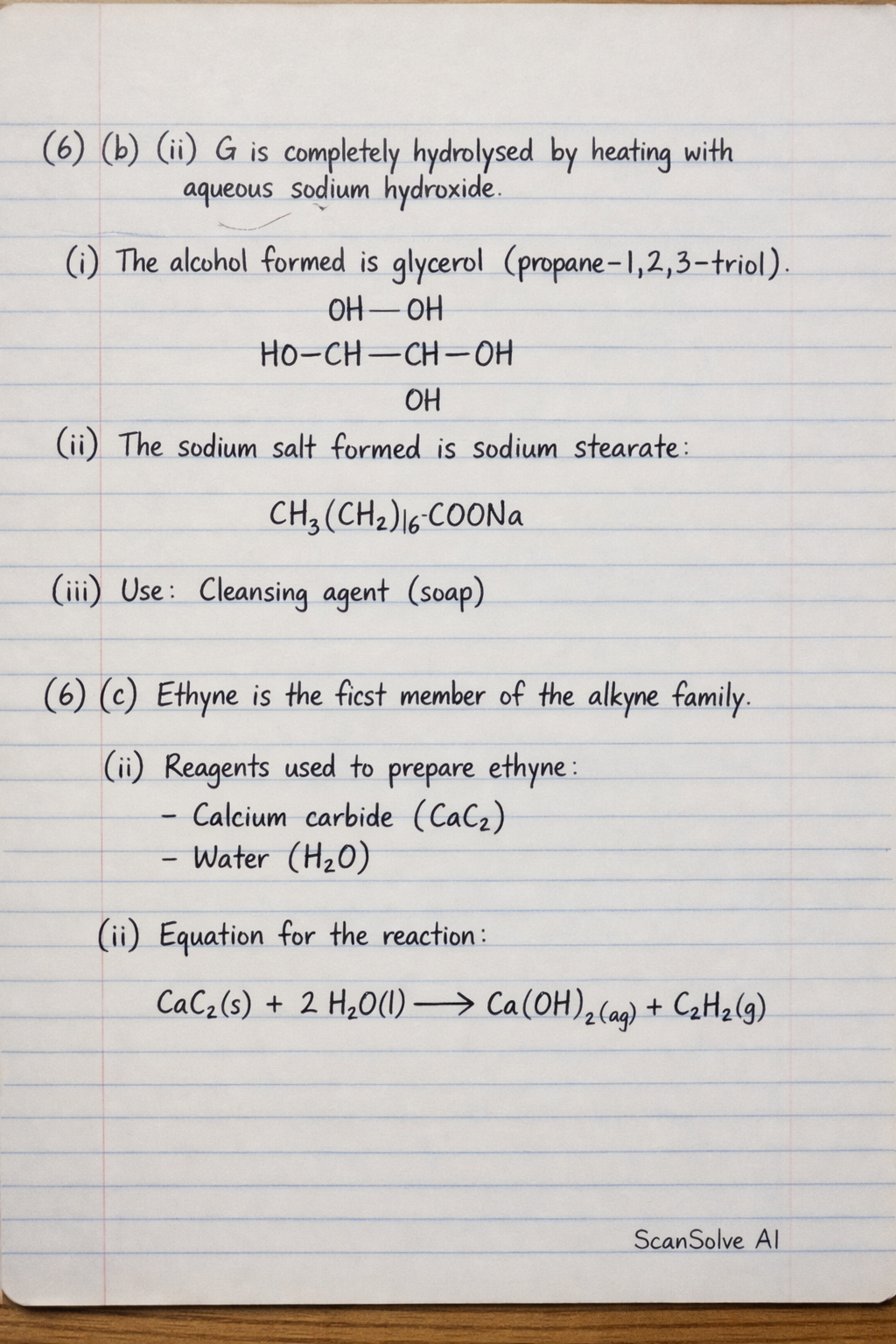
6. (b) (ii) G is completely hydrolysed by heating with aqueous sodium hydroxide.
- (I) Give the structural formula of the alcohol formed. The alcohol formed from the hydrolysis of a triglyceride is glycerol (propane-1,2,3-triol).
- (II) Write a formula for the sodium salt formed. Assuming compound G is a tri-ester of stearic acid, the sodium salt formed is sodium stearate.
- (III) State the use of the sodium salt. Cleansing agent (soap)
6. (c) Ethyne is the first member of the alkyne family.
- (i) Name two reagents that can be used in the laboratory to prepare the gas.
- Calcium carbide ()
- Water ()
- (ii) Write an equation for the reaction.
6. (d) Perspex is an addition synthetic polymer formed from the monomer,
The monomer is methyl methacrylate: .
-
(i) What is meant by addition polymerisation? Addition polymerisation is a process where unsaturated monomers (containing double or triple bonds) join together without the loss of any atoms, forming a long chain polymer.
-
(ii) Draw three repeat units of Perspex. The repeat unit is . Three repeat units are:
-
(iii) Give one use of Perspex. Making lenses (e.g., in spectacles or aircraft windows)
6. (e) State two environmental hazards associated with synthetic polymers.
- Non-biodegradability: Synthetic polymers do not decompose naturally, leading to persistent waste accumulation in landfills and oceans.
- Pollution during incineration: Burning synthetic polymers can release toxic gases and contribute to air pollution.
Still stuck on this one?
Ask a follow-up, and the answer starts from this question.
More Chemistry Questions
Handwritten Step-by-Step Solution
Get this as a handwritten image on WhatsApp — like a tutor wrote it for you.
Try on WhatsApp