
We read your photo as:
Describe three common reactions of ethyne, including reaction equations and products.
ScanSolve AI Answer
Step-by-step solution
3 stepsThe image shows the chemical structure for ethyne (acetylene), . Here are some common reactions for ethyne:
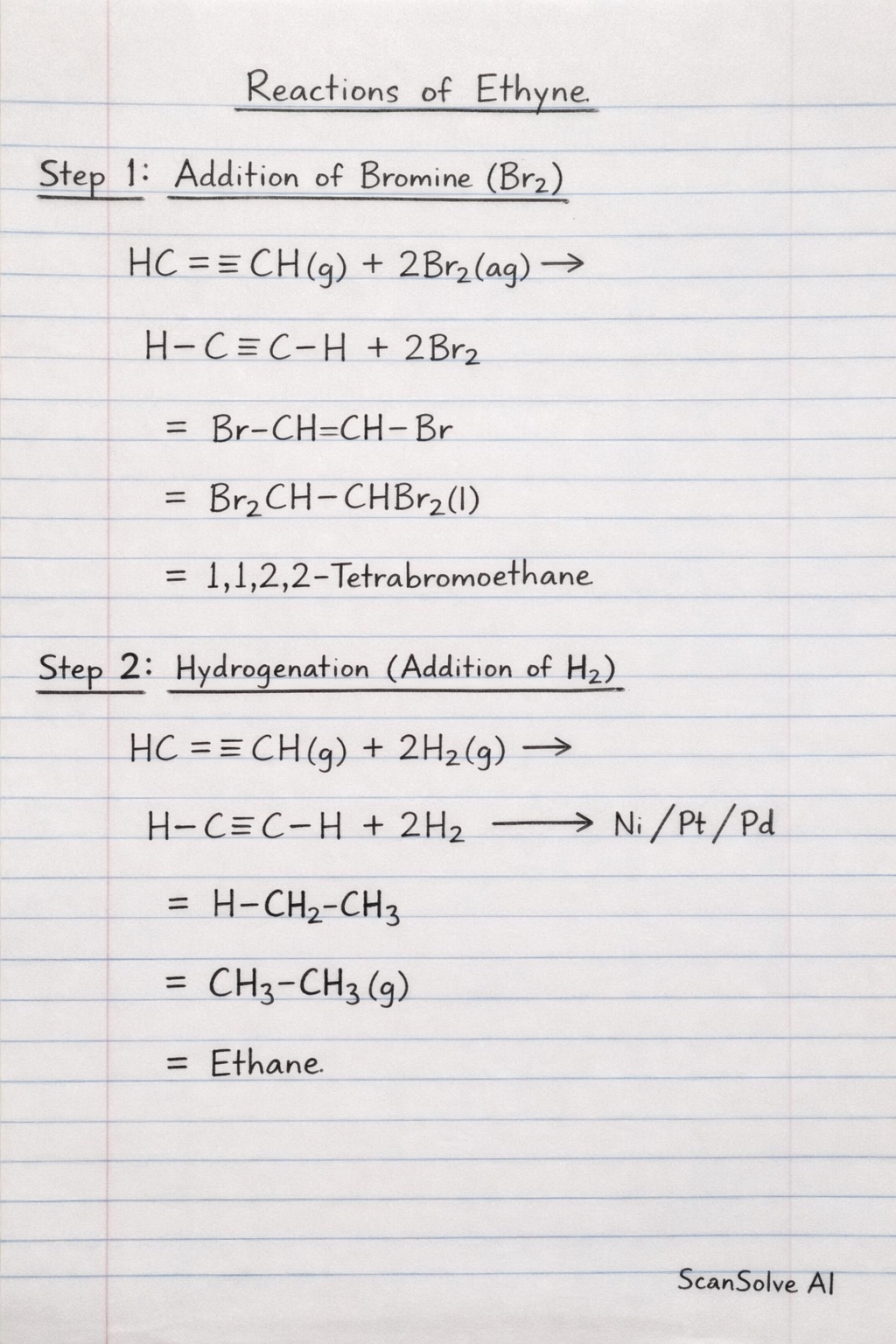
Addition of Bromine ()
Ethyne undergoes addition reactions with halogens like bromine. It can add two molecules of bromine across the triple bond.
Ethyne + Bromine 1,1,2,2-Tetrabromoethane
Hydrogenation (Addition of )
Ethyne can be fully hydrogenated to an alkane by adding two molecules of hydrogen in the presence of a metal catalyst (e.g., Nickel, Platinum, or Palladium).
Ethyne + Hydrogen Ethane
Hydration (Addition of )
Ethyne reacts with water in the presence of mercury(II) sulfate () and sulfuric acid () to form an enol, which immediately tautomerizes to acetaldehyde.
Ethyne + Water Acetaldehyde
Still stuck on this one?
Ask a follow-up, and the answer starts from this question.
More Chemistry Questions
Handwritten Step-by-Step Solution
Get this as a handwritten image on WhatsApp — like a tutor wrote it for you.
Try on WhatsApp