
We read your photo as:
The standard cell potential ΔE° is 1.100V for the cell Zn(s)/Zn²⁺//Cu²⁺/Cu(s) if [Zn²⁺] = 0.01M and [Cu²⁺] = 1.0M, what is the ΔE or EMF?
ScanSolve AI Answer
Answer
Step-by-step solution
4 stepsTo find the cell potential () under non-standard conditions, we use the Nernst equation.
Write the overall cell reaction and determine the number of electrons transferred ().
The cell notation indicates the following half-reactions:
Anode (oxidation):
Cathode (reduction):
Overall reaction:
From the half-reactions, the number of electrons transferred, , is 2.Write the Nernst equation.
The Nernst equation at is:
Where is the standard cell potential, is the number of electrons transferred, and is the reaction quotient.
Calculate the reaction quotient ().
For the overall reaction , the reaction quotient is:
Given concentrations are and .
Substitute the values into the Nernst equation and solve for .
Given , , and .
Rounding to three decimal places, .
Comparing this to the given options:
(a)
(b)
(c)
(d)
(e)
The calculated value matches option (a).
The final answer is .
Try one yourself
A new problem that tests the same skill.
Still stuck on this one?
Ask a follow-up, and the answer starts from this question.
More Chemistry Questions
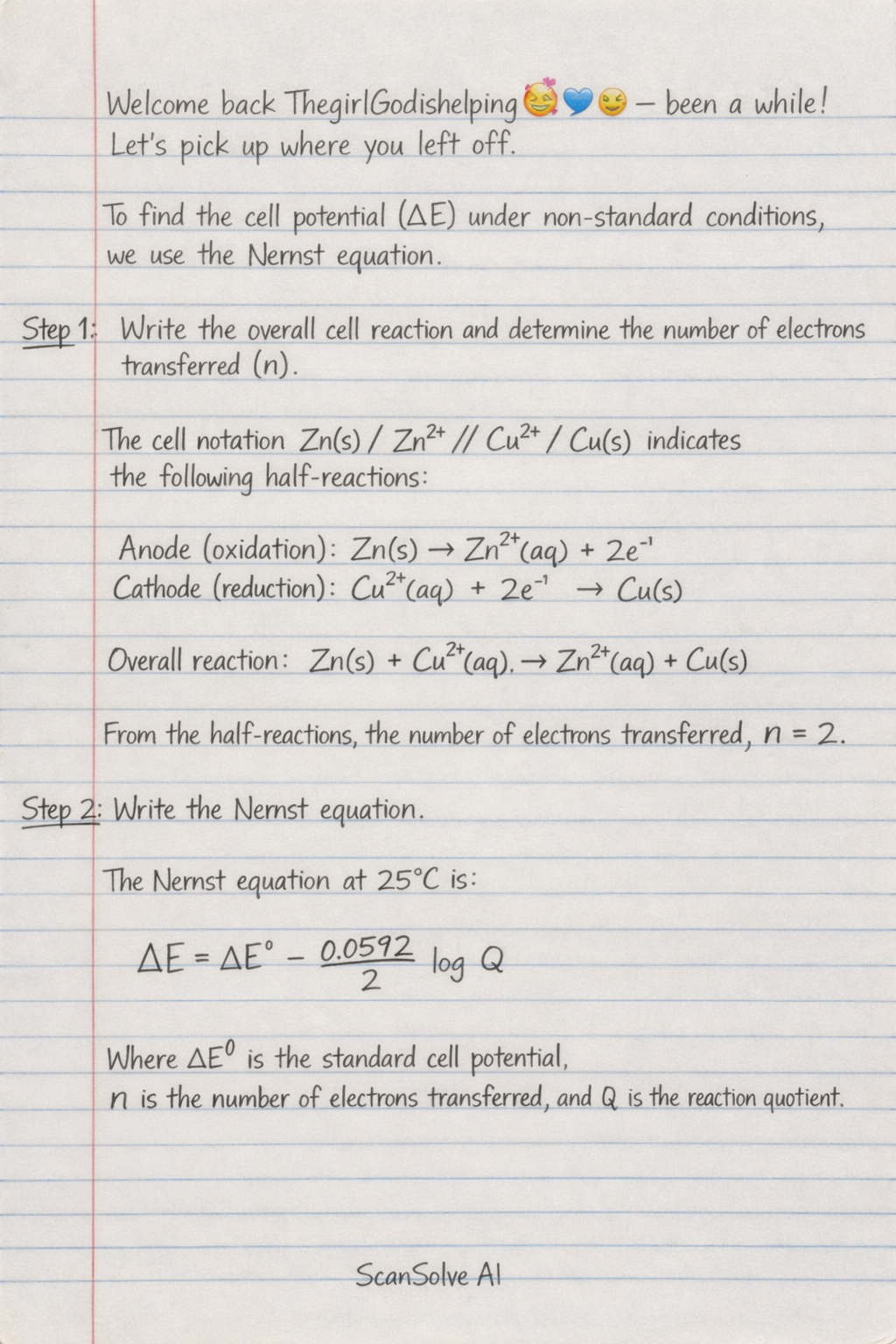
Handwritten Step-by-Step Solution
Get this as a handwritten image on WhatsApp — like a tutor wrote it for you.
Try on WhatsApp