
Solve this chemistry practical for me
ScanSolve AI Answer
Answers
2 partsStep-by-step solution
4 stepsHere is the solution to your chemistry practical problem.
a) To find the average volume of acid used, we identify the concordant readings (those within of each other). In this case, all three readings (24.80, 24.70, 24.70) are concordant.
Step 1: Calculate the average volume of acid used.
Part b· 1 step
To calculate the concentration of the acid, we use the titration formula. We assume the acid is monoprotic (e.g., HCl) and reacts with sodium hydroxide in a 1:1 molar ratio.
Calculate the concentration of the acid.
Given:
Volume of base () =
Concentration of base () =
Average volume of acid () = (from part a)Using the formula :
Part c
To find the concentration of the acid in g/dm, we multiply its molar concentration by its molar mass. We will assume the acid is hydrochloric acid (HCl) for this calculation.
Calculate the concentration of the acid in g/dm.
Molar mass of HCl =
Concentration in g/dm = Molar concentration Molar mass
Part d· 1 step
For a strong acid-strong base titration, a suitable indicator is one that changes color around the neutral pH.
Name a suitable indicator.
A suitable indicator for this titration is phenolphthalein.
Part e· 1 step
The color of phenolphthalein at the endpoint of a strong acid-strong base titration is a very faint pink.
State the color of the indicator at the end point.
The color of phenolphthalein at the end point is faint pink.
Still stuck on this one?
Ask a follow-up, and the answer starts from this question.
More Chemistry Questions
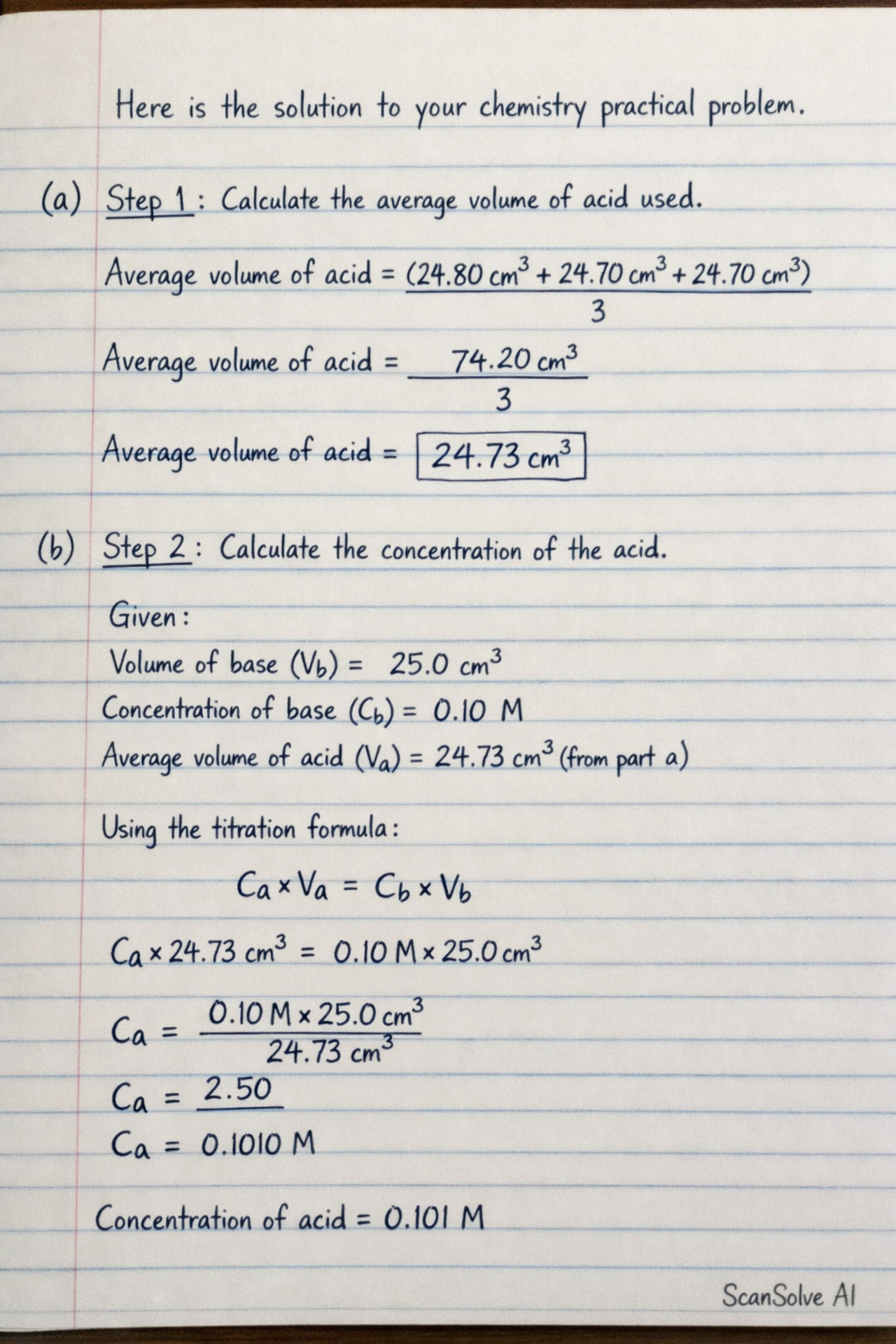
Handwritten Step-by-Step Solution
Get this as a handwritten image on WhatsApp — like a tutor wrote it for you.
Try on WhatsApp