
We read your photo as:
Solve this chemistry questions
ScanSolve AI Answer
Step-by-step solution
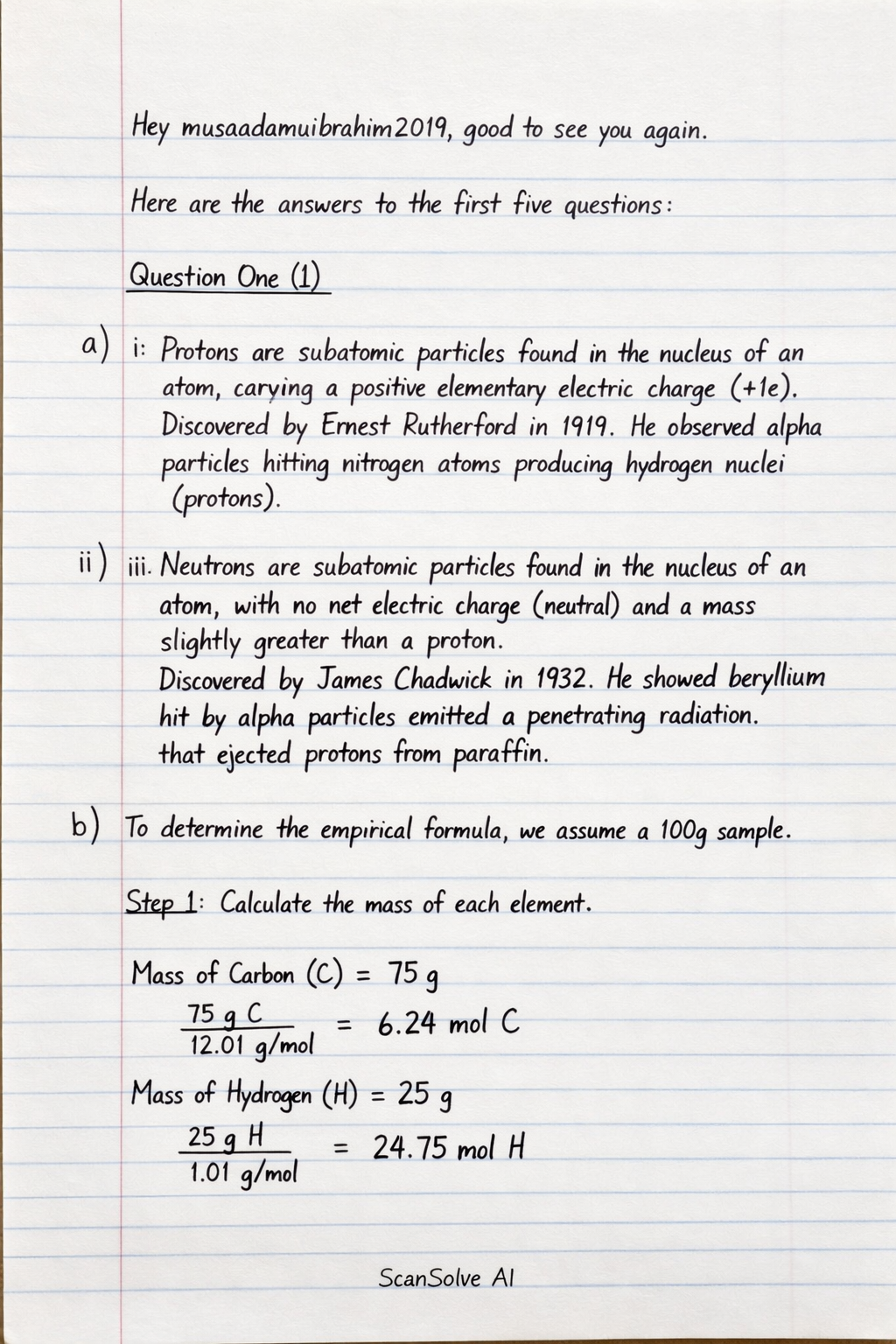
10 stepsHere are the answers to the first five questions:
Question One (1)
a)
i- Protons are subatomic particles found in the nucleus of an atom, carrying a positive elementary electric charge (). Their discovery is attributed to Ernest Rutherford in 1919, who observed that alpha particles colliding with nitrogen atoms produced hydrogen nuclei, which he identified as protons.
ii- Neutrons are subatomic particles found in the nucleus of an atom, having no net electric charge (neutral) and a mass slightly greater than that of a proton. They were discovered by James Chadwick in 1932, who observed that beryllium bombarded with alpha particles emitted a highly penetrating, uncharged radiation that could eject protons from paraffin.
b)
To determine the empirical formula, we assume a 100g sample.
Calculate the mass of each element.
Mass of Carbon (C) = 75 g
Mass of Hydrogen (H) = 25 gCalculate the number of moles for each element.
Molar mass of C = 12 g/mol
Molar mass of H = 1 g/molDetermine the simplest mole ratio by dividing by the smallest number of moles.
Smallest number of moles = 6.25 mol
Write the empirical formula.
The empirical formula is .
Question Two (2)
a)
An empirical formula represents the simplest whole-number ratio of atoms of each element present in a compound. It shows the relative number of atoms, but not necessarily the actual number of atoms in a molecule.b)
i- Four examples of non-metallic radicals are:- Sulfate ()
- Nitrate ()
- Carbonate ()
- Phosphate ()
ii- Two natural phenomena that support the kinetic theory of gas are:
- Diffusion: The spontaneous mixing of gases due to the random motion of their particles.
- Brownian motion: The random movement of microscopic particles suspended in a fluid (liquid or gas), resulting from their collision with the fast-moving atoms or molecules in the fluid.
Question Three (3)
a)
Degenerate orbitals are atomic orbitals that have the same energy level within a subshell. For example, the three p orbitals () in a given principal energy level are degenerate.b)
i- Electronic configuration:
a- Scandium (Sc, atomic number 21): or
b- Nickel (Ni, atomic number 28): orii- Two physical properties of water are:
- It is a colorless, odorless, and tasteless liquid at room temperature.
- It has a relatively high boiling point ( at standard pressure) and freezing point ( at standard pressure).
Question Four (4)
a)
Use the given value.
Calculate the concentration of hydroxide ions using the formula.
b)
i- Sodium chloride () is formed through electrovalent bonding (ionic bonding) by the transfer of electrons between a sodium atom and a chlorine atom. A sodium atom (Na) has one valence electron, which it readily loses to achieve a stable octet, forming a positively charged sodium ion (). A chlorine atom (Cl) has seven valence electrons and readily gains one electron to achieve a stable octet, forming a negatively charged chloride ion (). The oppositely charged ions ( and ) are then held together by strong electrostatic forces of attraction, forming the ionic compound sodium chloride.ii- Two properties of electrovalent (ionic) compounds are:
- They typically have high melting and boiling points due to the strong electrostatic forces between ions.
- They are generally soluble in polar solvents like water and can conduct electricity when molten or dissolved in water.
Question Five (5)
a)
i- The solubility of a salt refers to the maximum amount of that salt (solute) that can dissolve in a given amount of solvent at a specific temperature to form a saturated solution.ii- Two examples of insoluble salts are:
- Silver chloride ()
- Barium sulfate ()
b)
Calculate the molar mass of .
Molar mass of K = 39 g/mol
Molar mass of N = 14 g/mol
Molar mass of O = 16 g/molCalculate the number of moles of .
Convert the volume of water from to .
Calculate the solubility in .
The solubility of is approximately .
Still stuck on this one?
Ask a follow-up, and the answer starts from this question.
More Chemistry Questions
Handwritten Step-by-Step Solution
Get this as a handwritten image on WhatsApp — like a tutor wrote it for you.
Try on WhatsApp