
We read your photo as:
This problem contains multiple parts: (ii) Arrange Group VII elements by increasing oxidizing strength and explain the trend. (iii) Write balanced chemical equations for Cl2(g) reactions with cold dil
ScanSolve AI Answer
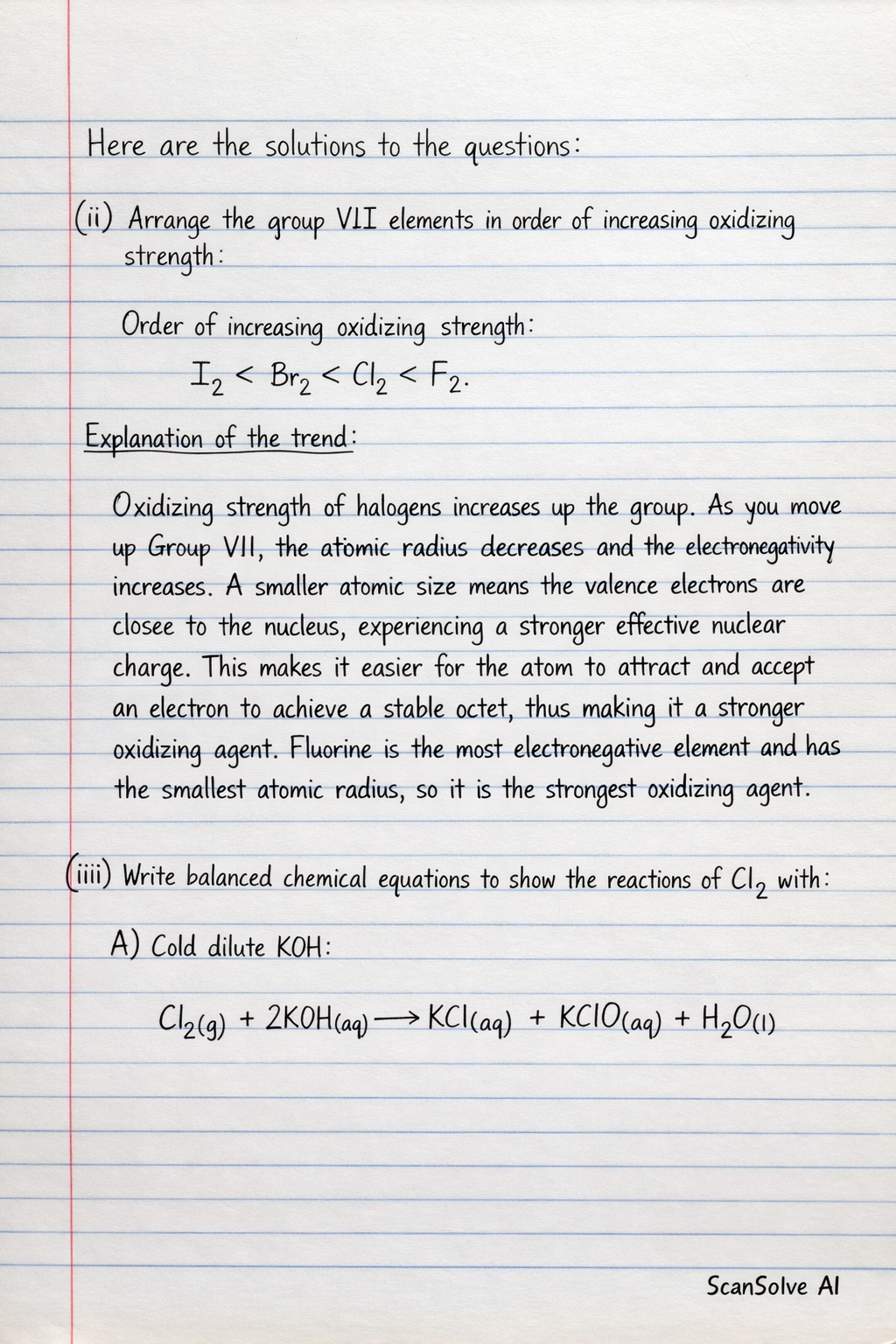
Here are the solutions to the questions:
(ii) Arrange the group VII elements in order of increasing oxidizing strength. Explain the trend.
-
Order of increasing oxidizing strength: Iodine () < Bromine () < Chlorine () < Fluorine ()
-
Explanation of the trend: Oxidizing strength of halogens increases up the group. This is because as you move up Group VII, the atomic radius decreases, and the electronegativity increases. A smaller atomic size means the valence electrons are closer to the nucleus, experiencing a stronger effective nuclear charge. This makes it easier for the atom to attract and accept an electron to achieve a stable octet, thus making it a stronger oxidizing agent. Fluorine is the most electronegative element and has the smallest atomic radius, making it the strongest oxidizing agent.
(iii) Write balanced chemical equations to show the reactions of Cl with:
-
A) Cold dilute KOH.
-
B) Hot concentrated KOH.
(iv) Give the formulae and names of the oxo-acids of iodine in the following oxidation states:
| Oxidation state | Formula | Name |
|---|---|---|
| +1 | HIO | Hypoiodous acid |
| +5 | HIO | Iodic acid |
(b) (i) How does the second ionization energy vary for group I and group II elements in the same Periodic Table. Give a reason for your trend.
The second ionization energy (IE2) for Group I elements is significantly higher than for Group II elements in the same period.
- Reason for the trend: For Group I elements, the first electron is removed from the outermost s-orbital, resulting in a stable noble gas electron configuration. Removing a second electron from a Group I element means removing it from a fully filled inner electron shell, which requires a very large amount of energy due to the strong electrostatic attraction from the now ion and the stability of the core electron configuration. For Group II elements, both the first and second electrons are removed from the outermost s-orbital. While IE2 is higher than IE1 (due to removing an electron from a ion), it is still a valence electron being removed, not a core electron. Therefore, the energy required is much less compared to removing a core electron from a Group I element.
(b) (ii) Lithium shows a diagonal relationship with magnesium.
-
A) Why are these elements diagonally related? Lithium and magnesium are diagonally related because they exhibit similar properties despite being in different groups. This similarity arises from their comparable charge-to-radius ratios (ionic potential) and similar electronegativities. As you move diagonally across the periodic table, the effects of decreasing atomic size (moving right) and increasing atomic size (moving down) tend to cancel each other out, leading to similar polarizing power and chemical behavior.
-
B) Give one reaction in which Li and Mg show a diagonal relationship. Both lithium and magnesium react directly with nitrogen gas to form nitrides, a property not typically shared by other Group 1 elements (which usually do not react with nitrogen under normal conditions).
(b) (iii) With the use of chemical equations show the effect of heat on the nitrates of lithium and potassium.
-
LiNO: Lithium nitrate decomposes to form lithium oxide, nitrogen dioxide, and oxygen.
-
KNO: Potassium nitrate decomposes to form potassium nitrite and oxygen.
(b) (iv) How does the solubility of hydroxides of the group II elements vary down the group?
The solubility of hydroxides of Group II elements increases down the group.
For example, Beryllium hydroxide () and Magnesium hydroxide () are sparingly soluble, while Calcium hydroxide (), Strontium hydroxide (), and Barium hydroxide () are increasingly soluble.
(c) (i) In the space below sketch a graph of variation of the first ionization energy for the elements S...
(Assuming the question asks for the general trend of first ionization energy across a period, as the full question is cut off.)
A sketch of the variation of the first ionization energy across a typical period (e.g., Period 2 or 3) would show a general increasing trend from left to right, with characteristic dips at Group 13 (e.g., B, Al) and Group 16 (e.g., O, S).
\begin{tikzpicture}[scale=0.8]
\draw[->] (0,0) -- (10,0) node[below] {Atomic Number / Position in Period};
\draw[->] (0,0) -- (0,6) node[left] {First Ionization Energy};

% General increasing trend with dips
\draw[blue, thick] (0.5,1) -- (1.5,2.5) -- (2.5,1.8) -- (3.5,3.5) -- (4.5,4.2) -- (5.5,3.8) -- (6.5,5) -- (7.5,4.5) -- (8.5,5.8);

% Labels for general groups (example for Period 2)
\node at (0.5,0.7) {Li};
\node at (1.5,2.2) {Be};
\node at (2.5,1.5) {B};
\node at (3.5,3.2) {C};
\node at (4.5,3.9) {N};
\node at (5.5,3.5) {O};
\node at (6.5,4.7) {F};
\node at (8.5,5.5) {Ne};

\end{tikzpicture}
- Explanation of the trend:
The first ionization energy generally increases across a period due to an increase in effective nuclear charge and a decrease in atomic radius, making it harder to remove an electron.
There are dips in the trend:
- At Group 13 (e.g., B, Al), the first electron is removed from a p-orbital, which is slightly higher in energy and more shielded than an s-orbital, making it easier to remove.
- At Group 16 (e.g., O, S), the first electron is removed from a p-orbital that is already paired. The electron-electron repulsion in the paired orbital makes it easier to remove this electron compared to an unpaired p-electron in Group 15.
Still stuck on this one?
Ask a follow-up, and the answer starts from this question.
More Chemistry Questions
Handwritten Step-by-Step Solution
Get this as a handwritten image on WhatsApp — like a tutor wrote it for you.
Try on WhatsApp