
We read your photo as:
Explain three chemical properties of monosaccharides and state the significance of Ninhydrin reagent and Benedict's reagent in biochemistry.
ScanSolve AI Answer
Here are the solutions to your homework questions.
Question 1:
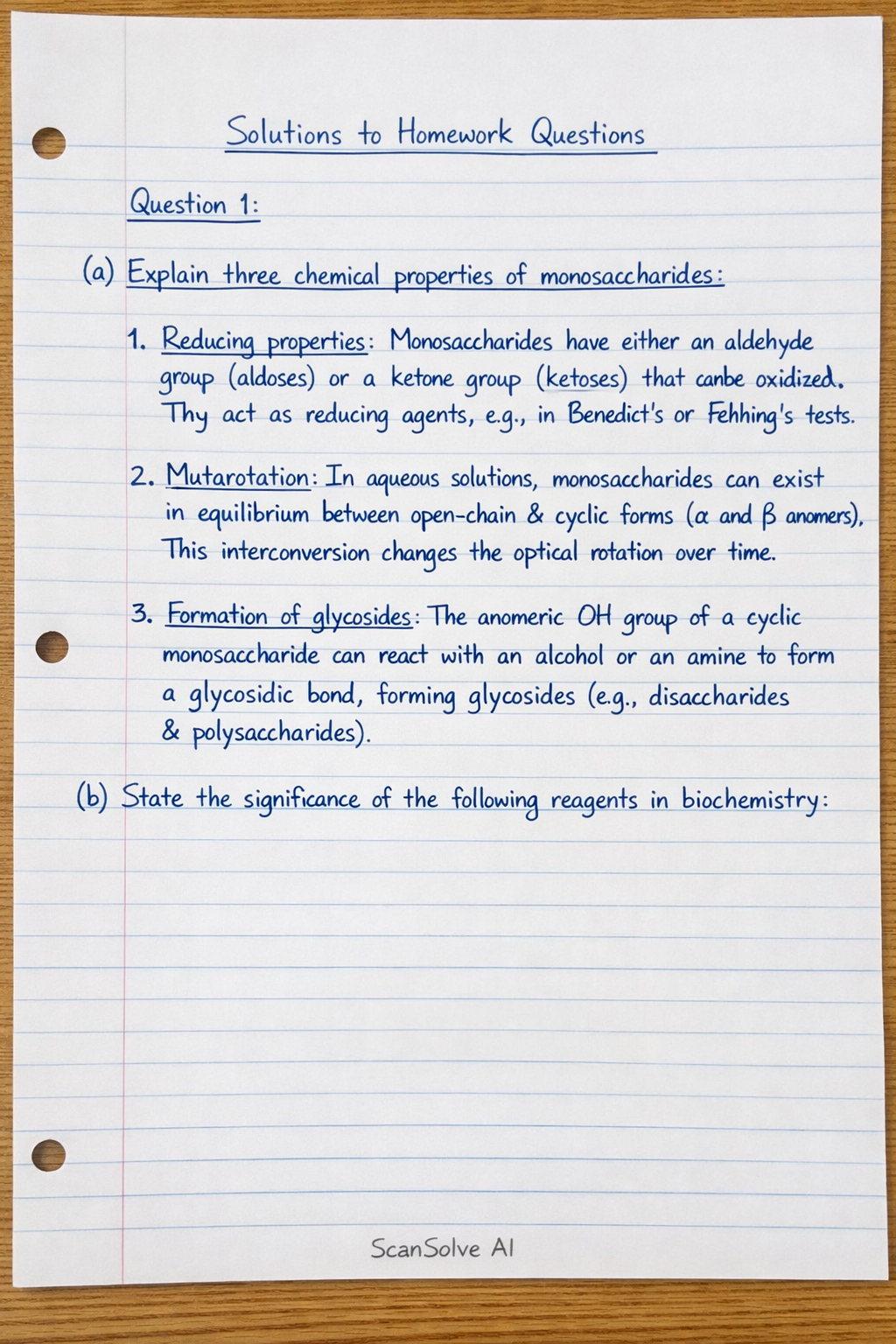
a) Explain three chemical properties of monosaccharides.
Monosaccharides are simple sugars with several key chemical properties:
- Reducing properties: Monosaccharides contain either an aldehyde group (aldoses) or a ketone group (ketoses) that can be oxidized. This allows them to act as reducing agents, for example, in the Benedict's or Fehling's tests.
- Mutarotation: In aqueous solutions, monosaccharides exist in equilibrium between their open-chain and cyclic (hemiacetal or hemiketal) forms. The cyclic forms can interconvert between and anomers, leading to a change in optical rotation over time, a phenomenon known as mutarotation.
- Formation of glycosides: The anomeric hydroxyl group of a cyclic monosaccharide can react with an alcohol or an amine to form a glycosidic bond, resulting in a glycoside. This is a crucial reaction for forming disaccharides, oligosaccharides, and polysaccharides.
b) State the significance of the following reagents in biochemistry:
(i) Ninhydrin reagent
Ninhydrin reagent is used to detect the presence of amino acids, peptides, and proteins that have a free -amino group. It reacts to produce a characteristic blue-purple color (Ruhemann's purple), while proline and hydroxyproline (imino acids) yield a yellow color.
(ii) Benedict's reagent
Benedict's reagent is used to detect the presence of reducing sugars (monosaccharides and some disaccharides like lactose and maltose). It contains copper(II) ions, which are reduced to copper(I) oxide, forming a brick-red precipitate upon heating in the presence of an aldehyde or -hydroxy ketone group.
(iii) Biuret reagent
Biuret reagent is used to detect the presence of peptide bonds in proteins and peptides. It contains copper(II) ions in an alkaline solution, which complex with the nitrogen atoms of peptide bonds to produce a characteristic violet or purple color.
(iv) Millon's reagent
Millon's reagent is used to detect the presence of tyrosine, an amino acid containing a phenolic hydroxyl group. It reacts with the phenolic group to form a red precipitate or solution upon heating.
(v) Fehling reagent
Fehling's reagent, similar to Benedict's reagent, is used to detect the presence of reducing sugars. It consists of two solutions, Fehling's A (copper(II) sulfate) and Fehling's B (potassium sodium tartrate in strong alkali). Upon heating with a reducing sugar, the copper(II) ions are reduced to copper(I) oxide, forming a brick-red precipitate.
Question 2:
a) Mention two chemical and physical properties of proteins, carbohydrates and lipids.
-
Proteins:
- Chemical property: Amphoteric nature – Proteins contain both acidic (carboxyl) and basic (amino) groups, allowing them to act as both acids and bases.
- Physical property: Denaturation – Proteins can lose their specific three-dimensional structure and biological activity due to changes in temperature, pH, or exposure to certain chemicals.
-
Carbohydrates:
- Chemical property: Oxidation-reduction reactions – Monosaccharides can be oxidized to form aldonic acids or reduced to form alditols.
- Physical property: Optical activity – Most carbohydrates contain chiral centers and can rotate plane-polarized light.
-
Lipids:
- Chemical property: Saponification – Esters in lipids (e.g., triglycerides) can be hydrolyzed by strong bases to yield fatty acid salts (soaps) and glycerol.
- Physical property: Insolubility in water – Lipids are largely nonpolar and hydrophobic, making them insoluble in water but soluble in organic solvents.
b) Write the name and structure of one example of the following sugars:
(i) triose
Name: Glyceraldehyde
Structure:
(ii) pentose
Name: Ribose
Structure (D-Ribose, open-chain form):
(iii) hexose
Name: Glucose
Structure (D-Glucose, open-chain form):
Question 3:
a) What is a cell? In a tabular form, state five differences between a prokaryotic and eukaryotic cell.
A cell is the fundamental structural, functional, and biological unit of all known organisms. It is the smallest unit of life that can replicate independently.
| Feature | Prokaryotic Cell | Eukaryotic Cell |
|---|---|---|
| Nucleus | Absent; genetic material in nucleoid region | Present; genetic material enclosed in a nuclear envelope |
| Organelles | No membrane-bound organelles (e.g., mitochondria, ER, Golgi) | Membrane-bound organelles present |
| Size | Generally smaller (0.1-5 m) | Generally larger (10-100 m) |
| DNA | Circular, usually single chromosome, no histones | Linear, multiple chromosomes, associated with histones |
| Cell Wall | Present (peptidoglycan in bacteria) | Present in plants (cellulose) and fungi (chitin), absent in animals |
| Ribosomes | Smaller (70S) | Larger (80S) |
b) Draw the structure of a typical (i) prokaryotic cell (ii) eukaryotic cell.
(i) Prokaryotic cell (e.g., bacterium):
A typical prokaryotic cell is simpler in structure. It consists of a cell wall (for protection and shape), a cell membrane (regulating passage of substances), and cytoplasm. Within the cytoplasm, there is a nucleoid region containing a circular chromosome (DNA), ribosomes (for protein synthesis), and sometimes plasmids (extra-chromosomal DNA) and a capsule or flagella.
(ii) Eukaryotic cell (e.g., animal cell):
A typical eukaryotic cell is more complex. It has a cell membrane enclosing the cytoplasm. The cytoplasm contains various membrane-bound organelles: a nucleus (containing linear chromosomes), mitochondria (for energy production), endoplasmic reticulum (rough and smooth, for protein and lipid synthesis), Golgi apparatus (for modifying and packaging proteins/lipids), lysosomes (for waste breakdown), and peroxisomes. Plant cells also have a cell wall, chloroplasts, and a large central vacuole.
c) State the cell theory.
The cell theory is a fundamental concept in biology that states:
- All living organisms are composed of one or more cells.
- The cell is the basic unit of structure and organization in organisms.
- All cells arise from pre-existing cells.
Question 4:
a) Describe the Xanthoproteic test for aromatic amino acids.
The Xanthoproteic test is a chemical test used to detect the presence of aromatic amino acids (tyrosine, tryptophan, and phenylalanine) in a protein solution. The principle involves the nitration of the benzene ring present in the side chains of these amino acids. When concentrated nitric acid is added to a solution containing aromatic amino acids, the benzene rings undergo nitration, forming yellow nitro-derivatives. Upon subsequent addition of a strong base (like NaOH), the yellow color intensifies to an orange color due to the ionization of the phenolic hydroxyl group (in tyrosine) or the formation of a quinoid structure.
b) In the bid to carry out ninhydrin test, a student during a practical class, carried the test on three different samples A, B and C. Sample A on receiving the procedure for the test produced blue-purple coloration while sample B on passing through the ninhydrin test procedure produced yellow coloration and sample C produced a brown coloration. Using the observed colors, identify samples A, B and C and give reasons for your answer.
Based on the standard ninhydrin test results:
- Sample A (blue-purple coloration): This indicates the presence of amino acids with a free -amino group (e.g., alanine, glycine, lysine) or peptides/proteins. The free amino group reacts with ninhydrin to form Ruhemann's purple.
- Sample B (yellow coloration): This indicates the presence of imino acids, specifically proline or hydroxyproline. These amino acids have a secondary amino group (part of a ring structure) which reacts with ninhydrin to produce a yellow product instead of blue-purple.
- Sample C (brown coloration): A brown coloration is not a typical standard result for common amino acids with ninhydrin. It could suggest several possibilities:
- High concentration of amino acids: Very high concentrations can sometimes lead to charring or degradation products that appear brown.
- Presence of other interfering substances: Other compounds with primary or secondary amines that react differently or degrade under the test conditions.
- Degradation of the sample: The sample might have degraded, leading to non-specific reactions.
- Specific non-standard amino acids or derivatives: Some less common amino acids or their derivatives might yield different colors. Without further information, it's difficult to definitively identify Sample C, but it suggests a non-standard reaction or interfering compounds.
c) Write short notes on the different types of starch.
Starch is a polysaccharide that serves as the primary energy storage carbohydrate in plants. It is
Still stuck on this one?
Ask a follow-up, and the answer starts from this question.
More Chemistry Questions
Handwritten Step-by-Step Solution
Get this as a handwritten image on WhatsApp — like a tutor wrote it for you.
Try on WhatsApp