
We read your photo as:
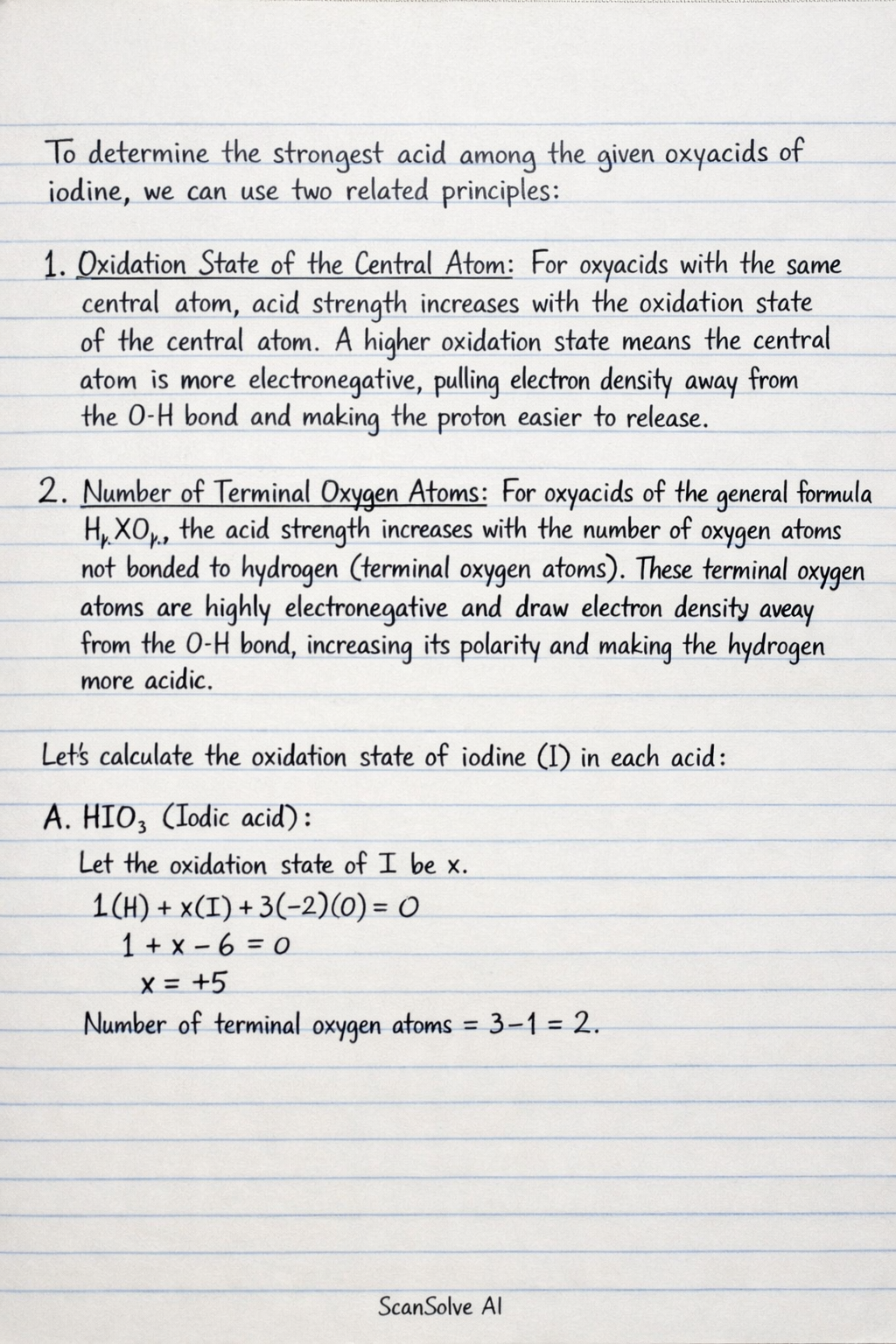
To determine the strongest acid among the given oxyacids of iodine, we can use two related principles:
ScanSolve AI Answer
To determine the strongest acid among the given oxyacids of iodine, we can use two related principles:
- Oxidation State of the Central Atom: For oxyacids with the same central atom, acid strength increases with the oxidation state of the central atom. A higher oxidation state means the central atom is more electronegative, pulling electron density away from the O-H bond and making the proton easier to release.
- Number of Terminal Oxygen Atoms: For oxyacids of the general formula , the acid strength increases with the number of oxygen atoms not bonded to hydrogen (terminal oxygen atoms). These terminal oxygen atoms are highly electronegative and draw electron density away from the O-H bond, increasing its polarity and making the hydrogen more acidic.
Let's calculate the oxidation state of iodine (I) in each acid:
-
A. (Iodic acid): Let the oxidation state of I be . Number of terminal oxygen atoms = .
-
B. (Periodic acid): Let the oxidation state of I be . Number of terminal oxygen atoms = .
-
C. (Iodous acid): Let the oxidation state of I be . Number of terminal oxygen atoms = .
-
D. (Hypoiodous acid): Let the oxidation state of I be . Number of terminal oxygen atoms = .
Comparing the oxidation states of iodine:
(+1) < (+3) < (+5) < (+7)
Comparing the number of terminal oxygen atoms:
(0) < (1) < (2) < (3)
Both principles indicate that the acid strength increases in the order .
Therefore, is the strongest acid.
The final answer is .
Still stuck on this one?
Ask a follow-up, and the answer starts from this question.
More Chemistry Questions
Handwritten Step-by-Step Solution
Get this as a handwritten image on WhatsApp — like a tutor wrote it for you.
Try on WhatsApp