
We read your photo as:
Calculate the total vapor pressure of an aerosol mixture containing 20% CCl3F and 80% CCl2F2, given their molar masses and assuming Raoult's Law applies.
ScanSolve AI Answer
Answer
Step-by-step solution
4 stepsTo calculate the total vapor pressure of the aerosol mixture, we will use Raoult's Law and Dalton's Law of Partial Pressures. This involves determining the mole fractions of each component and then summing their partial pressures.
Calculate the moles of each component.
Assume a total mass of for the mixture.
Mass of Propellant I () =
Mass of Propellant II () =Using the given molar masses:
For Propellant I (, ):For Propellant II (, ):
Calculate the total moles and mole fraction () of each component.
Mole fraction of Propellant I:
Mole fraction of Propellant II:
Calculate the partial vapor pressure () of each component using Raoult's Law ().
Given pure vapor pressures: and .
Partial pressure of Propellant I:Partial pressure of Propellant II:
Calculate the total vapor pressure () of the mixture using Dalton's Law of Partial Pressures.
Rounding to one decimal place:
The total vapor pressure of the aerosol mixture is .
Try one yourself
A new problem that tests the same skill.
Still stuck on this one?
Ask a follow-up, and the answer starts from this question.
More Chemistry Questions
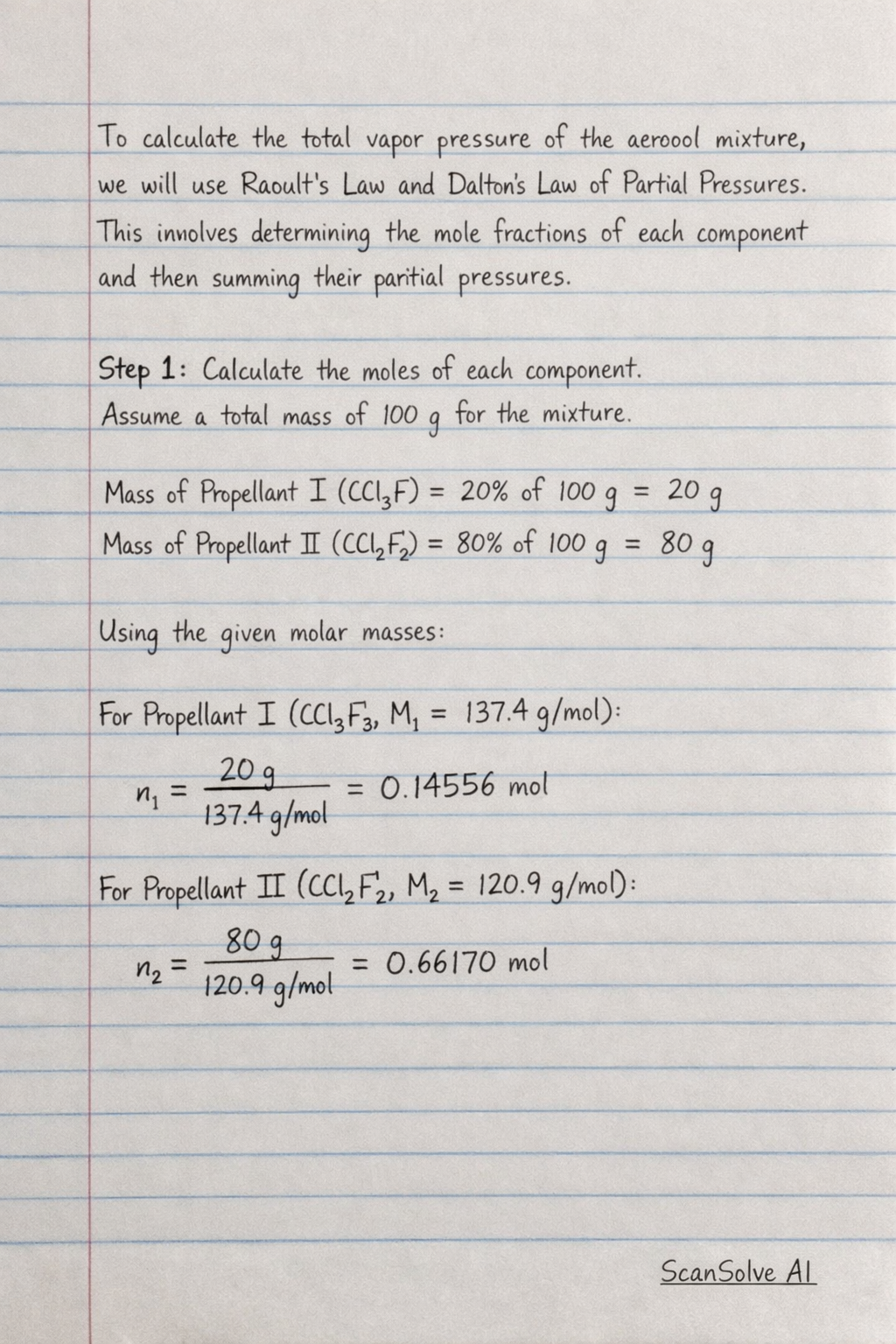
Handwritten Step-by-Step Solution
Get this as a handwritten image on WhatsApp — like a tutor wrote it for you.
Try on WhatsApp