
We read your photo as:
Calculate the total volume of residual gases after the reaction between 60 cm³ of H₂ and 20 cm³ of O₂ at 100°C.
ScanSolve AI Answer
Answer
Step-by-step solution
5 stepsTo determine the total volume of residual gases, we first write the balanced chemical equation for the reaction between hydrogen and oxygen:
Write the balanced chemical equation.
The reaction of hydrogen gas with oxygen gas produces water. Since the temperature is , water will be in its gaseous state (steam).
Determine the limiting reactant.
According to Gay-Lussac's Law of Combining Volumes, at constant temperature and pressure, the volumes of gaseous reactants and products are in simple whole-number ratios corresponding to the stoichiometric coefficients in the balanced equation.
From the equation, 2 volumes of react with 1 volume of .Given volumes:
Volume of
Volume ofTo react completely with of , the required volume of would be:
Since we have of , which is more than the required, oxygen () is the limiting reactant.
Calculate the volumes of reactants consumed and products formed.
- Oxygen consumed: All of will be consumed.
- Hydrogen consumed: Based on the ratio with , of will be consumed.
- Water vapor formed: Based on the (or ) ratio with , of will be formed.
Calculate the volume of residual gases.
- Unreacted hydrogen: Initial - Consumed .
- Unreacted oxygen: (all consumed).
- Water vapor (product): .
The residual gases are the unreacted hydrogen and the water vapor formed.
Calculate the total volume of residual gases.
Total volume of residual gases = Volume of unreacted + Volume of
Total volume of residual gases = .The total volume of the residual gases is .
The final answer is .
Try one yourself
A new problem that tests the same skill.
Still stuck on this one?
Ask a follow-up, and the answer starts from this question.
More Chemistry Questions
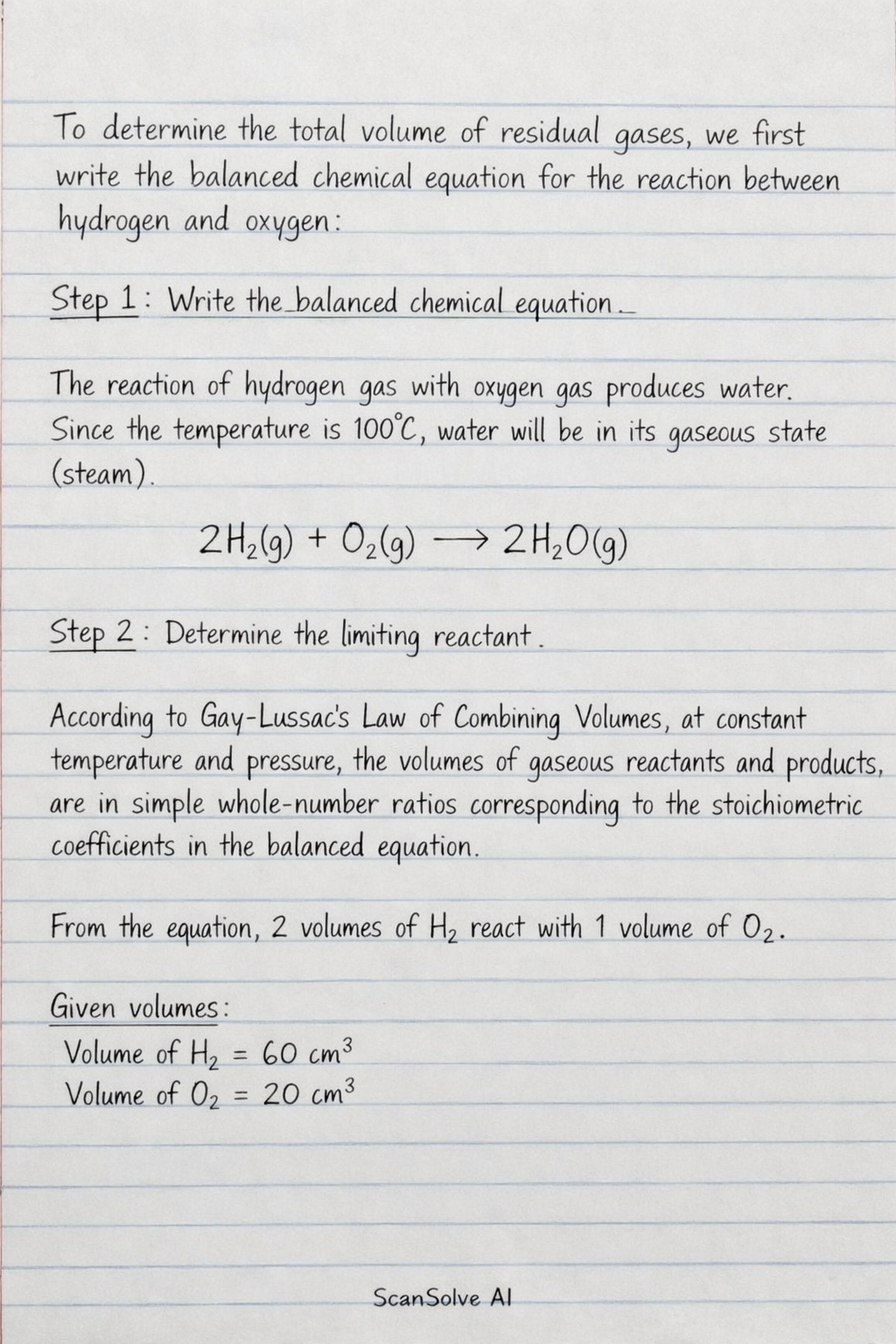
Handwritten Step-by-Step Solution
Get this as a handwritten image on WhatsApp — like a tutor wrote it for you.
Try on WhatsApp