
We read your photo as:
Calculate the volume of oxygen at STP which theoretically could be obtained from 50 cm³ solution of hydrogen peroxide containing 6.8 g/dm³.
ScanSolve AI Answer
Step-by-step solution
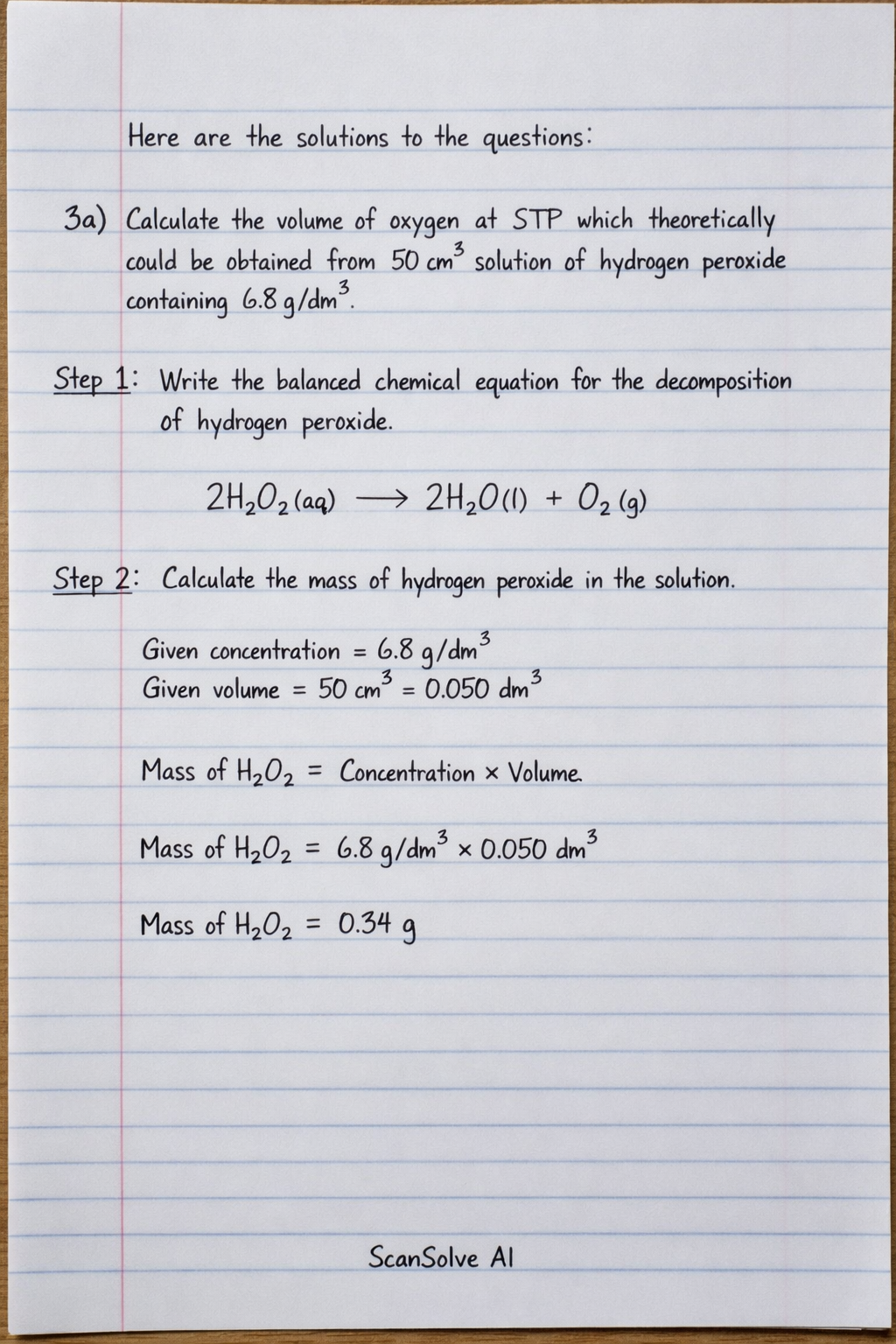
5 stepsHere are the solutions to the questions:
3a) Calculate the volume of oxygen at STP which theoretically could be obtained from 50 cm³ solution of hydrogen peroxide containing 6.8 g/dm³.
Write the balanced chemical equation for the decomposition of hydrogen peroxide.
Calculate the mass of hydrogen peroxide in the solution.
Given concentration = 6.8 g/dm³
Given volume = 50 cm³ = 0.050 dm³Calculate the moles of hydrogen peroxide.
Molar mass of H₂O₂ = (2 × 1.008) + (2 × 16.00) = 34.016 g/mol (approximately 34 g/mol)
Using 34 g/mol for simplicity:
Use stoichiometry to find the moles of oxygen produced.
From the balanced equation, 2 moles of H₂O₂ produce 1 mole of O₂.
Calculate the volume of oxygen at STP.
At STP, 1 mole of any gas occupies 22.4 dm³.
Converting to cm³:
The volume of oxygen produced at STP is .
3b) What is the application of mole concept in daily life?
The mole concept is used in daily life to quantify amounts of substances, especially in chemical reactions. For example, it helps in determining the precise amounts of ingredients needed in cooking recipes, formulating medicines with exact dosages, and calculating the yield of products in industrial chemical processes to ensure efficiency and safety.
4a) Give the name of the process of making coke from coal. Write one characteristic which makes coke a better fuel than coal.
The process of making coke from coal is called destructive distillation (or carbonization).
One characteristic that makes coke a better fuel than coal is its higher carbon content and lower impurity content (like sulfur and volatile matter), which results in a hotter, cleaner burn with less smoke and ash.4b) State the difference between physical strength and chemical strength of metal.
- Physical strength (or mechanical strength) of a metal refers to its ability to withstand external forces without deforming or breaking. This includes properties like tensile strength (resistance to pulling apart), hardness (resistance to scratching or indentation), and ductility (ability to be drawn into wires). These properties depend on the metallic bonding and crystal structure.
- Chemical strength (or chemical stability/reactivity) of a metal refers to its resistance to chemical change or its tendency to react with other substances. For example, a metal with high chemical strength would be unreactive and resistant to corrosion (like gold), while a metal with low chemical strength would be reactive and easily corrode (like sodium).
4c) Describe three (3) physical properties of metals and explain how each property influences their use in daily life.
Here are three physical properties of metals and how they influence their use:
- Electrical Conductivity: Metals are excellent conductors of electricity due to the presence of delocalized electrons. This property makes them indispensable for electrical wiring (e.g., copper and aluminum) and components in electronic devices.
- Malleability and Ductility: Metals can be hammered into thin sheets (malleability) and drawn into wires (ductility) without breaking. This allows them to be shaped into various forms for construction (e.g., steel beams), packaging (e.g., aluminum foil), and jewelry.
- Luster: Metals have a characteristic shiny appearance when polished, known as metallic luster. This property makes them desirable for decorative items, jewelry (e.g., gold, silver), and mirrors.
4d) Give example explain why preparation of metallic oxide by direct method is not intensively used.
The "direct method" for preparing metallic oxides, such as directly burning a metal in oxygen (e.g., $2Mg(s) + O_2\text{(
Still stuck on this one?
Ask a follow-up, and the answer starts from this question.
More Chemistry Questions
Handwritten Step-by-Step Solution
Get this as a handwritten image on WhatsApp — like a tutor wrote it for you.
Try on WhatsApp