Calculate the volume occupied by 4.0 g of oxygen at STP, and the pressure exerted by 18.5 g of nitrogen in a 5 L container at 27°C.
|Chemistry
Calculate the volume occupied by 4.0 g of oxygen at STP, and the pressure exerted by 18.5 g of nitrogen in a 5 L container at 27°C.
ScanSolve AI Answer
Answer
2.8 L
You're on a roll —
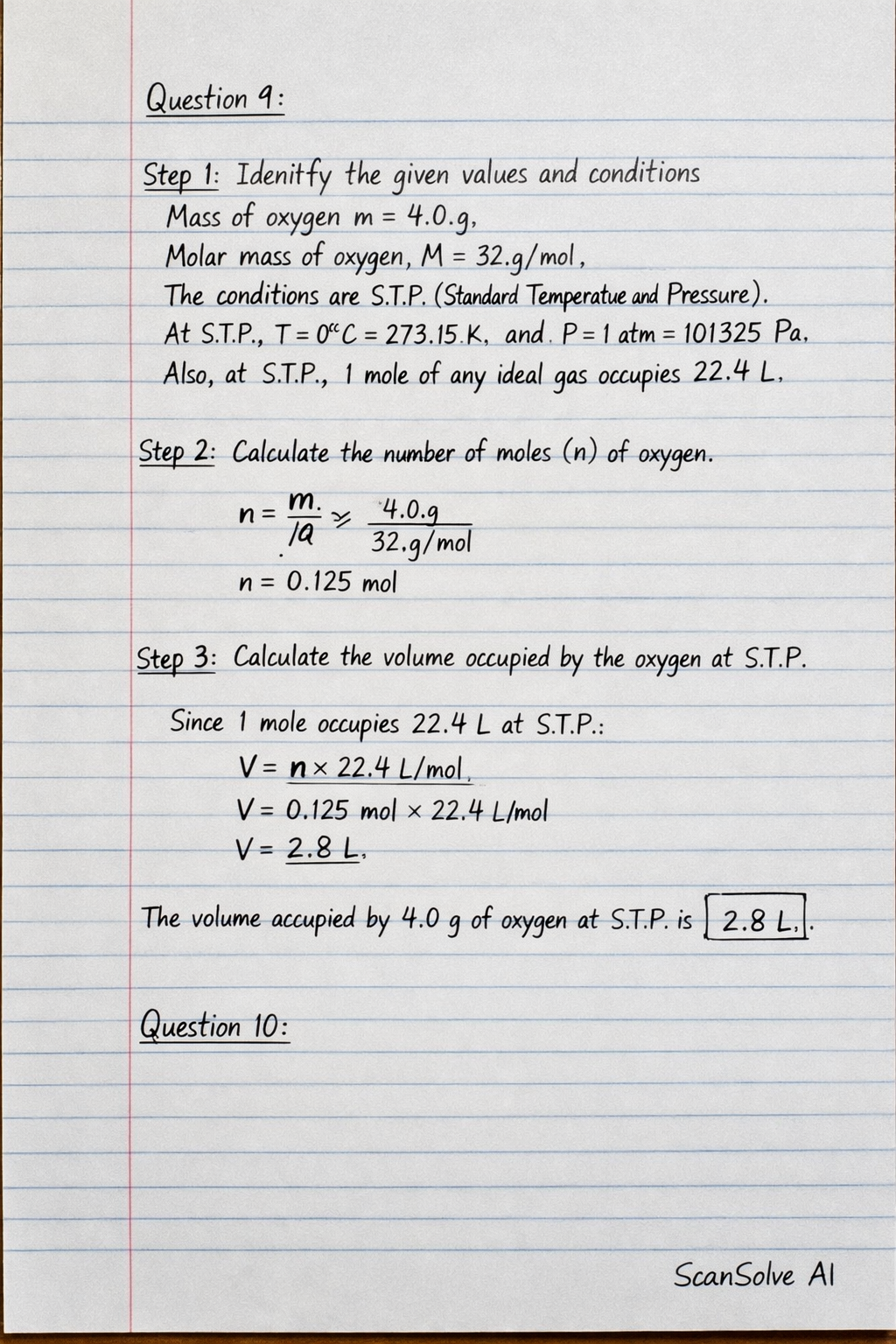
Question 9:
Step 1: Identify the given values and conditions.
Mass of oxygen m=4.0 g.
Molar mass of oxygen M=32 g/mol.
The conditions are S.T.P (Standard Temperature and Pressure).
At S.T.P., T=0∘C=273.15 K and P=1atm=101325 Pa.
Also, at S.T.P., 1 mole of any ideal gas occupies 22.4 L.
Step 2: Calculate the number of moles (n) of oxygen.
n=Mm=32g/mol4.0gn=0.125 mol
Step 3: Calculate the volume occupied by the oxygen at S.T.P.
Since 1 mole occupies 22.4 L at S.T.P.:
V=n×22.4 L/molV=0.125mol×22.4 L/molV=2.8 L
The volume occupied by 4.0 g of oxygen at S.T.P is 2.8L.
Question 10:
Step 1: Identify the given values and convert them to SI units.
Mass of nitrogen m=18.5 g.
Volume V=5L=5×10⁻³m3.
Temperature T=27∘C=27+273=300 K.
Molar mass of nitrogen M=28g/mol=0.028 kg/mol.
Universal Gas Constant R=8.314J/(mol⋅K).
Step 2: Calculate the number of moles (n) of nitrogen.
n=Mm=28g/mol18.5gn≈0.6607 mol
Step 3: Apply the Ideal Gas Law to find the pressure P.
The Ideal Gas Law is PV=nRT. Rearrange to solve for P:
P=VnRTP=5×10⁻³m3(0.6607mol)×(8.314J/(mol\cdotK))×(300K)P=5×10−31647.9 PaP=329580 PaP≈3.30×10⁵ Pa
The pressure of the nitrogen gas is 3.30×10⁵Pa.
Question 11:
Step 1: Identify the given values and convert temperature to Kelvin.
Temperature T=27∘C=27+273=300 K.
Boltzmann constant k=1.38×10⁻²³ J/K.
Step 2: Calculate the average translational kinetic energy (KEavg) of a nitrogen molecule.
The formula for the average translational kinetic energy per molecule is:
KEavg=23kTKEavg=23×(1.38×10−23J/K)×(300K)KEavg=1.5×1.38×10−23×300 JKEavg=621×10−23 JKEavg=6.21×10⁻²¹ J
The average translational kinetic energy of a nitrogen molecule at 27∘C is 6.21×10⁻²¹J.
Question 12:
Step 1: Identify the given values and convert them to SI units.
Temperature T=40∘C=40+273=313 K.
Molar mass of helium M=4.0 Kg/Kmole. This is equivalent to 4.0 g/mol or 0.004 kg/mol.
Universal Gas Constant R=8.314J/(mol⋅K).
Step 2: Calculate the root mean square speed (vrms).
The formula for the root mean square speed is:
vrms=M3RTvrms=0.004kg/mol3×(8.314J/(mol\cdotK))×(313K)vrms=0.0047807.74 m/svrms=1951935 m/svrms≈1397.12 m/s
The root mean square speed of a helium atom at 40∘C is 1397.12m/s.
Send me the next one 📸
Was this helpful?
Need help with your own homework?
Get instant step-by-step solutions to any question. Free to start.
This chemistry question involves key chemical concepts and calculations. The detailed solution below walks through each step, from identifying the reaction type to computing the final answer.
ScanSolve AI Answer
You're on a roll — Question 9: Step 1: Identify the given values and conditions. Mass of oxygen m = 4.0 g. Molar mass of oxygen M = 32 g/mol. The conditions are S.T.P (Standard Temperature and Pressure). At S.T.P., T = 0^ C = 273.15 K and P = 1 atm = 101325 Pa. Also, at S.T.P., 1 mole of any ideal gas occupies 22.4 L. Step 2: Calculate the number of moles (n) of oxygen. n = (m)/(M) = 4.0 g32 g/mol n = 0.125 mol Step 3: Calculate the volume occupied by the oxygen at S.T.P. Since 1 mole occupies 22.4 L at S.T.P.: V = n × 22.4 L/mol V = 0.125 mol × 22.4 L/mol V = 2.8 L The volume occupied by 4.0 g of oxygen at S.T.P is 2.8 L. --- Question 10: Step 1: Identify the given values and convert them to SI units. Mass of nitrogen m = 18.5 g. Volume V = 5 L = 5 × 10^-3 m^3. Temperature T = 27^ C = 27 + 273 = 300 K. Molar mass of nitrogen M = 28 g/mol = 0.028 kg/mol. Universal Gas Constant R = 8.314 J/(mol·K). Step 2: Calculate the number of moles (n) of nitrogen. n = (m)/(M) = 18.5 g28 g/mol n ≈ 0.6607 mol Step 3: Apply the Ideal Gas Law to find the pressure P. The Ideal Gas Law is PV = nRT. Rearrange to solve for P: P = (nRT)/(V) P = (0.6607 mol) × (8.314 J/(mol·K)) × (300 K)5 × 10^-3 m^3 P = (1647.9)/(5 × 10^-3) Pa P = 329580 Pa P ≈ 3.30 × 10^5 Pa The pressure of the nitrogen gas is 3.30 × 10^5 Pa. --- Question 11: Step 1: Identify the given values and convert temperature to Kelvin. Temperature T = 27^ C = 27 + 273 = 300 K. Boltzmann constant k = 1.38 × 10^-23 J/K. Step 2: Calculate the average translational kinetic energy (KE_avg) of a nitrogen molecule. The formula for the average translational kinetic energy per molecule is: KE_avg = (3)/(2) kT KE_avg = (3)/(2) × (1.38 × 10^-23 J/K) × (300 K) KE_avg = 1.5 × 1.38 × 10^-23 × 300 J KE_avg = 621 × 10^-23 J KE_avg = 6.21 × 10^-21 J The average translational kinetic energy of a nitrogen molecule at 27^ C is 6.21 × 10^-21 J. --- Question 12: Step 1: Identify the given values and convert them to SI units. Temperature T = 40^ C = 40 + 273 = 313 K. Molar mass of helium M = 4.0 Kg/Kmole. This is equivalent to 4.0 g/mol or 0.004 kg/mol. Universal Gas Constant R = 8.314 J/(mol·K). Step 2: Calculate the root mean square speed (v_rms). The formula for the root mean square speed is: v_rms = sqrt((3RT)/(M)) v_rms = sqrt(3 × (8.314 J/(mol)·K)) × (313 K)0.004 kg/mol v_rms = sqrt((7807.74)/(0.004)) m/s v_rms = sqrt(1951935) m/s v_rms ≈ 1397.12 m/s The root mean square speed of a helium atom at 40^ C is 1397.12 m/s. Send me the next one 📸