
We read your photo as:
Explain the trend in atomic radius across a period, state one use of a noble gas, and find the mass of 0.25 moles of CaCO3.
ScanSolve AI Answer
Step-by-step solution
5 stepsHere are the answers to the remaining questions:
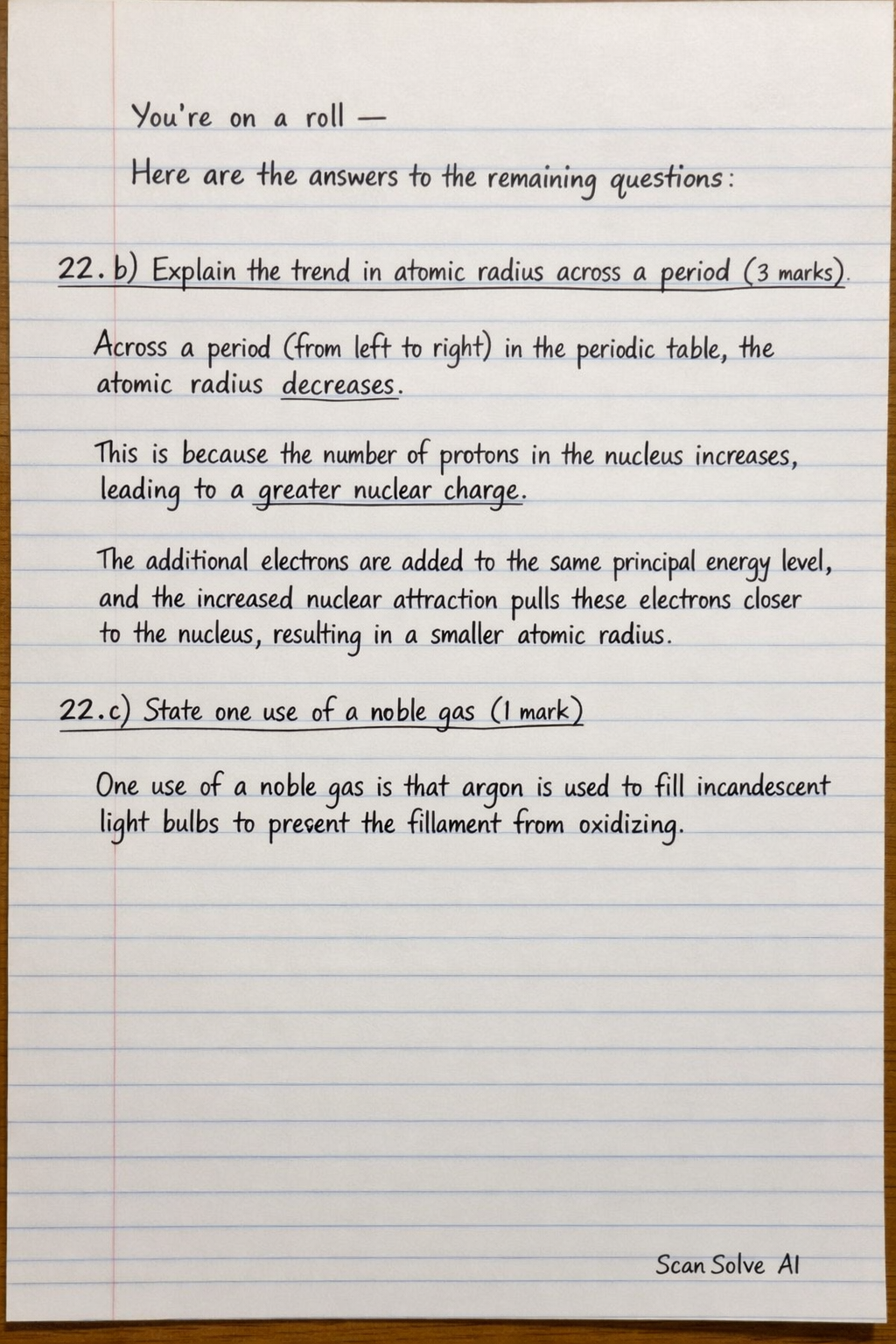
22. b) Explain the trend in atomic radius across a period (3 marks)
Across a period (from left to right) in the periodic table, the atomic radius decreases. This is because the number of protons in the nucleus increases, leading to a greater nuclear charge. The additional electrons are added to the same principal energy level, and the increased nuclear attraction pulls these electrons closer to the nucleus, resulting in a smaller atomic radius.
22. c) State one use of a noble gas (1 mark)
One use of a noble gas is that argon is used to fill incandescent light bulbs to prevent the filament from oxidizing.
23. Find the mass of 0.25 moles of () (4 marks)
Calculate the molar mass of .
Atomic mass of
Atomic mass of
Atomic mass ofCalculate the mass using the number of moles and molar mass.
Mass = Number of moles Molar mass
The mass of 0.25 moles of is .
24. a) Explain why carbon forms a large number of compounds (4 marks)
Carbon forms a large number of compounds primarily due to its ability to undergo catenation, which is the formation of strong covalent bonds with other carbon atoms to create long chains, branched structures, and rings. Additionally, carbon is tetravalent, meaning it can form four stable covalent bonds with other carbon atoms and various other elements (like hydrogen, oxygen, nitrogen, and halogens), leading to a vast diversity of organic molecules.24. b) Give two differences between diamond and graphite (4 marks)
Here are two differences between diamond and graphite:- Structure: Diamond has a tetrahedral arrangement where each carbon atom is covalently bonded to four other carbon atoms, forming a rigid 3D lattice. Graphite has a layered hexagonal structure where each carbon atom is covalently bonded to three other carbon atoms within a layer, and these layers are held together by weak intermolecular forces.
- Electrical Conductivity: Diamond is a poor conductor of electricity because all its valence electrons are involved in covalent bonding and are localized. Graphite is a good conductor of electricity because each carbon atom has one delocalized valence electron per layer, which can move freely within the layers.
25. A gas occupies at pressure. Calculate its volume at (4 marks)
Identify the given values and the relevant gas law.
This problem involves a change in volume and pressure at constant temperature, which is described by Boyle's Law: .
Given:
Initial volume,
Initial pressure,
Final pressure,
Final volume,Substitute the values into Boyle's Law equation.
Solve for .
The volume of the gas at is .
26. a) Explain the difference between simple molecular and giant covalent structures (4 marks)
Simple molecular structures consist of discrete molecules held together by strong covalent bonds within the molecule, but by weak intermolecular forces between molecules. This results in low melting and boiling points, and they are typically gases, liquids, or soft solids at room temperature. Giant covalent structures, on the other hand, consist of a vast network of atoms held together by strong covalent bonds throughout the entire structure. This extensive bonding leads to very high melting and boiling points, and they are typically hard solids.26. b) State two properties of covalent compounds (2 marks)
Two properties of covalent compounds are:- They generally have low melting and boiling points because the intermolecular forces between molecules are weak and require little energy to overcome.
- They are typically poor conductors of electricity because they do not have free-moving ions or delocalized electrons to carry an electric current.
Still stuck on this one?
Ask a follow-up, and the answer starts from this question.
More Chemistry Questions
Handwritten Step-by-Step Solution
Get this as a handwritten image on WhatsApp — like a tutor wrote it for you.
Try on WhatsApp