
We read your photo as:
Explain graphite's uses, convert 25C to Kelvin, why noble gases are unreactive, calculate CaCO3 molar mass, and define atomic radius.
ScanSolve AI Answer
Step-by-step solution
6 stepsHere are the answers to your questions:
-
One use of graphite is as a lubricant (due to its layered structure allowing layers to slide past each other easily). It is also used in pencils and as electrodes.
-
To convert to Kelvin:
The temperature is .
-
Noble gases are unreactive because they have a full outer electron shell (a stable octet, or duet for helium). This electron configuration makes them very stable and they have no tendency to gain, lose, or share electrons.
-
To calculate the molar mass of : Given atomic masses: , , .
The molar mass of is .
-
Atomic radius is defined as the distance from the center of the nucleus to the outermost electron shell of an atom.
-
One property of an ionic compound is that it typically has a high melting point. (Other properties include high boiling points, being soluble in polar solvents like water, and conducting electricity when molten or dissolved in water).
-
Molar mass is defined as the mass of one mole of a substance. It is expressed in grams per mole ().
-
The periodic table has .
-
Charles's Law states that for a fixed mass of gas at constant pressure, the volume of the gas is directly proportional to its absolute temperature. Mathematically, this can be expressed as .
-
To calculate the volume of the gas at , we use Boyle's Law, which states that for a fixed mass of gas at constant temperature, the pressure is inversely proportional to its volume ().
Identify the given values.
Initial volume ($V_1$) = $2.5 \text{ L}$ Initial pressure ($P_1$) = $100 \text{ kPa}$ Final pressure ($P_2$) = $250 \text{ kPa}$ Final volume ($V_2$) = ?Apply Boyle's Law formula.
$$ P_1V_1 = P_2V_2 $$Rearrange the formula to solve for .
$$ V_2 = \frac{P_1V_1}{P_2} $$Substitute the values and calculate.
$$ V_2 = \frac{100 \text{ kPa} \times 2.5 \text{ L}}{250 \text{ kPa}} $$ $$ V_2 = \frac{250 \text{ kPa} \cdot \text{L}}{250 \text{ kPa}} $$ $$ V_2 = 1 \text{ L} $$ The volume of the gas at $250 \text{ kPa}$ is $\boxed{\text{1 L}}$.19. To calculate the number of molecules in of a substance (assuming "oxygen gas " refers to 3 moles of molecules, despite the contradictory chemical formula):
Identify the given values.
Number of moles = $3 \text{ mol}$ Avogadro's number = $6.02 \times 10^{23} \text{ molecules/mol}$Calculate the number of molecules.
$$
\text{Number of molecules} = \text{Number of moles} \times \text{Avogadro's number}
$$
$$
\text{Number of molecules} = 3 \text{ mol} \times (6.02 \times 10^{23} \text{ molecules/mol})
$$
$$
\text{Number of molecules} = 18.06 \times 10^{23} \text{ molecules}
$$
$$
\text{Number of molecules} = 1.806 \times 10^{24} \text{ molecules}
$$
The number of molecules is $\boxed{1.806 \times 10^{24} \text{ molecules}}$.
Still stuck on this one?
Ask a follow-up, and the answer starts from this question.
More Chemistry Questions
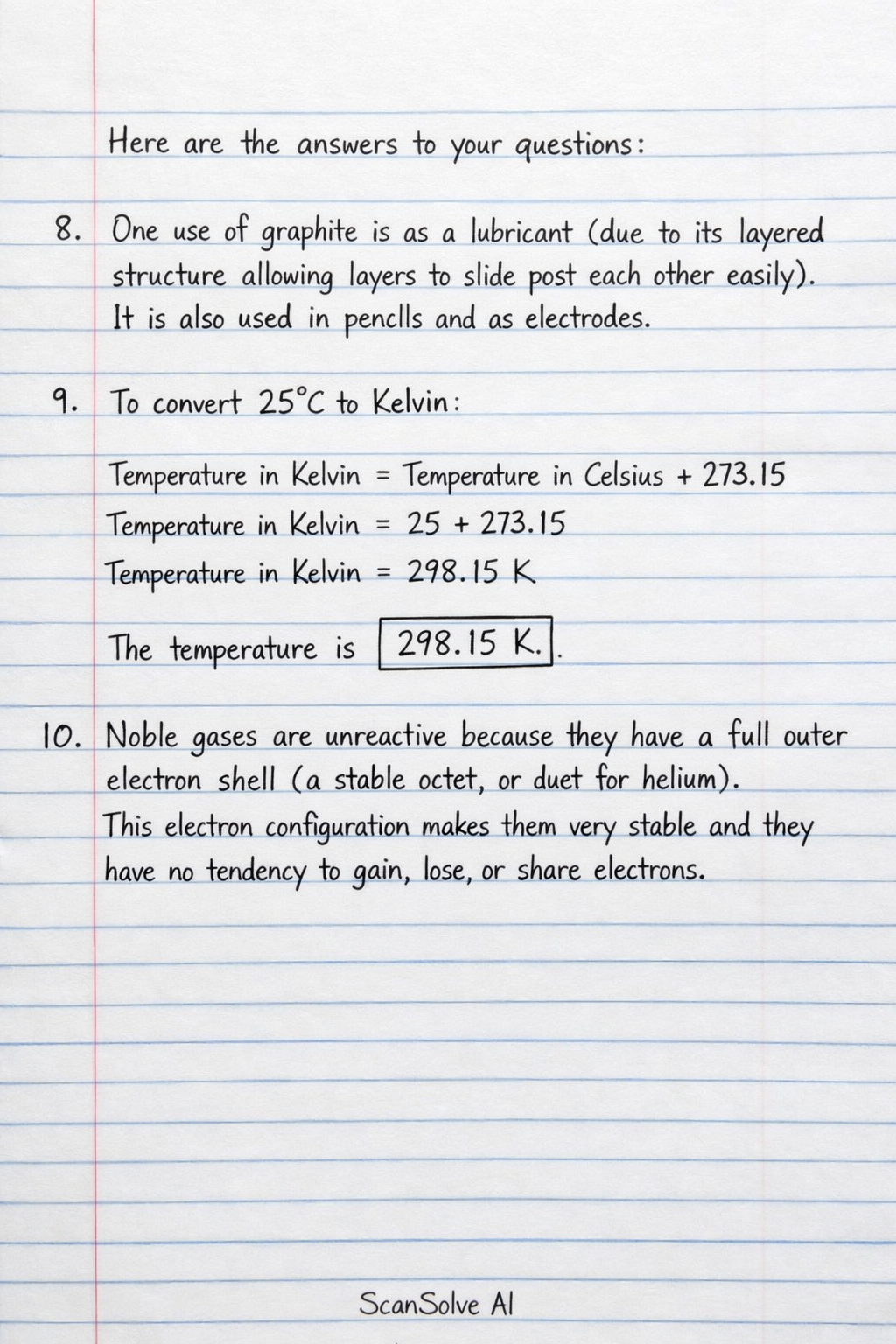
Handwritten Step-by-Step Solution
Get this as a handwritten image on WhatsApp — like a tutor wrote it for you.
Try on WhatsApp