
We read your photo as:
Explain trends in ionization energy, water's boiling point, metallic bonding, and the nature of ammonium chloride.
ScanSolve AI Answer
Answer
Step-by-step solution
11 stepsAnswer Question 12.
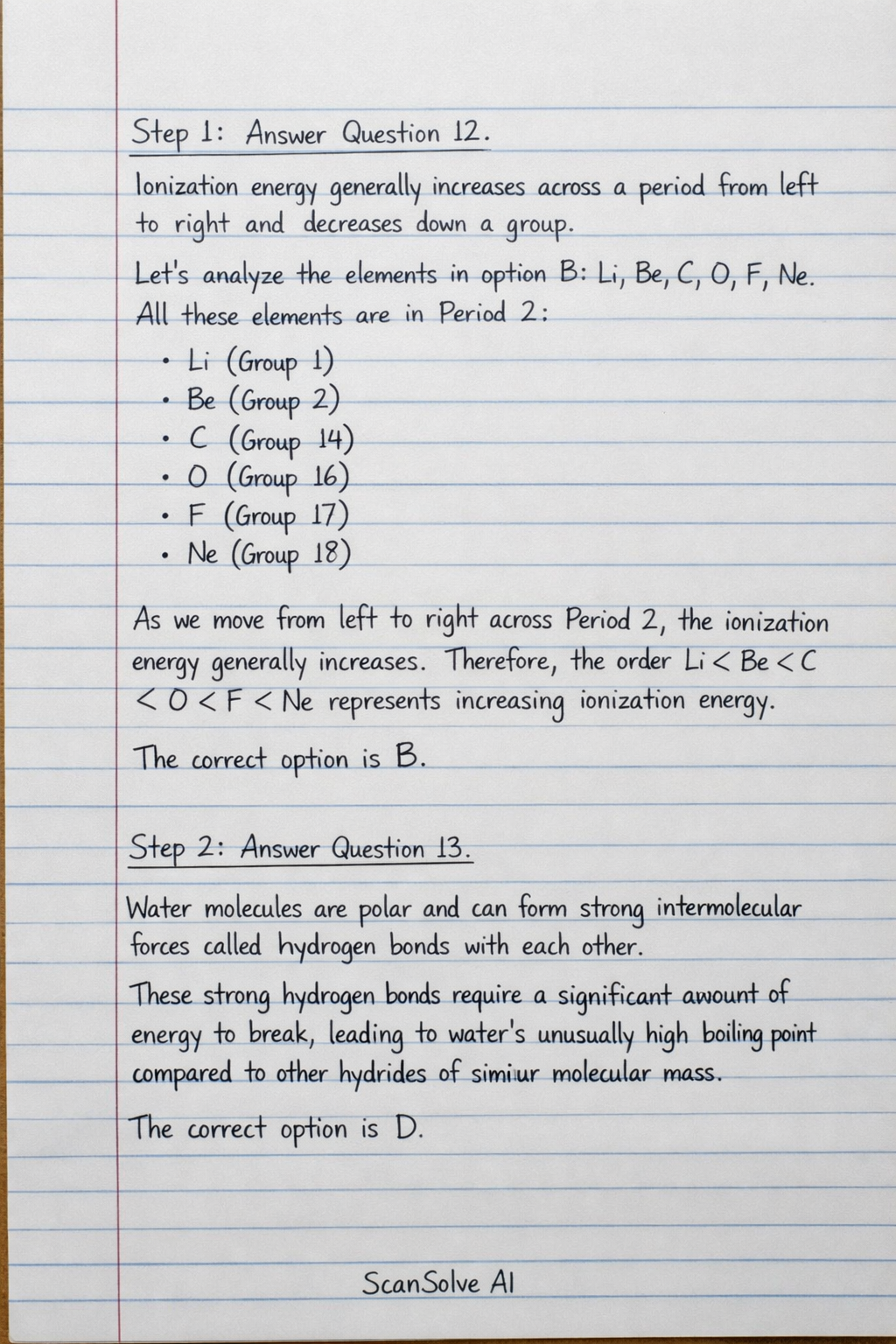
Ionization energy generally increases across a period from left to right and decreases down a group.
Let's analyze the elements in option B: Li, Be, C, O, F, Ne. All these elements are in Period 2.- Li (Group 1)
- Be (Group 2)
- C (Group 14)
- O (Group 16)
- F (Group 17)
- Ne (Group 18) As we move from left to right across Period 2, the ionization energy generally increases. Therefore, the order Li < Be < C < O < F < Ne represents increasing ionization energy.
The correct option is B.
Answer Question 13.
Water molecules are polar and can form strong intermolecular forces called hydrogen bonds with each other. These strong hydrogen bonds require a significant amount of energy to break, leading to water's unusually high boiling point compared to other hydrides of similar molecular mass.
The correct option is D.
Answer Question 14.
In a metallic solid, the atoms are arranged in a lattice, and their valence electrons are delocalized, forming a "sea of electrons" that can move freely throughout the structure. The forces of attraction are between these mobile valence electrons and the positively charged nuclei (or metal cations) of the metal atoms.
The correct option is D.
Answer Question 15.
Crystalline ammonium chloride (NH₄Cl) is an ionic compound.
- It consists of ammonium ions (NH₄⁺) and chloride ions (Cl⁻), held together by ionic bonds.
- Within the ammonium ion (NH₄⁺), the nitrogen atom is covalently bonded to three hydrogen atoms, forming covalent bonds.
- The fourth N-H bond in NH₄⁺ is formed when the lone pair of electrons on the nitrogen atom in ammonia (NH₃) is donated to a hydrogen ion (H⁺), forming a dative (coordinate) covalent bond.
Therefore, ammonium chloride contains ionic, covalent, and dative bonds.
The correct option is C.
Answer Question 16.
A diatomic element is one that exists naturally as molecules composed of two atoms.
- A. Sodium (Na) is a metal and exists as individual atoms in a metallic lattice.
- B. Oxygen (O₂) exists as a diatomic gas at standard conditions.
- C. Iron (Fe) is a metal and exists as individual atoms in a metallic lattice.
- D. Neon (Ne) is a noble gas and exists as individual atoms.
The correct option is B.
Answer Question 17.
Noble gas atoms (like He, Ne, Ar, Kr, Xe, Rn) are monatomic and have full outer electron shells, making them very unreactive. The only forces of attraction between these nonpolar atoms are weak intermolecular forces known as van der Waals forces (specifically London dispersion forces).
The correct option is A.
Answer Question 18.
A nuclear reaction involves changes within the nucleus of an atom, leading to the formation of different elements or isotopes.
- A. Nuclear reactions involve protons and neutrons, not neutrons only.
- B. Nuclear reactions take place inside the nucleus. This is correct.
- C. Nuclear reactions are largely independent of external conditions like temperature and pressure, unlike chemical reactions.
- D. Nuclear reactions involve protons and neutrons, not protons and electrons only. Electrons are not directly involved in changes to the nucleus.
The correct option is B.
Answer Question 19.
The given reaction is:
To balance the equation, the number of atoms of each element must be the same on both sides of the reaction.
- Carbon (C): There are 2 carbon atoms on the left (in C₂H₂) and 2 carbon atoms on the right (in C₂H₆). Carbon is already balanced.
- Hydrogen (H):
- On the left side: 2 hydrogen atoms from C₂H₂ + hydrogen atoms from yH₂ = hydrogen atoms.
- On the right side: 6 hydrogen atoms from C₂H₆. Set the number of hydrogen atoms equal:
The value of y is 2.
The correct option is C.
Answer Question 20.
Given:
Concentration of KOH solution =
Mass of solid KOH =
Atomic masses: K = 39.0, O = 16.0, H = 1.0First, calculate the molar mass of KOH:
Next, calculate the number of moles of KOH:
Now, use the concentration formula to find the volume:
Rearrange to solve for Volume:
Convert the volume from to (since ):
Rounding to two decimal places, the volume is .
The correct option is A.
Answer Question 21.
Given:
Compound: Ca(OCl)₂
Atomic masses: Ca = 40.0, Cl = 35.5, O = 16.0First, calculate the molar mass of Ca(OCl)₂:
Next, calculate the percentage by mass of Calcium:
Rounding to one decimal place, this is .
The correct option is A.
Answer Question 22.
- Boyle's law describes the inverse relationship between the pressure and volume of a gas at constant temperature.
- Charles's law describes the direct relationship between the volume and absolute temperature of a gas at constant pressure.
- Dalton's law of partial pressures states that the total pressure exerted by a mixture of non-reacting gases is equal to the sum of the partial pressures of individual gases.
- Graham's law of effusion/diffusion relates the rate of effusion or diffusion of a gas to the square root of its molar mass.
The gas law that describes the relationship between volume and temperature is Charles's law.
The correct option is B.
Try one yourself
A new problem that tests the same skill.
Still stuck on this one?
Ask a follow-up, and the answer starts from this question.
More Chemistry Questions
Handwritten Step-by-Step Solution
Get this as a handwritten image on WhatsApp — like a tutor wrote it for you.
Try on WhatsApp