
We read your photo as:
Define valency and radical. State two differences between a lunar and solar eclipse. Name the elements in ammonia, common salt, and water. List three agents of pollination.
Chemistry
ScanSolve AI Answer
here are the answers to the questions from the image:
-
Define the following terms:
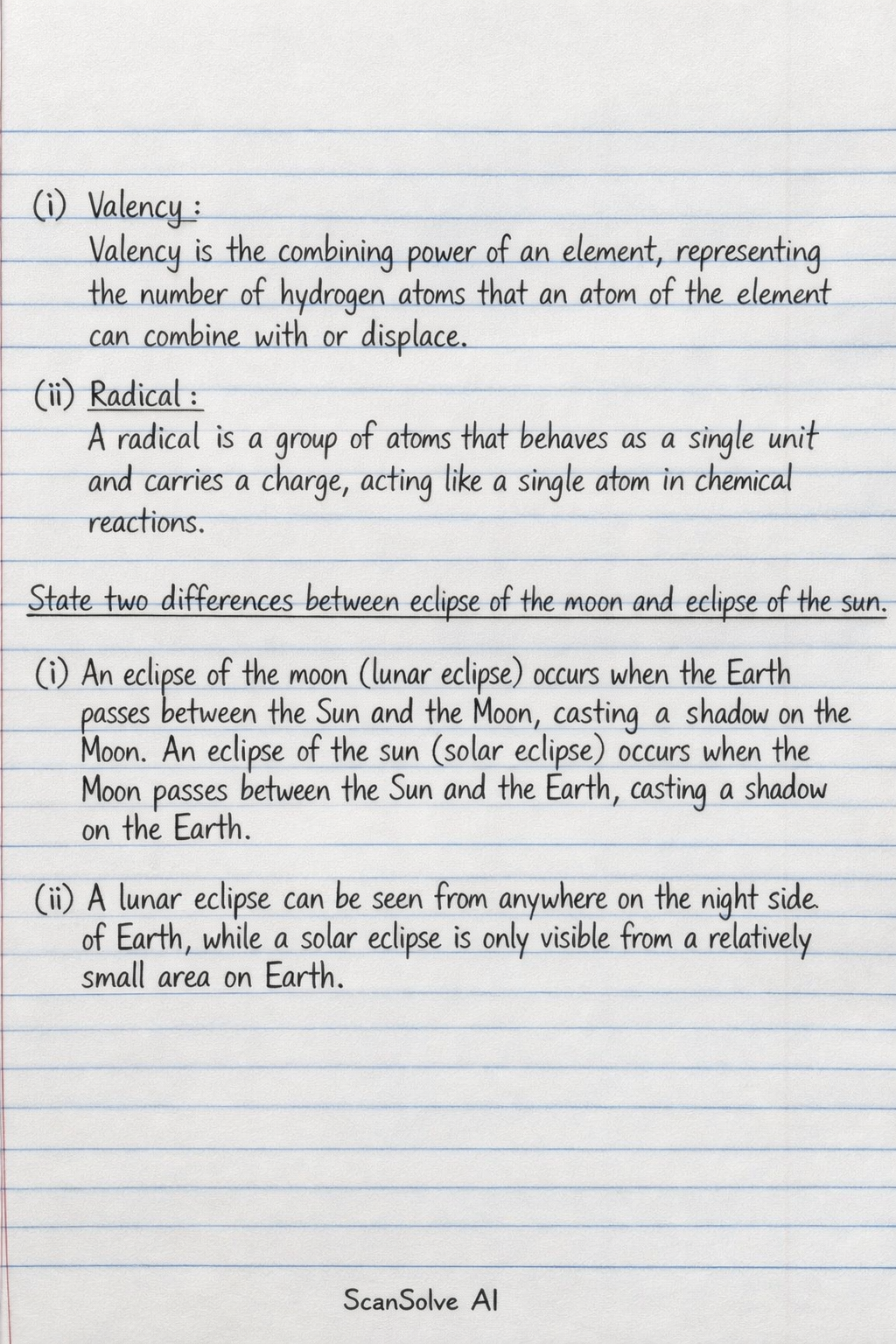
- (i) Valency: Valency is the combining power of an element, representing the number of hydrogen atoms that an atom of the element can combine with or displace.
- (ii) Radical: A radical is a group of atoms that behaves as a single unit and carries a charge, acting like a single atom in chemical reactions.
State two differences between eclipse of the moon and eclipse of the sun.
- (i) An eclipse of the moon (lunar eclipse) occurs when the Earth passes between the Sun and the Moon, casting a shadow on the Moon. An eclipse of the sun (solar eclipse) occurs when the Moon passes between the Sun and the Earth, casting a shadow on the Earth.
- (ii) A lunar eclipse can be seen from anywhere on the night side of Earth, while a solar eclipse is only visible from a relatively small area on Earth.
a) Name the elements that make up the following compounds:
- (i) Ammonia: Nitrogen, Hydrogen
- (ii) Common Salt: Sodium, Chlorine
- (iii) Water: Hydrogen, Oxygen
b) (i) List three agents of pollination.
-
- Wind
-
- Insects (e.g., bees, butterflies)
-
- Water
Was this helpful?
Still stuck on this one?
Ask a follow-up, and the answer starts from this question.
Got a different question?Ask your own question
More Chemistry Questions
QState the valencies of the following elements and radicals: (i) Aluminium (ii) Calcium (iii)…QName two types of pollination. (b) Name any one agent of pollination. (c) Give one reason why petals…QLabel the parts of the flower (anther, filament, stigma, petal, ovule, pedicel, sepal) and describe…QExplain why certain basic radicals produce two different colored beads with borax and provide…QIdentify the valency of the following radicals: (a) Sulphate, (b) Hydroxide, (c) Phosphate. What is…
Handwritten Step-by-Step Solution
Get this as a handwritten image on WhatsApp — like a tutor wrote it for you.
Try on WhatsApp