
We read your photo as:
State two uses of ammonia. State one similarity and one difference between ionic bond and covalent bond. Consider the redox reaction equation: Fe(s) + Cu2+(aq) → Fe2+(aq) + Cu(s). State the: (i) oxidizing agent; (ii) species reduced.
Chemistry
ScanSolve AI Answer
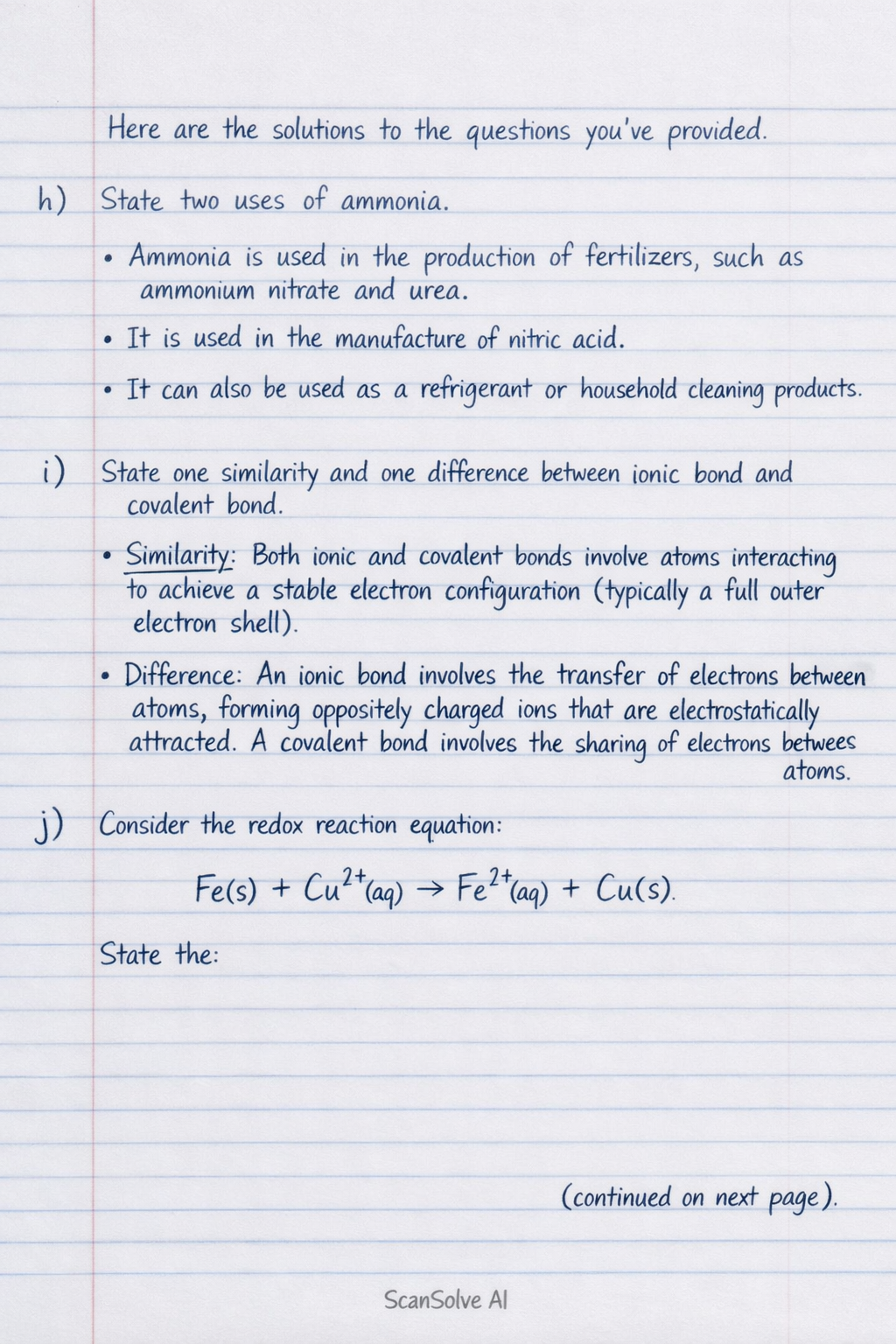
Here are the solutions to the questions you've provided.
h) State two uses of ammonia.
- Ammonia is used in the production of fertilizers, such as ammonium nitrate and urea.
- It is used in the manufacture of nitric acid.
- It can also be used as a refrigerant or in household cleaning products.
i) State one similarity and one difference between ionic bond and covalent bond.
- Similarity: Both ionic and covalent bonds involve atoms interacting to achieve a stable electron configuration (typically a full outer electron shell).
- Difference: An ionic bond involves the transfer of electrons between atoms, forming oppositely charged ions that are electrostatically attracted. A covalent bond involves the sharing of electrons between atoms.
j) Consider the redox reaction equation:
State the:
-
(i) oxidizing agent; In this reaction, gains electrons (is reduced), causing to lose electrons (be oxidized). Therefore, is the oxidizing agent.
-
(ii) species reduced. The species that gains electrons is reduced. Here, gains two electrons to become .
Was this helpful?
Still stuck on this one?
Ask a follow-up, and the answer starts from this question.
Got a different question?Ask your own question
More Chemistry Questions
QExplain ionic bonding and covalent bonding. (b) State two differences between ionic and covalent…QConsider the following substances: MgBr2, NH3, Mn. 4.1 Define a chemical bond. 4.2 Write down a…QExplain polyatomic ions and covalent bonds, using the provided notes and examples.QAmmonia reacts with copper(II) oxide. (i) Identify gas H. [1] (ii) Write a balanced chemical…QThe provided text is a solution to a chemistry question about the reactions of ammonia with…
Browse by topic:Inorganic Chemistry
Handwritten Step-by-Step Solution
Get this as a handwritten image on WhatsApp — like a tutor wrote it for you.
Try on WhatsApp