
We read your photo as:
Explain ionic bonding and covalent bonding. (b) State two differences between ionic and covalent bonds.
ScanSolve AI Answer
Step-by-step solution
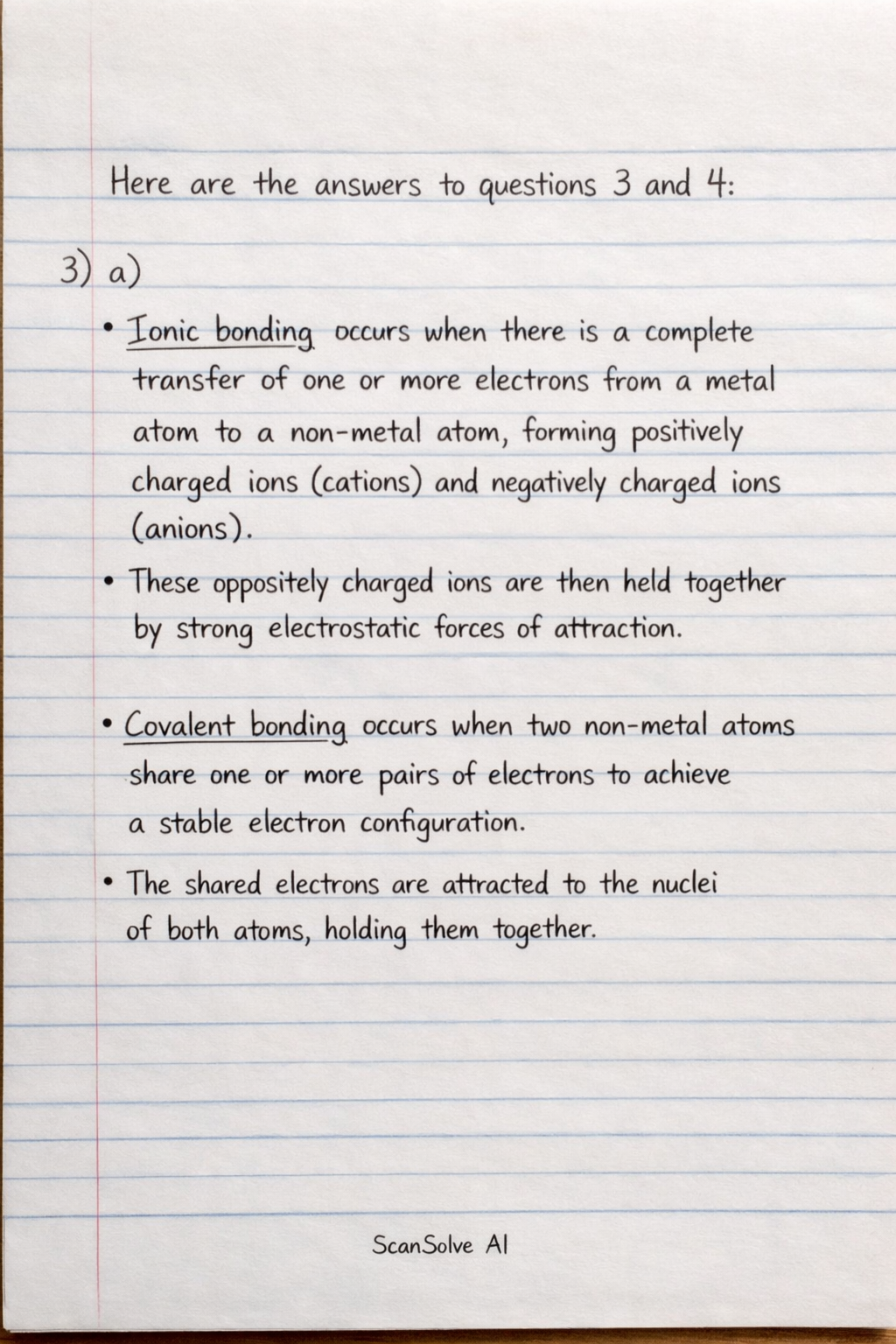
2 stepsHere are the answers to questions 3 and 4:
3)
a)
- Ionic bonding occurs when there is a complete transfer of one or more electrons from a metal atom to a non-metal atom, forming positively charged ions (cations) and negatively charged ions (anions). These oppositely charged ions are then held together by strong electrostatic forces of attraction.
- Covalent bonding occurs when two non-metal atoms share one or more pairs of electrons to achieve a stable electron configuration. The shared electrons are attracted to the nuclei of both atoms, holding them together.
b)
Two differences between ionic and covalent bonds are:
- Ionic bonds involve the transfer of electrons, typically between a metal and a non-metal, forming ions. Covalent bonds involve the sharing of electrons, typically between two non-metals, forming molecules.
- Ionic compounds generally have high melting and boiling points due to strong electrostatic forces between ions. Covalent compounds generally have lower melting and boiling points because the intermolecular forces between molecules are weaker.
4)
a)
Electrolysis is the process of using electrical energy to drive a non-spontaneous chemical reaction. It involves passing an electric current through an electrolyte (a molten ionic compound or a solution of ions) to decompose it into its constituent elements or other compounds.
b)
For the electrolysis of molten , the ions present are and .
Write the half-equation for the reaction at the cathode (negative electrode).
At the cathode, positive copper ions gain electrons (reduction) to form copper metal.
Write the half-equation for the reaction at the anode (positive electrode).
At the anode, negative chloride ions lose electrons (oxidation) to form chlorine gas.
The half equations for the electrolysis of molten are:
At cathode:
At anode:
Still stuck on this one?
Ask a follow-up, and the answer starts from this question.
More Chemistry Questions
Handwritten Step-by-Step Solution
Get this as a handwritten image on WhatsApp — like a tutor wrote it for you.
Try on WhatsApp