
We read your photo as:
Explain ionic, covalent, and metallic bonds, including their occurrence, properties, and relationships between structure and properties.
Chemistry
ScanSolve AI Answer
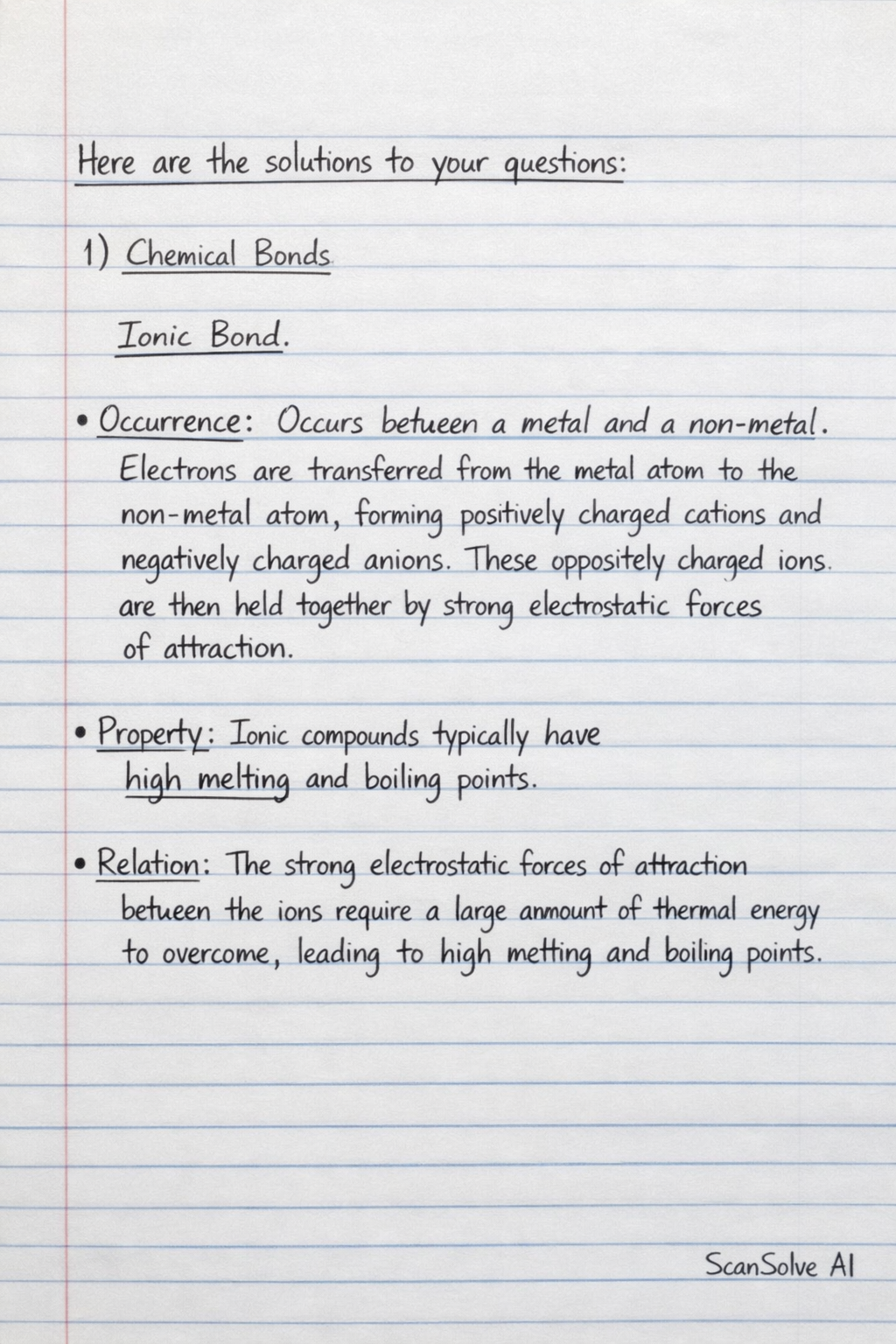
Here are the solutions to your questions:
1) Chemical Bonds
-
Ionic Bond
- Occurrence: Occurs between a metal and a non-metal. Electrons are transferred from the metal atom to the non-metal atom, forming positively charged cations and negatively charged anions. These oppositely charged ions are then held together by strong electrostatic forces of attraction.
- Property: Ionic compounds typically have high melting and boiling points.
- Relation: The strong electrostatic forces of attraction between the ions require a large amount of thermal energy to overcome, leading to high melting and boiling points.
-
Covalent Bond
- Occurrence: Occurs between two non-metal atoms. Atoms achieve a stable electron configuration by sharing one or more pairs of electrons.
- Property: Simple molecular covalent substances typically have low melting and boiling points.
- Relation: While the covalent bonds within the molecules are strong, the intermolecular forces of attraction between individual molecules are weak. Little energy is required to overcome these weak forces, resulting in low melting and boiling points.
-
Metallic Bond
- Occurrence: Occurs in metals. It is the electrostatic attraction between a lattice of positive metal ions and a 'sea' of delocalized electrons (valence electrons that are not associated with any one atom but are free to move throughout the structure).
- Property: Metals are generally good conductors of electricity.
- Relation: The delocalized electrons are free to move throughout the metallic structure and can carry an electrical charge, allowing metals to conduct electricity.
2) Bonding and Properties of Substances
-
Magnesium Chloride ()
- Type of Bonding: Ionic bonding. Magnesium () is a metal, and Chlorine () is a non-metal. Magnesium transfers two electrons to two chlorine atoms, forming and ions.
- Properties and Relation:
- High melting point: The strong electrostatic forces of attraction between the and ions in the crystal lattice require a large amount of energy to overcome.
- Conducts electricity when molten or dissolved in water: In these states, the ions are free to move and can carry an electric current.
-
Carbon Dioxide ()
- Type of Bonding: Covalent bonding (simple molecular structure). Carbon () and Oxygen () are both non-metals, sharing electrons to form molecules.
- Properties and Relation:
- Low melting and boiling point (sublimes): There are strong covalent bonds within each molecule, but only weak intermolecular forces of attraction between the molecules. Little energy is needed to overcome these weak forces.
- Does not conduct electricity: There are no free-moving ions or delocalized electrons to carry an electric charge.
-
Calcium ()
- Type of Bonding: Metallic bonding. Calcium is a metal.
- Properties and Relation:
- Good electrical conductivity: The delocalized electrons in the 'sea' are free to move and carry an electric charge throughout the metal.
- Malleable and ductile: The layers of positive calcium ions can slide past each other without breaking the metallic bond because the 'sea' of delocalized electrons can rearrange to maintain the electrostatic attraction.
Was this helpful?
Still stuck on this one?
Ask a follow-up, and the answer starts from this question.
Got a different question?Ask your own question
More Chemistry Questions
QExplain ionic bonding and covalent bonding. (b) State two differences between ionic and covalent…QExplain the "sea of electrons" model for metallic bonding and its relation to conductivity and…QDescribe the formation, properties, and relationship between bonding and properties for ionic and…QWhat are the key characteristics and properties of metallic bonding, including its explanation for…QDescribe the formation of ionic and simple covalent bonds, providing an example for ionic bonding.
Handwritten Step-by-Step Solution
Get this as a handwritten image on WhatsApp — like a tutor wrote it for you.
Try on WhatsApp