
We read your photo as:
State VSEPR theory and predict the shapes of PCl₅, CO₂, H₂O, XeF₆, and NO₂⁺. Give the name and structure of the transition metal complex [CuCl₄]²⁻.
ScanSolve AI Answer
Step-by-step solution
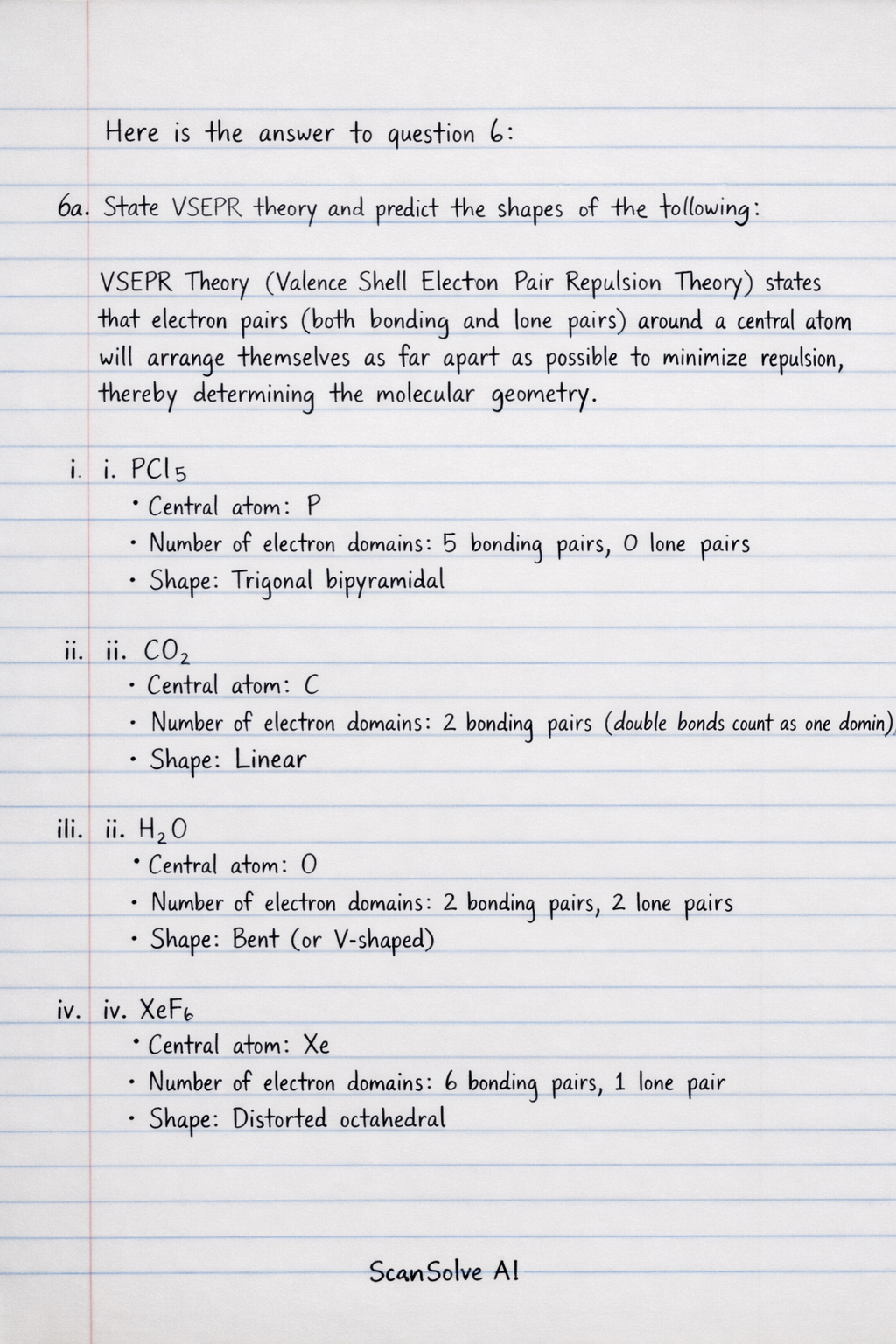
2 stepsHere is the answer to question 6:
6a. State VSEPR theory and predict the shapes of the following:
-
VSEPR Theory (Valence Shell Electron Pair Repulsion Theory) states that electron pairs (both bonding and lone pairs) around a central atom will arrange themselves as far apart as possible to minimize repulsion, thereby determining the molecular geometry.
-
i. PCl₅
- Central atom: P
- Number of electron domains: 5 bonding pairs, 0 lone pairs
- Shape: Trigonal bipyramidal
-
ii. CO₂
- Central atom: C
- Number of electron domains: 2 bonding pairs (double bonds count as one domain), 0 lone pairs
- Shape: Linear
-
iii. H₂O
- Central atom: O
- Number of electron domains: 2 bonding pairs, 2 lone pairs
- Shape: Bent (or V-shaped)
-
iv. XeF₆
- Central atom: Xe
- Number of electron domains: 6 bonding pairs, 1 lone pair
- Shape: Distorted octahedral
-
v. NO₂⁺
- Central atom: N
- Number of electron domains: 2 bonding pairs (double bonds count as one domain), 0 lone pairs
- Shape: Linear
-
6b. Give the name and structure of the following transition metal complexes:
-
i) [CuCl₄]²⁻
- Name: Tetrachlorocuprate(II) ion
- Structure: Tetrahedral
-
ii) [Ag(NH₃)₂]⁺
- Name: Diamminesilver(I) ion
- Structure: Linear
6c. Give reasons for the following facts about halogens:
-
i) halogens belong to group seven in the periodic table.
- Reason: Halogens are in Group 17 (formerly Group VIIA) because they all possess seven valence electrons in their outermost electron shell.
-
ii) halogens are the most reactive non-metal known.
- Reason: Halogens are highly reactive non-metals because they have a strong tendency to gain one electron to achieve a stable noble gas electron configuration (an octet). This is due to their high electronegativity and electron affinity.
6d. How many atoms are there in 6g of carbon?
Calculate the number of moles of carbon.
Calculate the number of atoms.
The number of atoms in 6g of carbon is .
Still stuck on this one?
Ask a follow-up, and the answer starts from this question.
More Chemistry Questions
Handwritten Step-by-Step Solution
Get this as a handwritten image on WhatsApp — like a tutor wrote it for you.
Try on WhatsApp