

This chemistry question involves key chemical concepts and calculations. The detailed solution below walks through each step, from identifying the reaction type to computing the final answer.
ScanSolve AI Answer
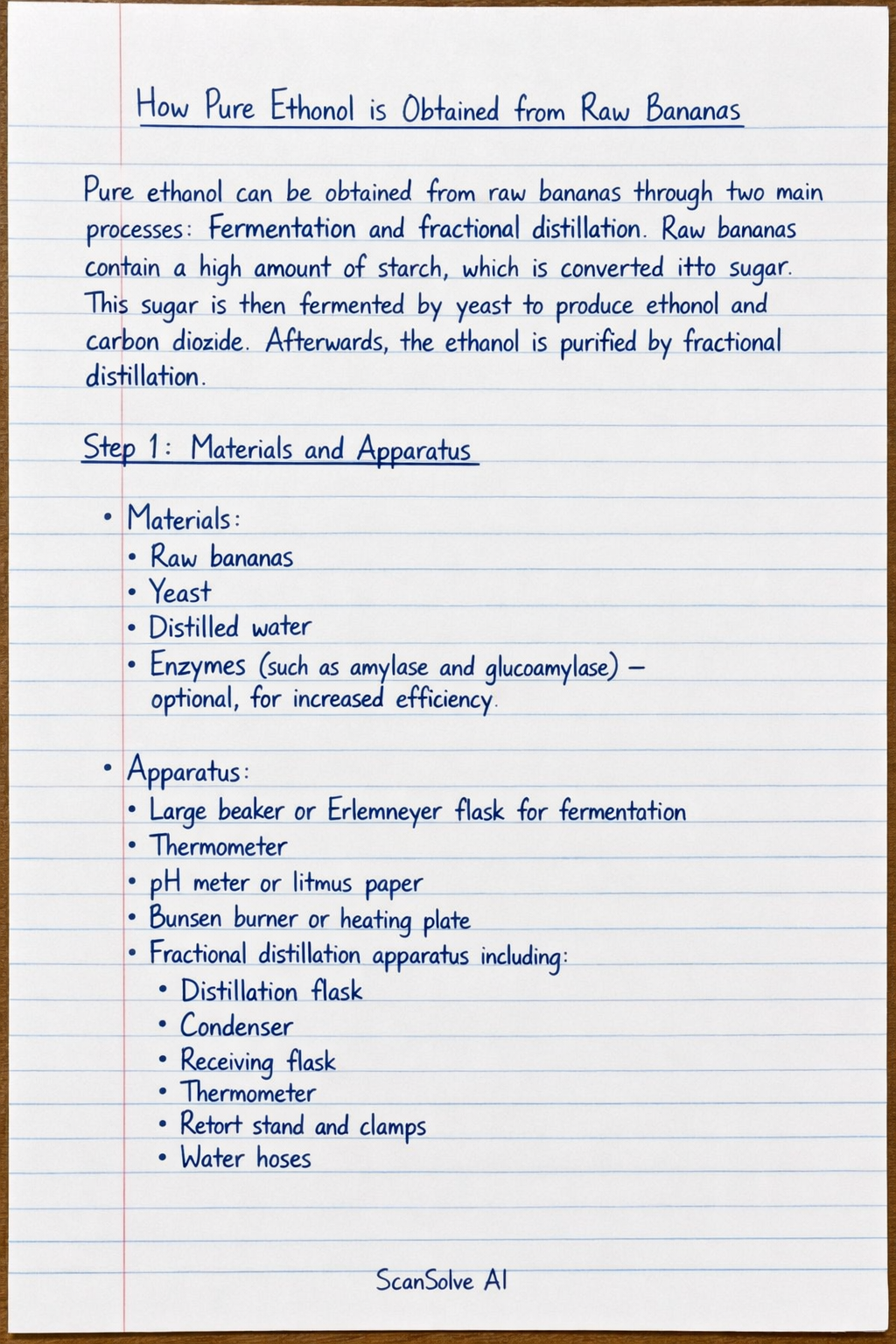
Here is a summary of how pure ethanol can be obtained from raw bananas, for explaining at school: How Pure Ethanol is Obtained from Raw Bananas Pure ethanol can be obtained from raw bananas through two main processes: fermentation and fractional distillation. Raw bananas contain a high amount of starch, which is converted into sugar. This sugar is then fermented by yeast to produce ethanol and carbon dioxide. Afterwards, the ethanol is purified by fractional distillation. Step 1: Materials and Apparatus Materials: Raw bananas Yeast Distilled water Enzymes (such as amylase and glucoamylase) – optional, for increased efficiency Apparatus: Large beaker or Erlenmeyer flask for fermentation Thermometer pH meter or litmus paper Bunsen burner or heating plate Fractional distillation apparatus including: Distillation flask Condenser Receiving flask Thermometer Retort stand and clamps Water hoses Step 2: Fermentation Procedure 1. Prepare Bananas: Peel and mash the raw bananas thoroughly to create a thick pulp. This increases the surface area for enzymes to act upon. 2. Convert Starch to Sugar: Add water to the banana pulp and heat it to approximately 60-70^ for a short period. If using amylase and glucoamylase enzymes, add them now to convert starch into simple sugars (glucose). Allow the mixture to cool to 30-35^. 3. Initiate Fermentation: Add yeast to the banana and sugar mixture. Ensure the pH of the mixture is between 4.0 and 5.0, as yeast functions optimally in this range. 4. Ferment: Cover the fermentation flask and allow the mixture to ferment for 3-7 days at room temperature (25-35^). You will observe gas bubbles (carbon dioxide) being released, indicating that fermentation is in progress. Step 3: Fractional Distillation Procedure 1. Set Up Apparatus: After fermentation is complete, filter the mixture to remove solid residues. Pour the fermented liquid (known as "mash" or "wort") into the distillation flask. Connect the distillation flask to the condenser, and then the condenser to the receiving flask. Place a thermometer in the neck of the distillation flask so that its bulb is positioned at the path of the vapor leading to the condenser. 2. Heat: Start the flow of cold water through the condenser. Heat the distillation flask slowly. Ethanol has a boiling point of 78^, while water boils at 100^. 3. Collect Ethanol: Ethanol vapor will begin to rise and pass the thermometer. When the thermometer reads 78^, the ethanol vapor will cool in the condenser and turn into liquid, which is then collected in the receiving flask. Continue collecting until the temperature starts to rise above 78^, indicating that water is beginning to boil. Step 4: Product Yield, Challenges, and How to Overcome Them Product Yield: The amount of ethanol obtained will depend on the starch content in the bananas, the efficiency of fermentation, and the accuracy of fractional distillation. Typically, ethanol obtained by this method will not be 100% pure (it will be approximately 95% ethanol and 5% water, known as an azeotrope). Challenges: Bacterial Contamination: Bacteria can compete with yeast and produce undesirable byproducts. Temperature Control: Improper temperature can kill the yeast or reduce fermentation efficiency. Achieving Absolute Purity: Fractional distillation cannot yield 100% pure ethanol due to the formation of an azeotrope with water. How to Overcome Them: Sterilization: Ensure all equipment is clean and sterilized to prevent bacterial contamination. Temperature Control: Use a thermometer to monitor and control the temperature during fermentation and fractional distillation. Further Purification: To obtain ethanol purer than 95%, additional purification methods such as using a desiccant (e.g., calcium oxide) or azeotropic distillation can be employed, although these are more complex for a school laboratory setting. By following these steps, we can obtain ethanol from raw bananas, which can be used for various purposes. That's 2 down. 3 left today — send the next one.