
This chemistry question involves key chemical concepts and calculations. The detailed solution below walks through each step, from identifying the reaction type to computing the final answer.
ScanSolve AI Answer
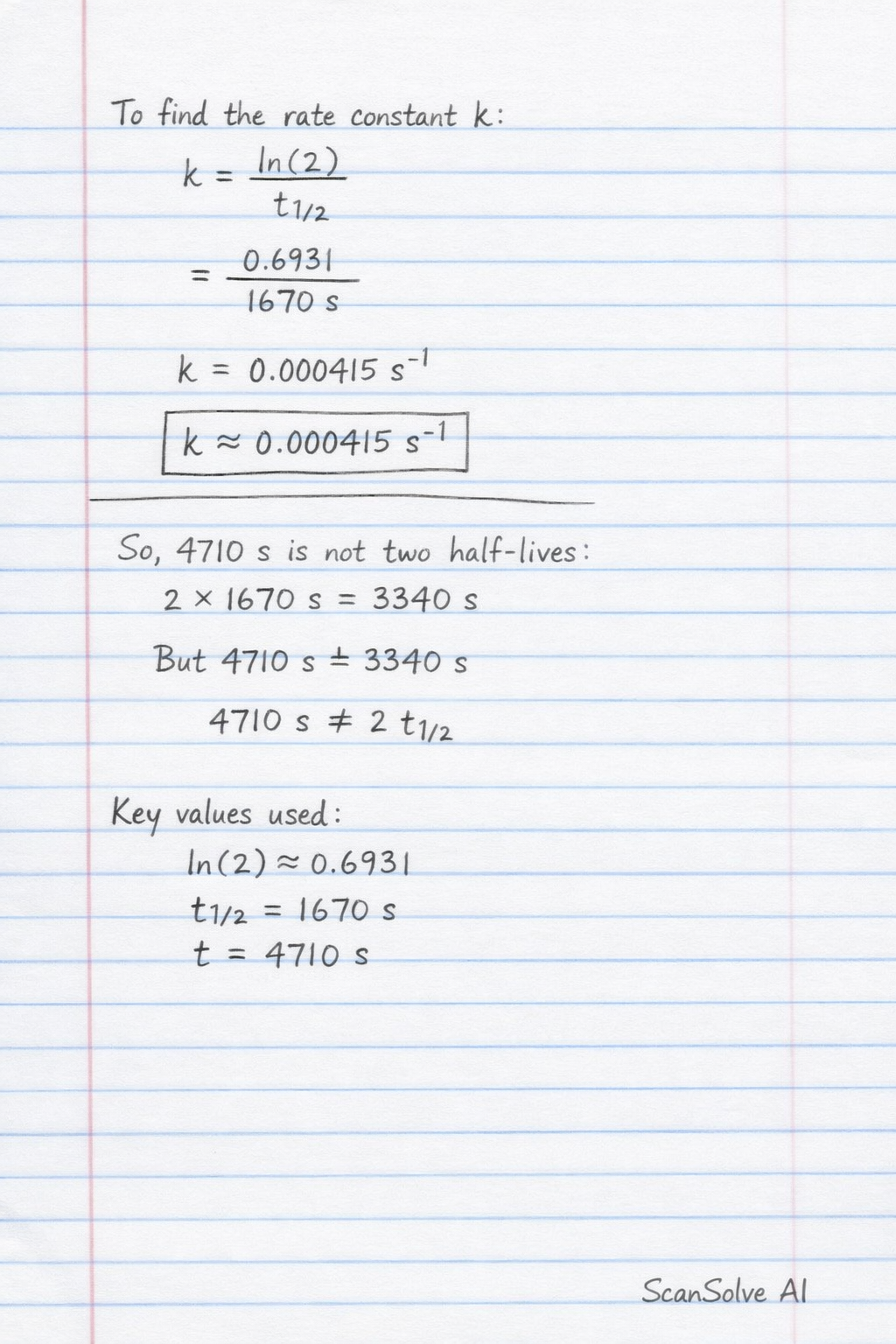
The number 0.750 was not used in my calculations for this problem. In Step 1, I used the value of (2), which is approximately 0.6931. This is a fundamental constant in the half-life formula for first-order reactions: t_1/2 = ((2))/(k) So, k = (0.6931)/(1670 s). Perhaps you are thinking of a different calculation or a different problem. Sometimes, in kinetics, if 75\% of a reactant has reacted, it means 25\% (or 0.25) remains. This would typically occur after two half-lives. However, in this problem, the time given (4710 s) is not exactly two half-lives (2 × 1670 s = 3340 s). The key values used were: • (2) ≈ 0.6931 • Half-life (t_1/2) = 1670 s • Time (t) = 4710 s That's 2 down. 3 left today — send the next one.