
We read your photo as:
Draw a bar graph which shows the number/type of discriminators and violations of learners' rights in cyberbullying cases that were witnessed in September, October, November and December 2025. Use the
ScanSolve AI Answer
Here are the solutions to your questions for Activity 3:
Activity 3
3.1 Draw a bar graph which shows the number/type of discriminators and violations of learners' rights in cyberbullying cases that were witnessed in September, October, November and December 2025. Use the following statistics to draw your bar graph: September 2025(cyberstalking 8%, harassment 10%, name calling 15%, faking 20%), October 2025(cyberstalking 25%, harassment 30%, name calling 35%, faking 40%), November 2025(cyberstalking 45%, harassment 50%, name calling 55%, faking 60%) and December 2025(cyberstalking 65%, harassment 70%, name calling 75%, faking 80%)
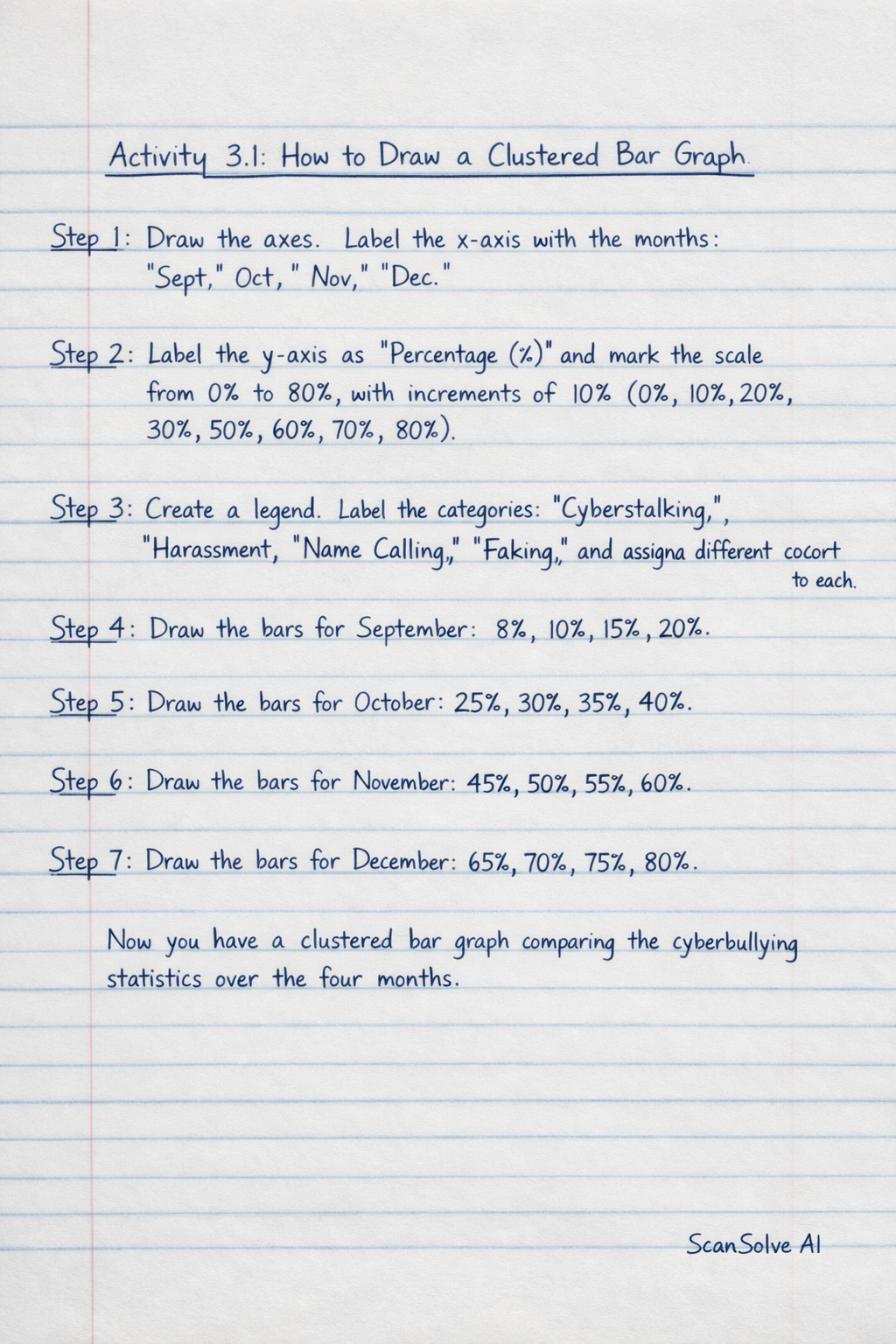
As an AI, I cannot physically draw a bar graph. However, I can provide a detailed description of how you would construct a clustered bar graph using the given data. This type of graph is suitable for comparing multiple categories (cyberbullying types) across different periods (months).
How to Construct the Bar Graph:
- Title: Give the graph a clear and descriptive title, such as "Prevalence of Cyberbullying Types Among Learners (September - December 2025)".
- X-axis (Horizontal Axis): Label this axis "Months". Divide it into four main sections, one for each month: September 2025, October 2025, November 2025, and December 2025.
- Y-axis (Vertical Axis): Label this axis "Percentage of Cases (%)". Scale it from 0% to 80% (or slightly higher, e.g., 85%) with consistent increments (e.g., every 10% or 5%).
- Bars: For each month, you will draw four separate bars clustered together. Each bar within a cluster will represent one type of cyberbullying.
- Use a distinct color for each type of cyberbullying (e.g., blue for Cyberstalking, red for Harassment, green for Name Calling, yellow for Faking) and maintain these colors across all months.
- For September 2025, draw bars up to 8% (cyberstalking), 10% (harassment), 15% (name calling), and 20% (faking).
- For October 2025, draw bars up to 25% (cyberstalking), 30% (harassment), 35% (name calling), and 40% (faking).
- For November 2025, draw bars up to 45% (cyberstalking), 50% (harassment), 55% (name calling), and 60% (faking).
- For December 2025, draw bars up to 65% (cyberstalking), 70% (harassment), 75% (name calling), and 80% (faking).
- Legend: Include a legend to clearly indicate which color corresponds to which type of cyberbullying (Cyberstalking, Harassment, Name Calling, Faking).
3.2 Interview one RCL member in your school about cyberbullying cases and explain your findings for each of the five questions.
As an AI, I cannot conduct an interview. However, I can provide a framework for the interview and examples of potential findings for five questions you might ask an RCL member.
Suggested Interview Questions:
- "What are the most common forms of cyberbullying that learners in our school experience or report?"
- "How effective do you believe the school's current strategies are in preventing and addressing cyberbullying?"
- "What challenges do students face when they want to report a cyberbullying incident?"
- "In what ways does cyberbullying impact the academic performance and overall well-being of students?"
- "What new initiatives or changes would you suggest to improve cyberbullying awareness and support for victims in our school?"
Example of Potential Findings (for each question):
- Findings: The RCL member noted that name-calling and spreading rumors through social media platforms are the most frequently observed forms of cyberbullying. They also mentioned instances of social exclusion from online groups.
- Findings: The RCL member felt that while the school has policies, their enforcement is inconsistent. They suggested that students are often unaware of the official reporting channels, making current strategies less effective than intended.
- Findings: Students often fear retaliation from bullies or worry about being judged by peers or even staff. There's also a perception that reporting might not lead to any concrete action, discouraging victims from coming forward.
- Findings: Cyberbullying significantly impacts students' mental health, leading to increased anxiety, stress, and sometimes depression. Academically, it can result in decreased concentration, lower grades, and absenteeism as students try to avoid school.
- Findings: The RCL member suggested implementing peer-led workshops on digital citizenship, creating an anonymous reporting system, and establishing a student support group specifically for those affected by cyberbullying.
3.3 Provide ONE effective campaign that schools could conduct to create an awareness on cyberbullying in your community.
Campaign Name: #DigitalKindnessChallenge: Our School, Our Community
Description: This campaign aims to foster a culture of empathy, respect, and responsible digital citizenship within the school and extend its positive influence into the wider community. It will encourage proactive steps against cyberbullying and promote supportive online interactions.
Key Activities:
- Interactive Workshops & Assemblies: Conduct mandatory workshops for all students, tailored to different age groups, focusing on identifying cyberbullying, its impact, safe online practices, and effective reporting methods. School assemblies will feature guest speakers (e.g., cyber safety experts, local police) and student testimonials.
- Parent & Community Engagement Evenings: Host evening sessions for parents and community members to raise awareness about cyberbullying trends, digital parenting tips, and how to support young people online. Provide resources and open forums for discussion.
- Student-Led Content Creation: Empower students to create short videos, posters, and social media content (e.g., TikToks, Instagram stories) promoting positive online behavior, kindness, and anti-cyberbullying messages. These will be shared on school platforms and local community channels.
Still stuck on this one?
Ask a follow-up, and the answer starts from this question.
More Computer Science Questions
Handwritten Step-by-Step Solution
Get this as a handwritten image on WhatsApp — like a tutor wrote it for you.
Try on WhatsApp