

This mathematics problem involves applying core mathematical principles and formulas. Below you will find a complete step-by-step solution with detailed explanations for each step, helping you understand not just the answer but the method behind it.
ScanSolve AI Answer
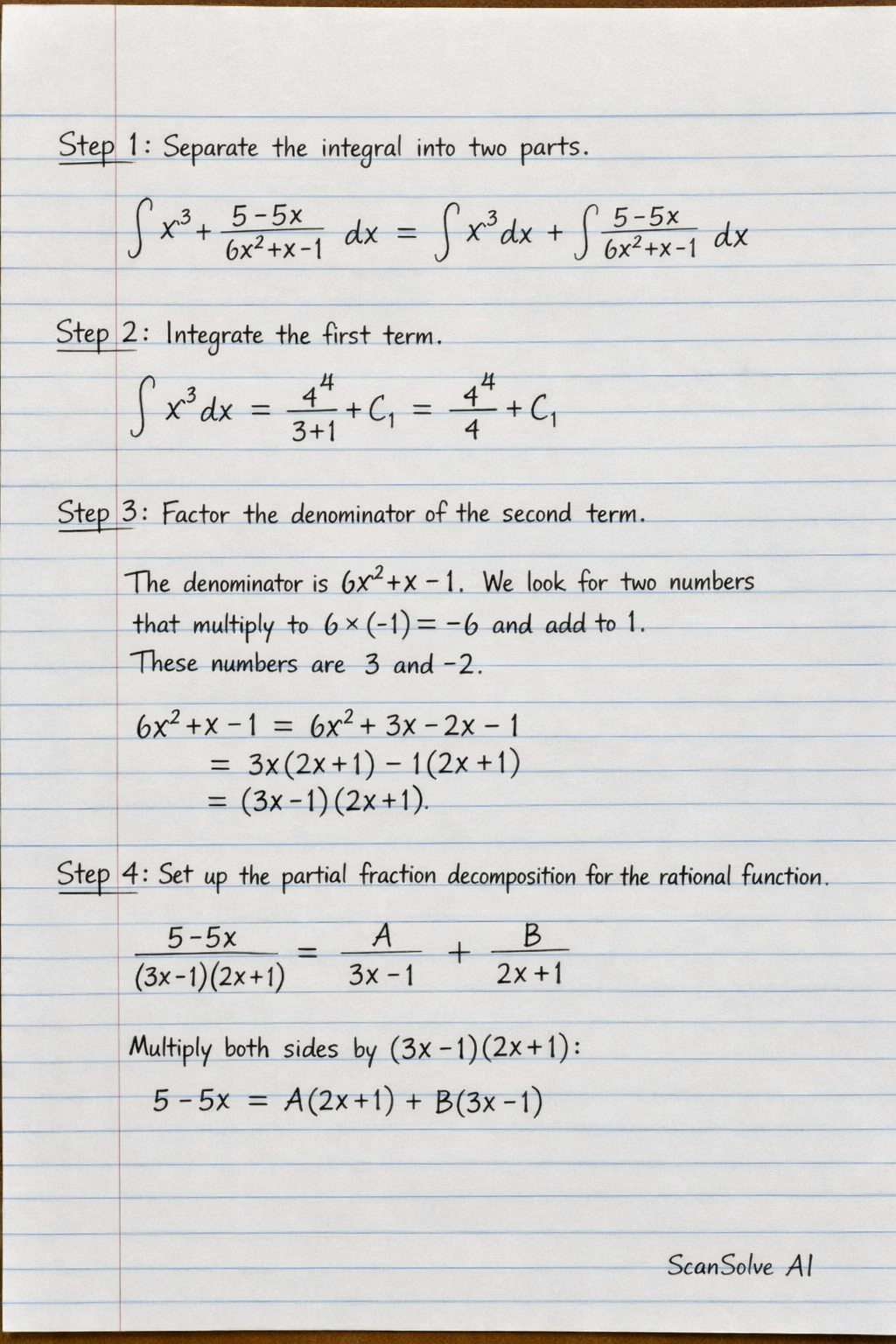
Step 1: Separate the integral into two parts. x^3 + (5-5x)/(6x^2+x-1) dx = x^3 dx + (5-5x)/(6x^2+x-1) dx Step 2: Integrate the first term. x^3 dx = x^3+13+1 + C_1 = (x^4)/(4) + C_1 Step 3: Factor the denominator of the second term. The denominator is 6x^2+x-1. We look for two numbers that multiply to 6 × (-1) = -6 and add to 1. These numbers are 3 and -2. 6x^2+x-1 = 6x^2+3x-2x-1 = 3x(2x+1) - 1(2x+1) = (3x-1)(2x+1) Step 4: Set up the partial fraction decomposition for the rational function. (5-5x)/((3x-1)(2x+1)) = (A)/(3x-1) + (B)/(2x+1) Multiply both sides by (3x-1)(2x+1): 5-5x = A(2x+1) + B(3x-1) Step 5: Solve for the constants A and B. To find A, set 3x-1=0 x=(1)/(3): 5-5((1)/(3)) = A(2((1)/(3))+1) + B(0) 5-(5)/(3) = A((2)/(3)+1) (15-5)/(3) = A((5)/(3)) (10)/(3) = (5)/(3)A A = 2 To find B, set 2x+1=0 x=-(1)/(2): 5-5(-(1)/(2)) = A(0) + B(3(-(1)/(2))-1) 5+(5)/(2) = B(-(3)/(2)-1) (10+5)/(2) = B(-(5)/(2)) (15)/(2) = -(5)/(2)B B = -3 So, the partial fraction decomposition is: (5-5x)/(6x^2+x-1) = (2)/(3x-1) - (3)/(2x+1) Step 6: Integrate the partial fractions. ((2)/(3x-1) - (3)/(2x+1)) dx = (2)/(3x-1) dx - (3)/(2x+1) dx For (2)/(3x-1) dx: Let u=3x-1, du=3dx. (2)/(u) (1)/(3) du = (2)/(3) (1)/(u) du = (2)/(3) |u| = (2)/(3) |3x-1| For (3)/(2x+1) dx: Let v=2x+1, dv=2dx. (3)/(v) (1)/(2) dv = (3)/(2) (1)/(v) dv = (3)/(2) |v| = (3)/(2) |2x+1| Combining these, we get: (5-5x)/(6x^2+x-1) dx = (2)/(3) |3x-1| - (3)/(2) |2x+1| + C_2 Step 7: Combine the results from Step 2 and Step 6. x^3 + (5-5x)/(6x^2+x-1) dx = (x^4)/(4) + (2)/(3) |3x-1| - (3)/(2) |2x+1| + C The final answer is (x^4)/(4) + (2)/(3) |3x-1| - (3)/(2) |2x+1| + C.