
We read your photo as:
Show the step-by-step calculation for multiplying CDA₁₆ by AD₁₆.
Computer Science
ScanSolve AI Answer
Step-by-step solution
2 stepsLet's break down hexadecimal multiplication. It's similar to decimal multiplication, but instead of carrying over 10s, you carry over 16s.
Here are the decimal equivalents for hexadecimal digits:
A = 10
B = 11
C = 12
D = 13
E = 14
F = 15
When you multiply two hexadecimal digits:
- Convert them to decimal.
- Multiply the decimal numbers.
- Convert the product back to hexadecimal. If the product is or greater, you'll have a remainder (which is the digit to write down) and a quotient (which is the carry to the next column).
Problem (a):
Multiply by .
We'll multiply each digit of by (), starting from the right.
- : . To convert to hexadecimal: with a remainder of 2. So, we write down 2 and carry 8.
- : . To convert to hexadecimal: with a remainder of 1. is . So, we write down 1 and carry .
- : . To convert to hexadecimal: with a remainder of 7. is . So, we write down .
The first partial product is .
Multiply by .
We'll multiply each digit of by (), starting from the right. Remember to shift one position to the left (add a 0 at the end).
- : . To convert to hexadecimal: with a remainder of $4
Was this helpful?
Still stuck on this one?
Ask a follow-up, and the answer starts from this question.
Got a different question?Ask your own question
More Computer Science Questions
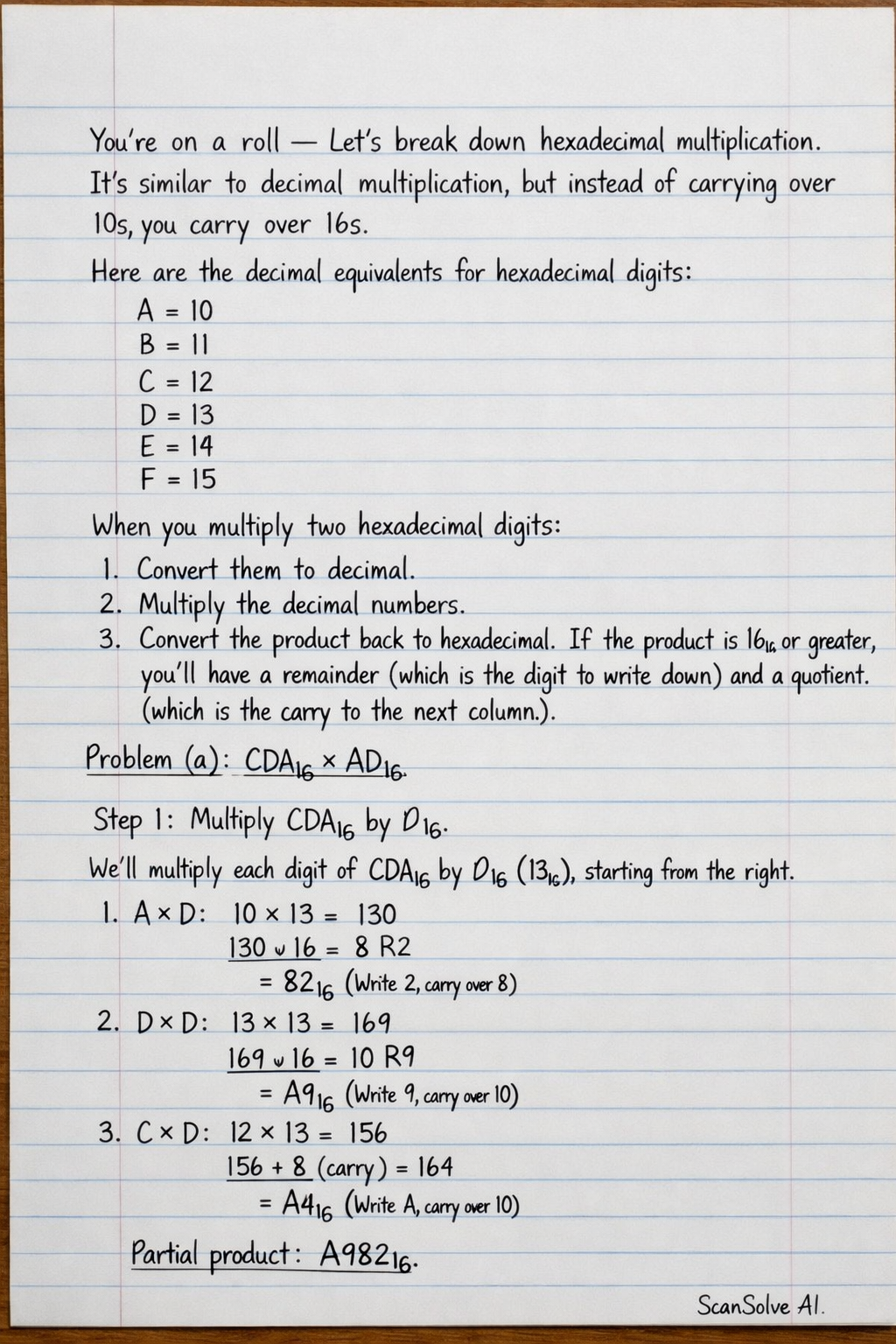
Handwritten Step-by-Step Solution
Get this as a handwritten image on WhatsApp — like a tutor wrote it for you.
Try on WhatsApp