
We read your photo as:
4.5.1. The market structure represented by the graph above is perfect competition.
ScanSolve AI Answer
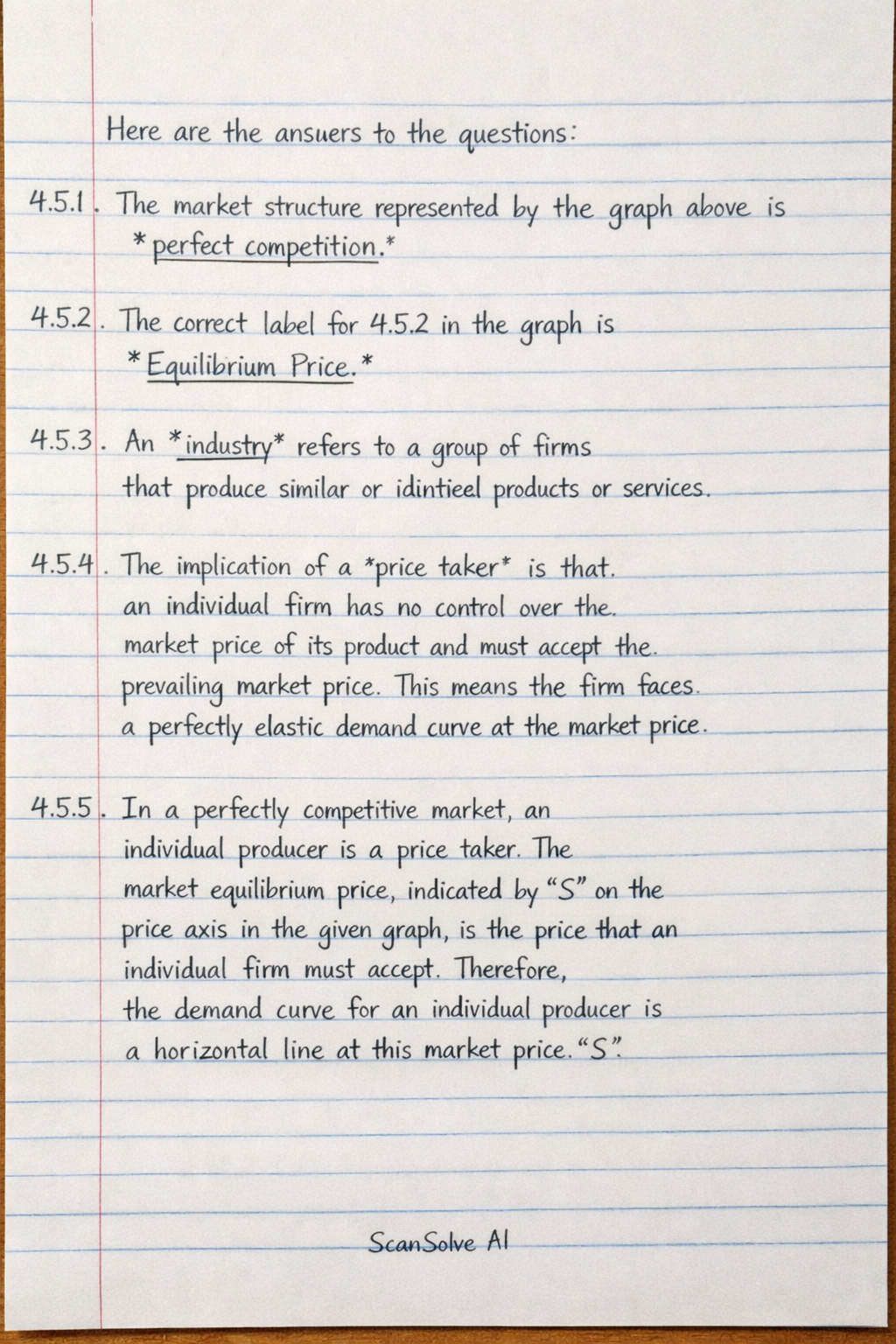
Here are the answers to the questions:
4.5.1. The market structure represented by the graph above is perfect competition.
4.5.2. The correct label for 4.5.2 in the graph is Equilibrium Price.
4.5.3. An industry refers to a group of firms that produce similar or identical products or services.
4.5.4. The implication of a price taker is that an individual firm has no control over the market price of its product and must accept the prevailing market price. This means the firm faces a perfectly elastic demand curve at the market price.
4.5.5. In a perfectly competitive market, an individual producer is a price taker. The market equilibrium price, indicated by 'S' on the price axis in the given graph, is the price that an individual firm must accept. Therefore, the demand curve for an individual producer is a horizontal line at this market price 'S'.
4.5.6. The shut-down point for an individual firm in a perfect market occurs when the market price falls below the firm's minimum average variable cost (AVC). At this point, the firm cannot even cover its variable costs of production, and it minimizes its losses by shutting down operations immediately.
Here is a graph illustrating the shut-down point:
The shut-down point is where the Marginal Cost (MC) curve intersects the Average Variable Cost (AVC) curve at its minimum. If the market price (P) drops below this minimum AVC, the firm should shut down.
4.5.7. A perfect market is considered unrealistic because its underlying assumptions are rarely met in the real world. Key reasons include:
- Homogeneous products: Most real-world markets feature product differentiation, where goods are not identical.
- Perfect information: Buyers and sellers rarely have complete and perfect information about prices, products, and costs.
- Free entry and exit: Many industries have significant barriers to entry or exit, such as high start-up costs or regulatory hurdles.
- Many buyers and sellers: While some markets have many participants, it's rare for no single entity to have any market power.
Still stuck on this one?
Ask a follow-up, and the answer starts from this question.
More Economics Questions
Handwritten Step-by-Step Solution
Get this as a handwritten image on WhatsApp — like a tutor wrote it for you.
Try on WhatsApp