
We read your photo as:
B. CODEL Limited has the following cost structure: i. Copy and complete the table by calculating the values to fill the blank columns.
ScanSolve AI Answer
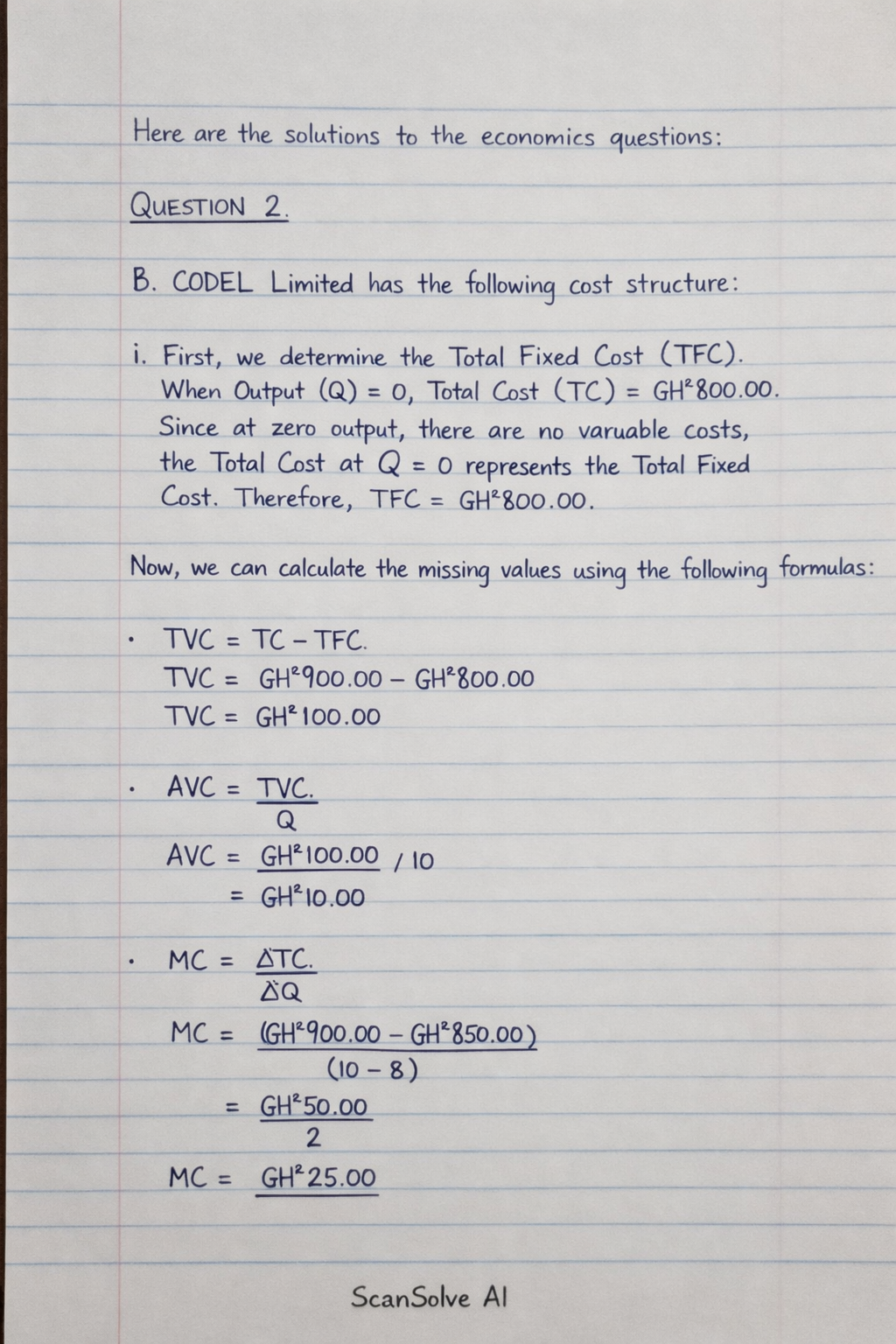
Here are the solutions to the economics questions:
QUESTION 2
B. CODEL Limited has the following cost structure:
i. Copy and complete the table above by calculating the values to fill the blank columns above.
First, we determine the Total Fixed Cost (TFC). When Output (Q) is 0, Total Cost (TC) is GH¢800.00. Since at zero output, there are no variable costs, the Total Cost at Q=0 represents the Total Fixed Cost.
Therefore, .
Now we can calculate the missing values using the following formulas:
| Output (Q) | Total Cost (TC) in Cedis | Total Variable Cost (TVC) in Cedis | Average Variable Cost (AVC) in Cedis | Marginal Cost (MC) in Cedis |
|---|---|---|---|---|
| 0 | 800.00 | 0 | - | - |
| 1 | 1,000.00 | |||
| 2 | 1,400.00 | |||
| 3 | 2,100.00 | |||
| 4 | 2,800.00 | |||
| 5 | 4,000.00 | |||
| 6 | 6,000.00 |
ii. What market structure is CODEL operating in?
CODEL is operating in a perfectly competitive market. This is indicated by the fact that the industry price is fixed, meaning the firm is a price taker and cannot influence the market price.
C. If the industry price is fixed at GH¢1,200
i. Determine the profit maximisation level of output. Explain your answer.
The profit maximization rule for any firm is to produce at the level of output where Marginal Revenue (MR) equals Marginal Cost (MC). In a perfectly competitive market, the firm is a price taker, so the Price (P) is equal to the Marginal Revenue (MR).
Given: Industry Price (P) = GH¢1,200.
Therefore, Marginal Revenue (MR) = GH¢1,200.
We compare this MR with the calculated MC values from the table:
- At Output = 1, MC = GH¢200
- At Output = 2, MC = GH¢400
- At Output = 3, MC = GH¢700
- At Output = 4, MC = GH¢700
- At Output = 5, MC = GH¢1,200
- At Output = 6, MC = GH¢2,000
The profit maximization level of output is 5 units.
Explanation:
A firm maximizes its profit by producing at the output level where its marginal revenue (MR) is equal to its marginal cost (MC). At 5 units of output, the marginal cost is GH¢1,200, which exactly matches the industry price (and thus the firm's marginal revenue) of GH¢1,200. Producing less than 5 units would mean MR > MC, indicating that additional profit could be made by increasing output. Producing more than 5 units (e.g., 6 units) would mean MC > MR, leading to a reduction in total profit.
Still stuck on this one?
Ask a follow-up, and the answer starts from this question.
More Economics Questions
Handwritten Step-by-Step Solution
Get this as a handwritten image on WhatsApp — like a tutor wrote it for you.
Try on WhatsApp