
We read your photo as:
Explain the concepts of fixed and variable costs, economies of scale, market participants, product type in a perfect market, market structure, price determination in a perfect market, and market effic
ScanSolve AI Answer
Step-by-step solution
7 stepsAnswer 4.1.1
Two types of costs used to calculate the total costs of a firm are fixed costs and variable costs. Fixed costs do not change with the level of output, while variable costs change with the level of output.
Answer 4.1.2
Long-term average costs decrease as output increases overtime due to economies of scale. This occurs when a firm's average cost per unit of output falls as the scale of production increases, often due to specialization, bulk purchasing, or more efficient use of capital.
Answer 4.2.1
One market participant depicted in the information is buyers (or sellers).
Answer 4.2.2
The type of product sold in a perfect market is a homogeneous product (or identical product).
Answer 4.2.3
Market structure refers to the organizational characteristics of a market, including the number of buyers and sellers, the degree of product differentiation, and the ease of entry and exit for firms. It influences the behavior of firms and market outcomes.
Answer 4.2.4
In a perfect market, price is determined by the interaction of overall market demand and supply. Individual firms are price takers and must accept the market price, as they are too small to influence it.
Answer 4.2.5
Markets with no barriers to entry are the most efficient because the free entry and exit of firms ensures that resources are allocated optimally. If firms are making supernormal profits, new firms will enter, increasing supply and driving prices down to the average cost, leading to allocative and productive efficiency in the long run.
Still stuck on this one?
Ask a follow-up, and the answer starts from this question.
More Economics Questions
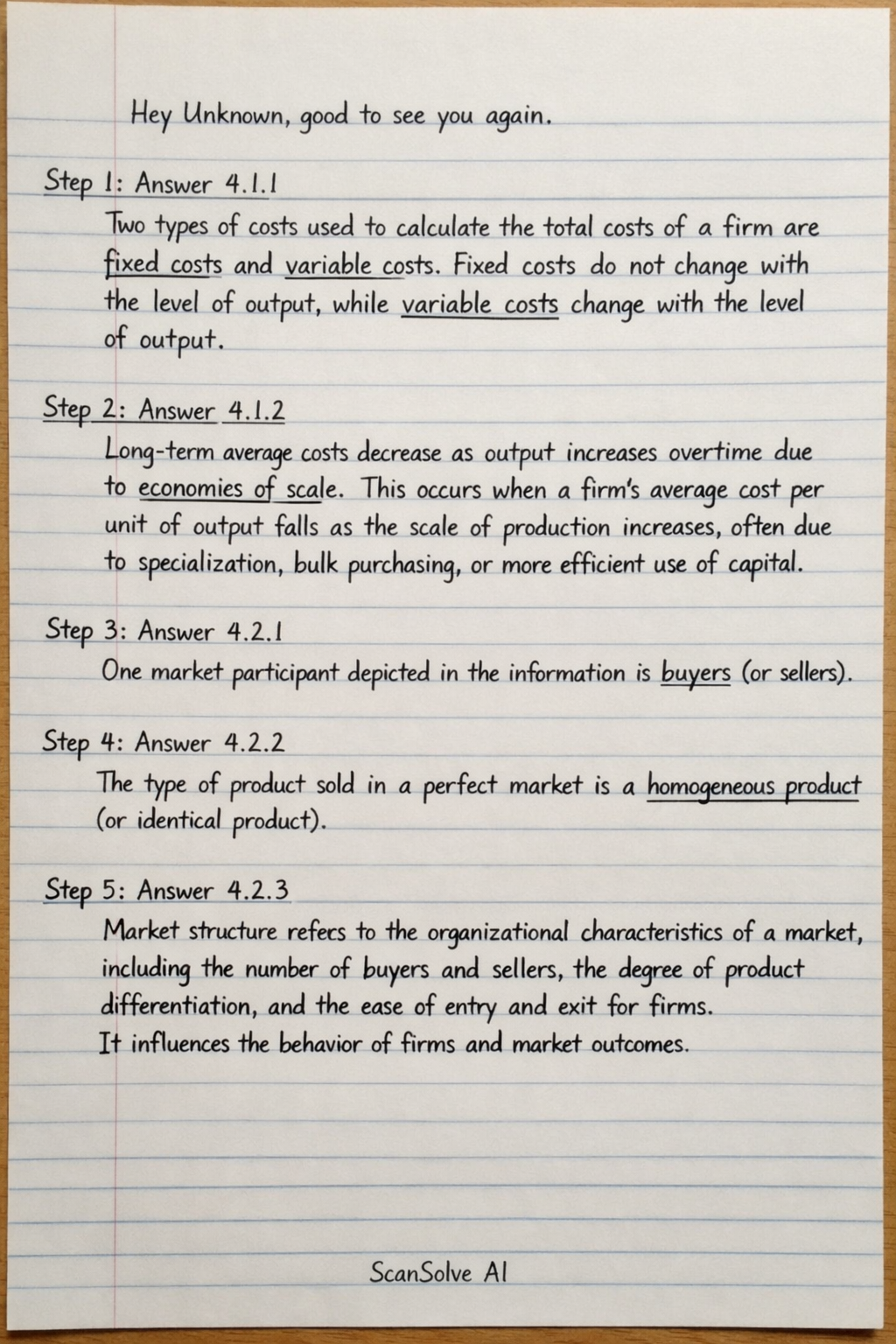
Handwritten Step-by-Step Solution
Get this as a handwritten image on WhatsApp — like a tutor wrote it for you.
Try on WhatsApp