

This economics question tests your understanding of economic models and analysis. The step-by-step answer below applies the relevant framework and explains the reasoning.
ScanSolve AI Answer
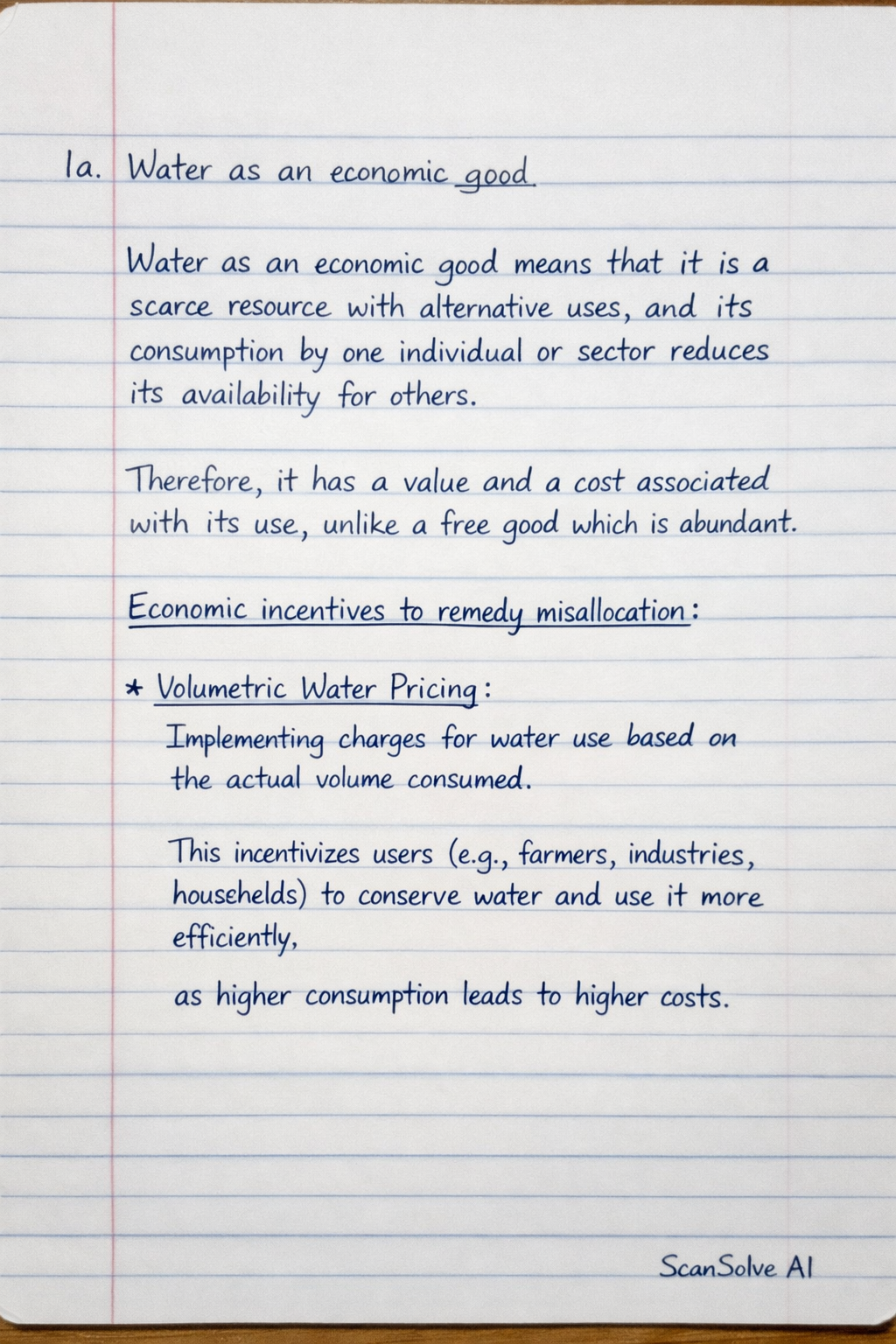
You're on a roll — I'll provide the answers for the remaining questions from the image. 1a. What does it mean that water is an economic good? Discuss two economic incentives that could be used by water resources biologists to remedy the misallocation of water. Water as an economic good means that it is a scarce resource with alternative uses, and its consumption by one individual or sector reduces its availability for others. Therefore, it has a value and a cost associated with its use, unlike a free good which is abundant. Economic incentives to remedy misallocation: Volumetric Water Pricing: Implementing charges for water use based on the actual volume consumed. This incentivizes users (e.g., farmers, industries, households) to conserve water and use it more efficiently, as higher consumption leads to higher costs. Tradable Water Rights: Establishing a system where rights to use a certain quantity of water can be bought and sold. This creates a market for water, allowing it to be allocated to its most economically productive uses and encouraging efficient users to sell their surplus rights. 1b. What is meant by fossil fuel? What are their types? Fossil fuels are non-renewable energy sources formed over millions of years from the anaerobic decomposition of buried dead organisms (plants and animals) under intense heat and pressure in the Earth's crust. They are rich in carbon and hydrogen. Types of fossil fuels: Coal: A combustible black or brownish-black sedimentary rock. Petroleum (Crude Oil): A naturally occurring yellowish-black liquid found in geological formations beneath the Earth's surface. Natural Gas: A naturally occurring hydrocarbon gas mixture consisting primarily of methane. 2a. Explain overgrazing. What are the changes caused due to overgrazing? Overgrazing occurs when plants are exposed to intensive grazing by livestock or wildlife for extended periods without sufficient recovery time. This prevents vegetation from regenerating, leading to degradation of the pasture or rangeland. Changes caused due to overgrazing: Soil Erosion: The removal of protective vegetation cover exposes the soil to wind and water, leading to increased soil erosion and loss of fertile topsoil. Desertification: Prolonged overgrazing can degrade productive land, especially in arid and semi-arid regions, transforming it into barren desert-like conditions. Loss of Biodiversity: Palatable plant species are selectively consumed, allowing less desirable or invasive species to dominate, which reduces overall plant and animal diversity in the ecosystem. Reduced Soil Fertility: The loss of vegetation and topsoil depletes organic matter and essential nutrients, leading to a decline in soil fertility and productivity. 2b. What do we get from forests? From forests, we obtain a wide range of products and ecological services: Products: Timber: Used for construction, furniture, and other wood products. Fuelwood: Wood used as a primary source of energy for heating and cooking. Paper and Pulp: Raw materials for paper, cardboard, and other cellulose-based products. Non-timber forest products: Medicinal plants, fruits, nuts, resins, rubber, and honey. Ecological Services: Oxygen Production: Through photosynthesis, forests release oxygen into the atmosphere. Carbon Sequestration: Forests absorb carbon dioxide, helping to mitigate climate change. Habitat for Wildlife: They provide shelter and food for a vast array of plant and animal species, supporting biodiversity. Water Regulation: Forests help regulate water cycles, prevent floods, and maintain water quality by filtering pollutants. Soil Conservation: Tree roots stabilize soil, preventing erosion and landslides. Drop the next question 📸