

This economics question tests your understanding of economic models and analysis. The step-by-step answer below applies the relevant framework and explains the reasoning.
ScanSolve AI Answer
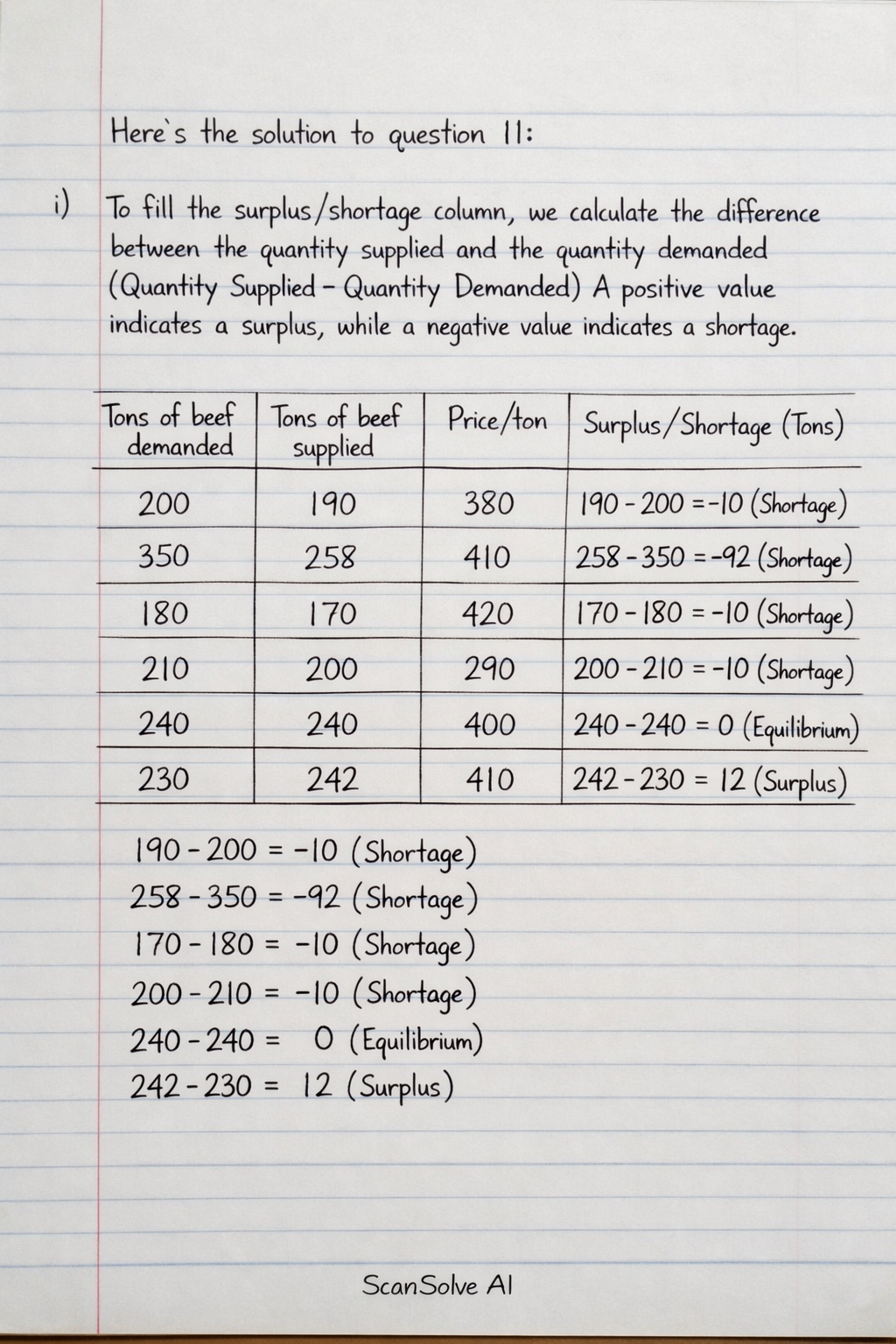
Here's the solution to question 11: i) To fill the surplus/shortage column, we calculate the difference between the quantity supplied and the quantity demanded (Quantity Supplied - Quantity Demanded). A positive value indicates a surplus, while a negative value indicates a shortage. | Tons of beef demanded | Tons of beef supplied | Price/ton | Surplus/Shortage (Tons) | | :-------------------- | :-------------------- | :-------- | :---------------------- | | 200 | 190 | 380 | 190 - 200 = -10 (Shortage) | | 350 | 258 | 410 | 258 - 350 = -92 (Shortage) | | 180 | 170 | 420 | 170 - 180 = -10 (Shortage) | | 210 | 200 | 290 | 200 - 210 = -10 (Shortage) | | 240 | 240 | 400 | 240 - 240 = 0 (Equilibrium) | | 230 | 242 | 410 | 242 - 230 = 12 (Surplus) | | 216 | 210 | 420 | 210 - 216 = -6 (Shortage) | ii) The equilibrium price and quantity levels occur where the quantity demanded equals the quantity supplied, resulting in zero surplus or shortage. From the table: The equilibrium price is \400/ton. The equilibrium quantity is 240 tons$. Send me the next one 📸