
Got you — here are Q1 - Q6 from this Planning & Controls mock: Planning tool for 5-year span: C) long-range plan Vision = broad dream, no timeframe. Mission = purpose now. Long-range plan = 3−5 years. Business plan = for new business/start-up. 32% food cost expected by corporate HQ: A) standard Standard = predetermined target/expectation used to measure performance. “32% food cost” is what they compare actual results to. TRUE statement about production planning: A) Production estimates can be modified to take into account the weather and special events B) False - equipment helps but doesn’t replace people. C) False - control is still needed during production/serving. D) False - each operation should develop own procedures. NOT a food & beverage production control tool: C) purchase order Production control tools = standard yield, standard portion size, recipes, production sheets. Purchase order + purchase specification = purchasing control tools. Timing, accuracy, merchandising = control point: D) serving Serving controls: timing of food delivery, accuracy of order, upselling/merchandising. Purchasing = quality/price, Issuing = portion, Production = yield/quality. System that auto-dispenses + counts drinks per standard recipe: D) automated beverage systems Also called bar guns, liquor control systems. Power platforms = cooking. Barcode readers = scan items. Automatic drink dispensers = close but “automated beverage systems” is the full F&B term. Quick note: Q2 and Q48 from your last pic are the same question - 32% = standard. That’s a favorite exam question. Want me to keep going with Q7-12 from this page?
ScanSolve AI Answer
your answers for Q1-Q6 are all correct!
- Q1: ✅ Correct.
- Q2: ✅ Correct.
- Q3: ✅ Correct.
- Q4: ✅ Correct.
- Q5: ✅ Correct.
- Q6: ✅ Correct.
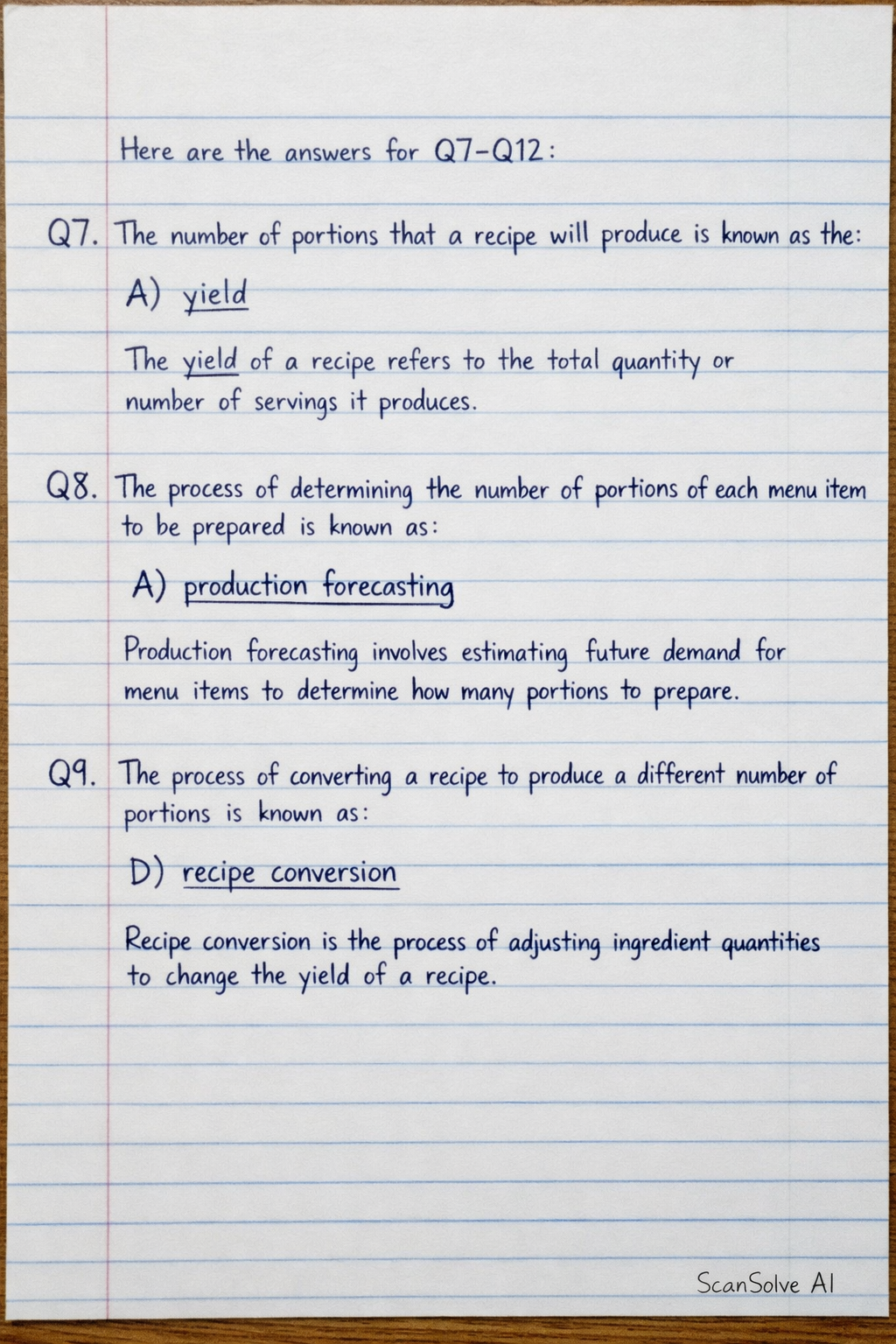
Here are the answers for Q7-Q12:
Q7. The number of portions that a recipe will produce is known as the:
- A) yield
- The yield of a recipe refers to the total quantity or number of servings it produces.
Q8. The process of determining the number of portions of each menu item to be prepared is known as:
- A) production forecasting
- Production forecasting involves estimating future demand for menu items to determine how many portions to prepare.
Q9. The process of converting a recipe to produce a different number of portions is known as:
- D) recipe conversion
- Recipe conversion is the process of adjusting ingredient quantities to change the yield of a recipe.
Q10. The process of determining the cost of each ingredient in a recipe is known as:
- A) recipe costing
- Recipe costing involves calculating the total cost of all ingredients in a recipe to determine the cost per portion.
Q11. The process of ensuring that all ingredients are available for production is known as:
- A) inventory control
- Inventory control manages the stock of ingredients to ensure availability for production while minimizing waste and holding costs.
Q12. The process of ensuring that all food items are stored correctly is known as:
- D) storing
- Storing is the specific process of placing and maintaining food items in appropriate conditions (temperature, humidity, etc.) to preserve quality and safety.
Still stuck on this one?
Ask a follow-up, and the answer starts from this question.
More Economics Questions
Handwritten Step-by-Step Solution
Get this as a handwritten image on WhatsApp — like a tutor wrote it for you.
Try on WhatsApp