
We read your photo as:
I. Perfect competition is a market structure characterized by a large number of buyers and sellers, homogeneous products, perfect information, and free entry and exit for firms. No single firm can i
ScanSolve AI Answer
Answer
Step-by-step solution
5 stepsPart a
i. Perfect competition is a market structure characterized by a large number of buyers and sellers, homogeneous products, perfect information, and free entry and exit for firms. No single firm can influence the market price.
ii. Monopolistic competition is a market structure with many firms selling differentiated products. There is free entry and exit, and each firm has some degree of market power due to product differentiation.
iii. Oligopoly is a market structure dominated by a small number of large firms. These firms are interdependent, meaning the actions of one firm significantly impact the others, and there are significant barriers to entry.
Part b(i)· 1 step
Step 1: Identify the equilibrium condition.
Equilibrium occurs where market demand equals market supply.
Locate the row in the table where market demand equals market supply.
From the table:
At a price of 20 FCFA, market demand is 60 kg and market supply is 60 kg.
The equilibrium price is 20 FCFA because at this price, the quantity demanded by consumers exactly matches the quantity supplied by producers, leading to no surplus or shortage in the market.
Part b(ii)
Step 1: Identify the initial and final prices and corresponding quantities supplied from the table.
Initial price () = 15 FCFA, initial quantity supplied () = 50 kg.
Final price () = 25 FCFA, final quantity supplied () = 70 kg.
Calculate the percentage change in quantity supplied using the midpoint formula.
Calculate the percentage change in price using the midpoint formula.
Calculate the price elasticity of supply (PES).
The price elasticity of supply is .
Part b(iii)· 1 step
Step 1: Compare the imposed price with the equilibrium price.
The equilibrium price is 20 FCFA. The government imposes a price of 30 FCFA.
Since 30 FCFA > 20 FCFA, the imposed price is above the equilibrium price.
Identify the name given to a government-imposed price above the equilibrium.
A government-imposed price set above the equilibrium price is called a price floor.
The name given to such a price is a price floor.
Try one yourself
A new problem that tests the same skill.
Still stuck on this one?
Ask a follow-up, and the answer starts from this question.
More Economics Questions
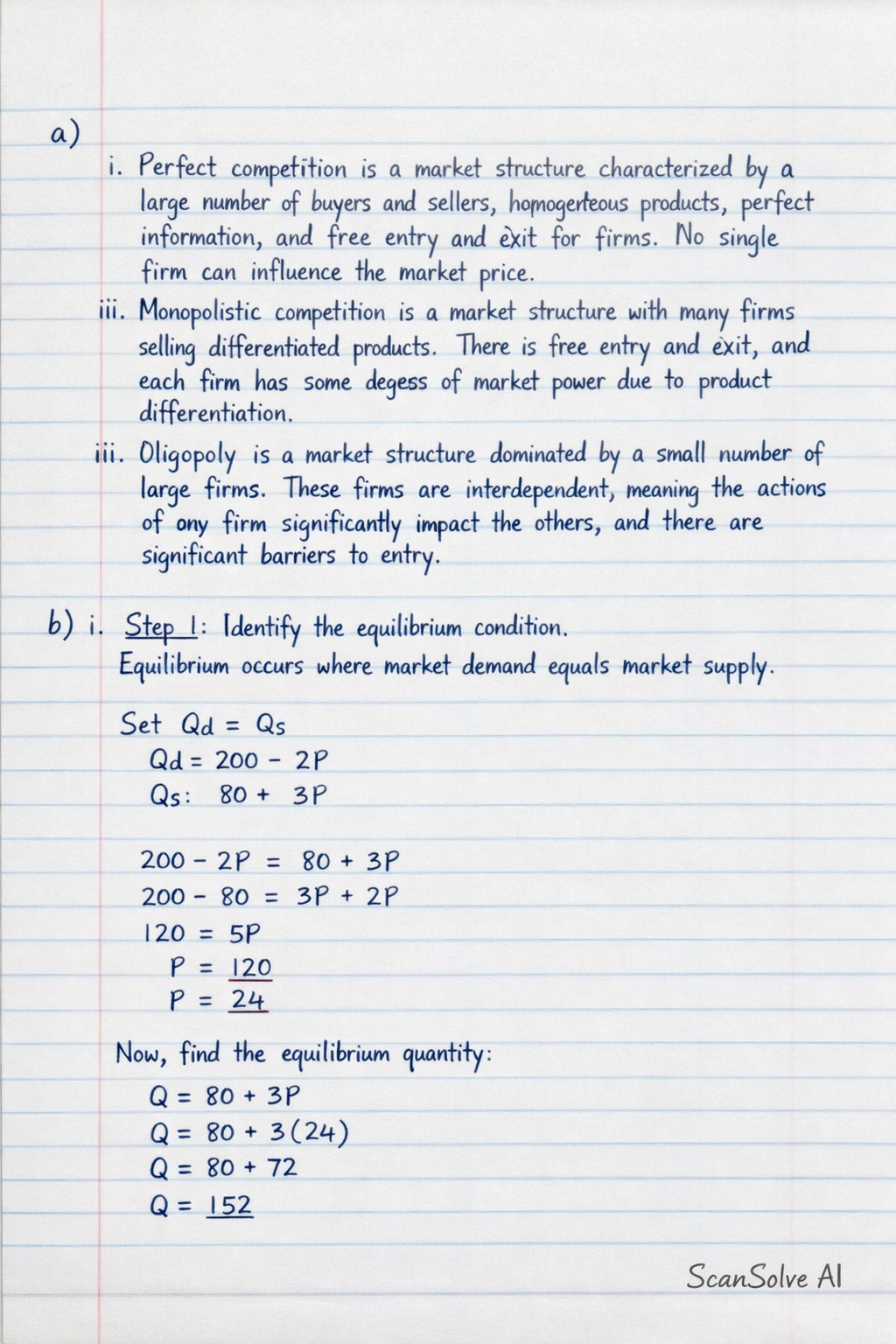
Handwritten Step-by-Step Solution
Get this as a handwritten image on WhatsApp — like a tutor wrote it for you.
Try on WhatsApp