
We read your photo as:
What are the functions of money in given scenarios, and name any four factors that can lead to inequality in wages?
Economics
ScanSolve AI Answer
Step-by-step solution
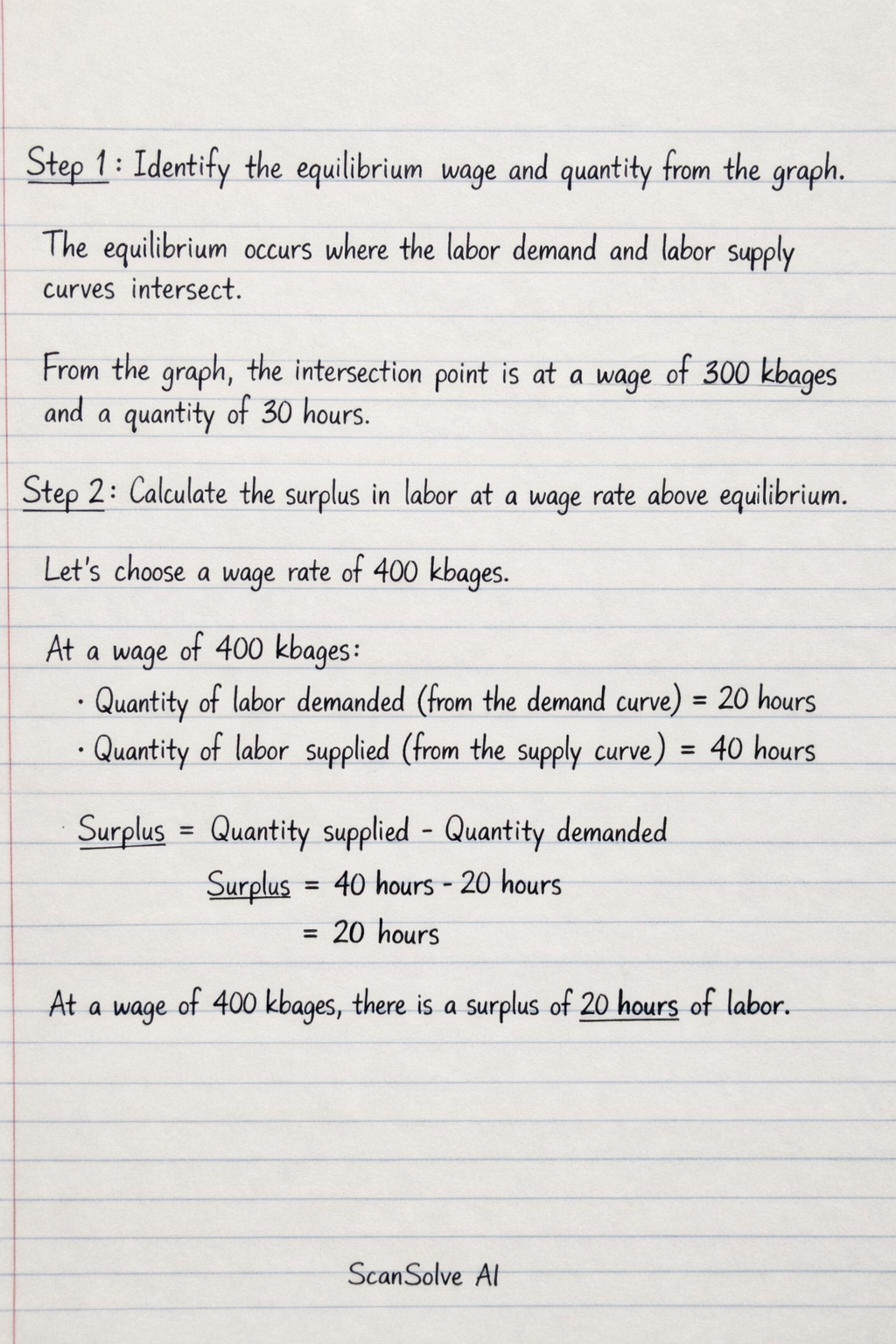
3 stepsIdentify the equilibrium wage and quantity from the graph.
The equilibrium occurs where the labor demand and labor supply curves intersect.
From the graph, the intersection point is at a wage of 300 kbages and a quantity of 30 hours.Calculate the surplus in labor at a wage rate above equilibrium.
Let's choose a wage rate of 400 kbages.
At a wage of 400 kbages:- Quantity of labor demanded (from the demand curve) = 20 hours
- Quantity of labor supplied (from the supply curve) = 40 hours Surplus = Quantity supplied - Quantity demanded
At a wage of 400 kbages, there is a surplus of 20 hours of labor.
Calculate the shortage in labor at a wage rate below equilibrium.
Let's choose a wage rate of 200 kbages.
At a wage of 200 kbages:- Quantity of labor demanded (from the demand curve) = 40 hours
- Quantity of labor supplied (from the supply curve) = 20 hours Shortage = Quantity demanded - Quantity supplied
At a wage of 200 kbages, there is a shortage of 20 hours of labor.
The shortage and surplus in labor demand are:
- At a wage of 400 kbages, there is a surplus of 20 hours.
- At a wage of 200 kbages, there is a shortage of 20 hours.
Was this helpful?
Still stuck on this one?
Ask a follow-up, and the answer starts from this question.
Got a different question?Ask your own question
More Economics Questions
QName 2 functions of Trade unions. 14. Differentiate - Money wages and Real wages - Creeping…QWhat factors should a person consider when setting wage expectations list at least 4 factorsQWhat are the main aims of the Division of Labour and which function of money solves the problem of…QIdentify motives for demand of money, factors determining money demanded by traders, define money…QWhat are the functions, motives for demand, and characteristics of money, with specific reference to…
Handwritten Step-by-Step Solution
Get this as a handwritten image on WhatsApp — like a tutor wrote it for you.
Try on WhatsApp