

This economics question tests your understanding of economic models and analysis. The step-by-step answer below applies the relevant framework and explains the reasoning.
ScanSolve AI Answer
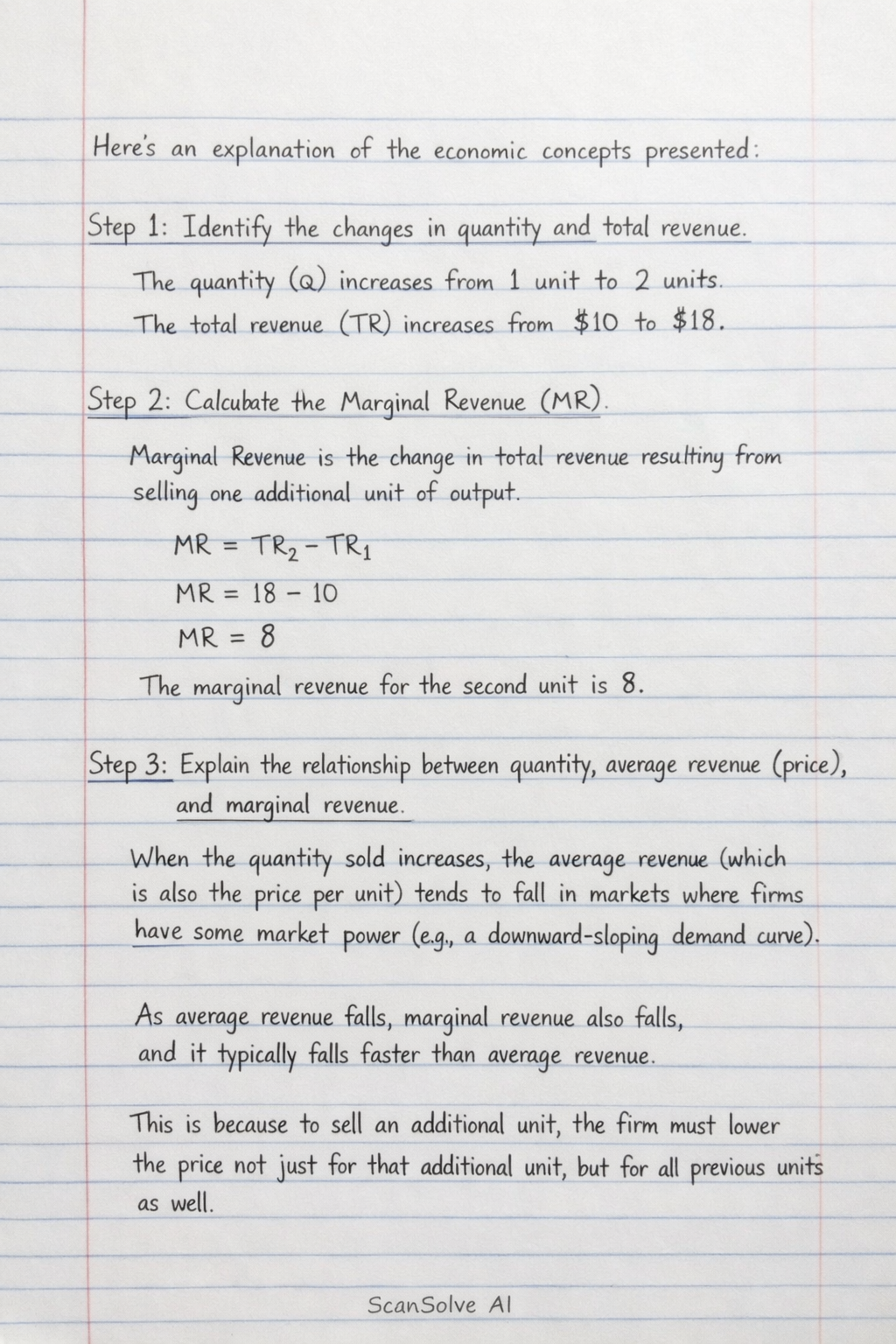
Here's an explanation of the economic concepts presented: Step 1: Identify the changes in quantity and total revenue. The quantity (Q) increases from 1 unit to 2 units. The total revenue (TR) increases from 10 to 18. Step 2: Calculate the Marginal Revenue (MR). Marginal Revenue is the change in total revenue resulting from selling one additional unit of output. MR = TR_2 - TR_1 MR = 18 - 10 MR = 8 The marginal revenue for the second unit is 8. Step 3: Explain the relationship between quantity, average revenue (price), and marginal revenue. When the quantity sold increases, the average revenue (which is also the price per unit) tends to fall in markets where firms have some market power (e.g., a downward-sloping demand curve). As average revenue falls, marginal revenue also falls, and it typically falls faster than average revenue. This is because to sell an additional unit, the firm must lower the price not just for that additional unit, but for all previous units as well. The observation is: When quantity (Q) increases, the average revenue (AR, or price) falls, and the marginal revenue (MR) also falls. This demonstrates a common relationship in economics where, for a firm facing a downward-sloping demand curve, marginal revenue is less than average revenue (price) and both decline as more units are sold. What's next? Send 'em 📸