
We read your photo as:
When Q increase from 1 to 2 TR increase from 10+18=28. MR = 18−10=8. Noticed that Q is increase, Price = AR is falls and MR falls
ScanSolve AI Answer
Step-by-step solution
2 stepsHere's a verification of your notes:
Verify the Marginal Revenue (MR) calculation.
Marginal Revenue (MR) is the change in total revenue () divided by the change in quantity ().
Given:
When increases from 1 to 2, increases from 10 to 18.Your calculation is correct.
Verify the observation about Price, Average Revenue (AR), and Marginal Revenue (MR).
In markets where a firm has some market power (e.g., monopoly, monopolistic competition), to sell more quantity ( increases), the firm must lower its price. Since Average Revenue (AR) is equal to Price (), if the price falls, then AR also falls. When AR is falling, MR will always be less than AR and will also be falling. This is a fundamental relationship in such market structures.
Your observation that "when increases, Price = AR falls and MR falls" is correct.✅ Correct. All your calculations and observations are accurate based on the principles of marginal revenue and average revenue.
Still stuck on this one?
Ask a follow-up, and the answer starts from this question.
More Economics Questions
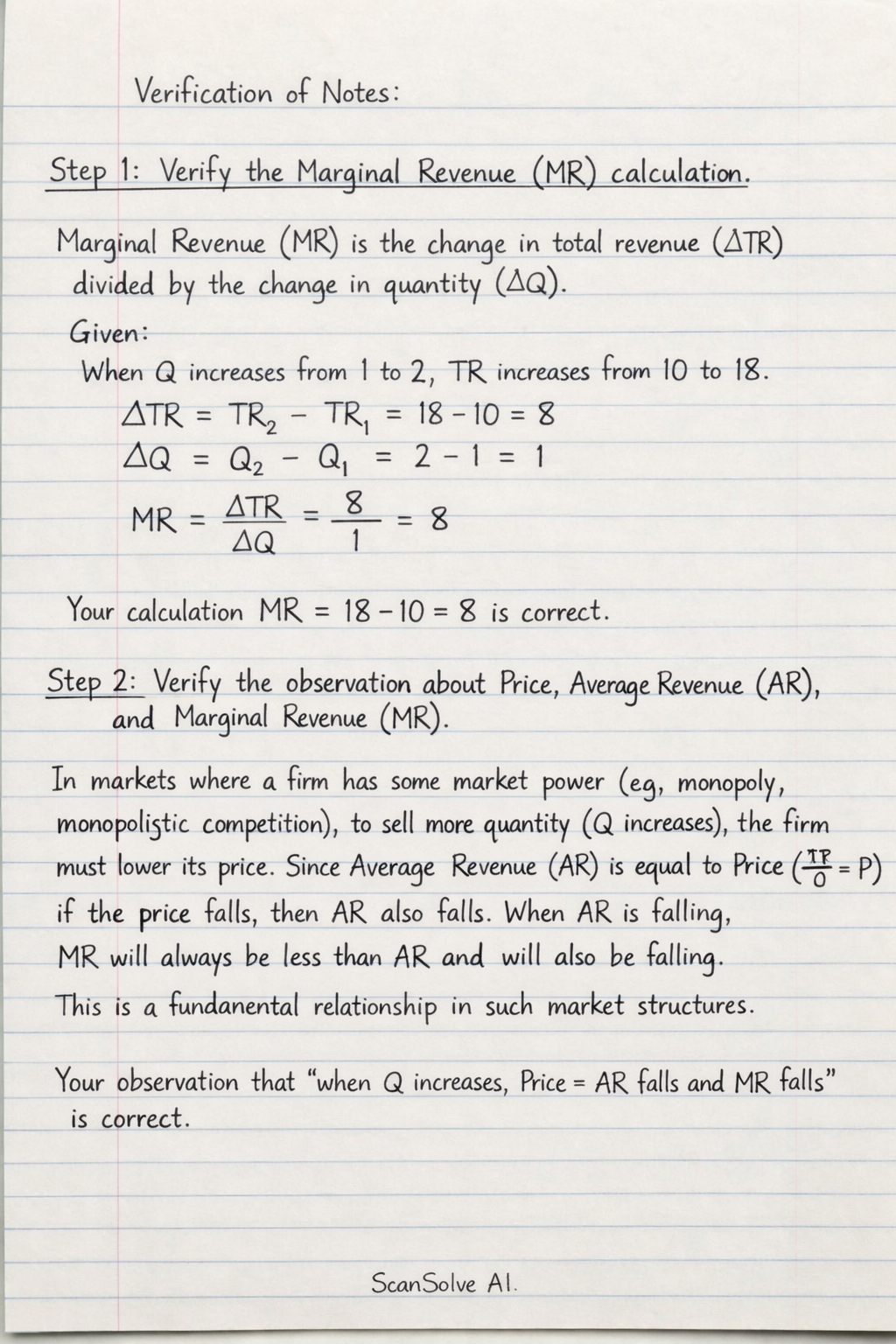
Handwritten Step-by-Step Solution
Get this as a handwritten image on WhatsApp — like a tutor wrote it for you.
Try on WhatsApp