
We read your photo as:
Match the economic terms to their descriptions.
Economics
ScanSolve AI Answer
here are the economic terms for each description:
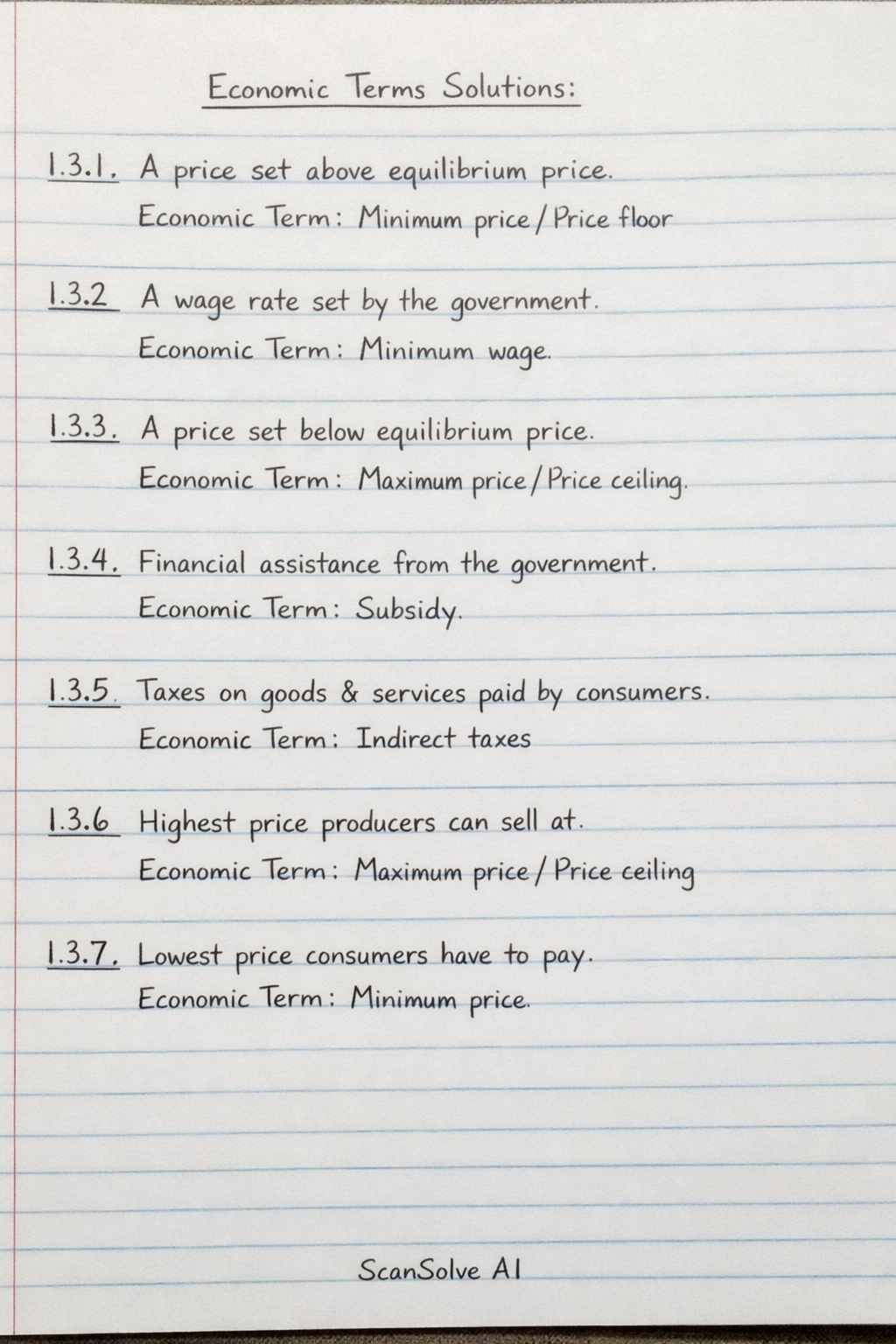
- 1.3.1 A price set above the equilibrium price/market price to allow producers to make a fair profit.
- Economic Term: Minimum price / Price floor
- 1.3.2 A wage rate set by the government, below which no employer can pay their workers and it is set above the equilibrium wage rate.
- Economic Term: Minimum wage
- 1.3.3 A price set below the equilibrium price/market price to make goods affordable.
- Economic Term: Maximum price / Price ceiling
- 1.3.4 A financial assistance given by the government to businesses or individuals.
- Economic Term: Subsidy
- 1.3.5 Taxes levied on goods and services before they reach the consumer but ultimately paid by the consumer as part of the market price.
- Economic Term: Indirect taxes
- 1.3.6 The highest price at which producers can sell a product.
- Economic Term: Maximum price / Price ceiling
- 1.3.7 The lowest price consumers have to pay.
- Economic Term: Minimum price / Price floor
- 1.3.8 The lowest wage an employer is allowed to pay an employee.
- Economic Term: Minimum wage
- 1.3.9 Taxes specifically calculated on the income of individuals and companies.
- Economic Term: Direct taxes
- 1.3.10 Taxes charged on goods that the government believes are harmful to human health.
- Economic Term: Sin tax / Excise duty
- 1.3.11 Central government, provincial governments, local governments, and state-owned enterprises.
- Economic Term: Public sector
- 1.3.12 A product that society values and everyone should have.
- Economic Term: Merit goods
- 1.3.13 Costs incurred by individuals or companies for goods and services.
- Economic Term: Costs of production
Was this helpful?
Still stuck on this one?
Ask a follow-up, and the answer starts from this question.
Got a different question?Ask your own question
More Economics Questions
QComplete the following matching exercise and define the given economic terms.QMatch the terms in Part III with their correct descriptions.QMatch the words and phrases with their definitions.QFill in the blanks for the following statements related to business and economics.QDefine the following economic terms: comparative cost advantage, tariff, balance of trade, internal…
Handwritten Step-by-Step Solution
Get this as a handwritten image on WhatsApp — like a tutor wrote it for you.
Try on WhatsApp