
We read your photo as:
Study the graph below and answer the questions that follow.
ScanSolve AI Answer
Step-by-step solution
4 stepsHere are the answers to your questions:
Part 4.13
Study the graph below and answer the questions that follow.
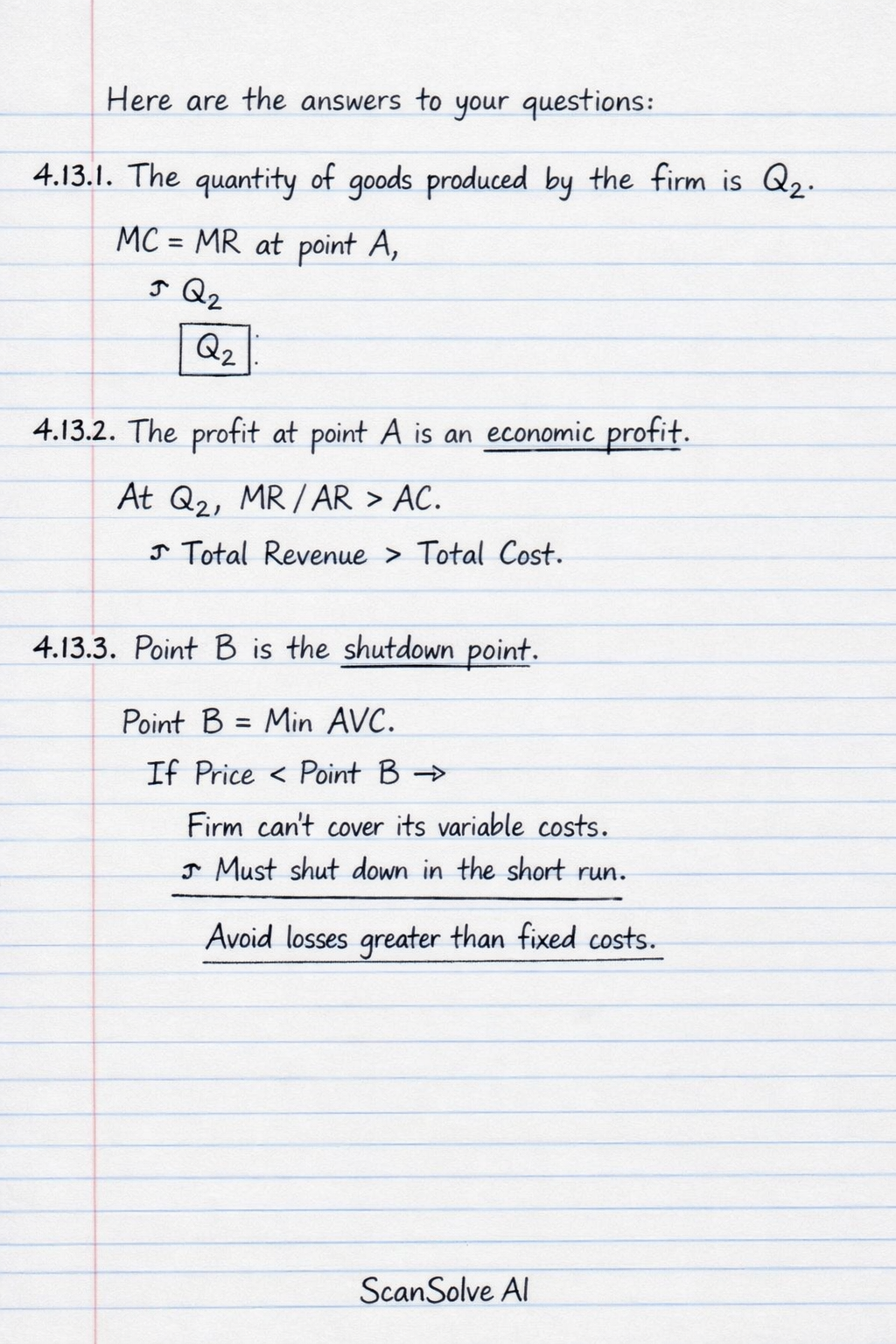
4.13.1. The quantity of goods that will be produced by the individual firm is .
Reason: A firm maximizes its profit by producing at the output level where its . In the graph, the MC curve intersects the MR curve at point A, which corresponds to the quantity Q2.
4.13.2. The profit depicted by point A is an . This is because at quantity Q2, the market price (MR/AR) is above the Average Cost (AC) curve, indicating that total revenue exceeds total cost.
4.13.3. Point B is the . It represents the minimum point of the Average Variable Cost (AVC) curve. Its importance is that if the market price falls below point B, the firm cannot even cover its variable costs of production. In the short run, the firm should shut down production to minimize its losses, as continuing to produce would result in losses greater than its fixed costs.
Part 4.14· 4 steps
Study the graph below and answer the questions that follow.
4.14.1. The market structure depicted in the graph above is .
4.14.2. The profit maximisation point in the above graph is .
4.14.3. The demand curve (MR/AR/DD) for an individual firm in perfect competition is . It is a horizontal line at the market price, indicating that the firm can sell any quantity at the prevailing market price but none at a higher price.
4.14.4. The output level of a perfect competitor is determined where . This is the profit-maximizing output level for the firm.
4.14.5. Calculate the profit/loss of the individual firm above. Show ALL calculations.
Identify Price (P), Average Cost (AC), and Quantity (Q) at profit maximization.
From the graph:
Calculate Total Revenue (TR).
Calculate Total Cost (TC).
Calculate Profit/Loss.
The individual firm is making an .
Still stuck on this one?
Ask a follow-up, and the answer starts from this question.
More Economics Questions
Handwritten Step-by-Step Solution
Get this as a handwritten image on WhatsApp — like a tutor wrote it for you.
Try on WhatsApp