
We read your photo as:
What are the answers to the following economics questions regarding import-substitution, money supply, and calculating available loans for a commercial bank?
ScanSolve AI Answer
Answer
Step-by-step solution
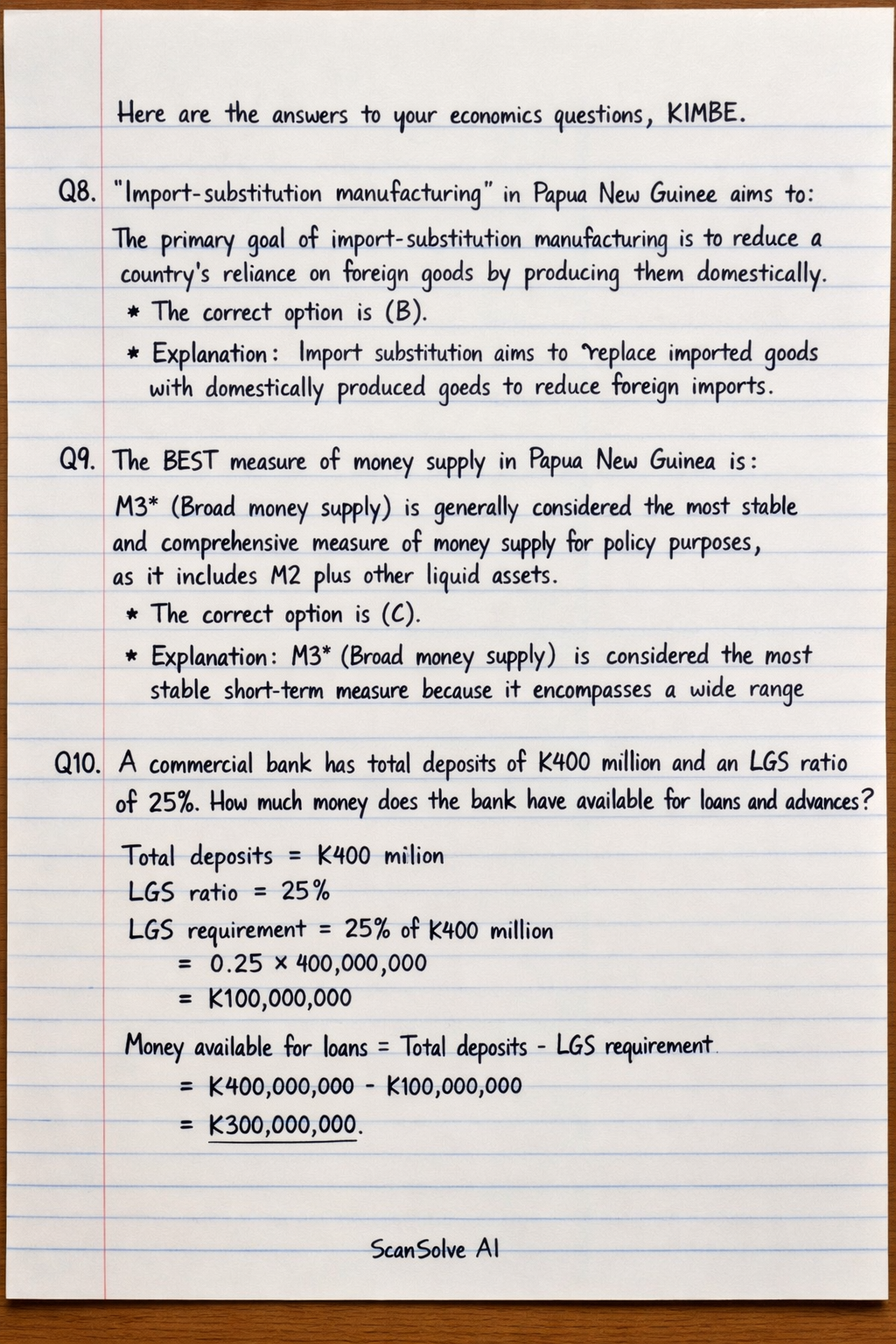
2 stepsHere are the answers to your economics questions, KIMBE.
Q8. 'Import-substitution manufacturing' in Papua New Guinea aims to:
The primary goal of import-substitution manufacturing is to reduce a country's reliance on foreign goods by producing them domestically.
- The correct option is (B).
- Explanation: Import substitution aims to replace imported goods with domestically produced goods to reduce foreign imports.
Q9. The BEST measure of money supply in Papua New Guinea is:
M3* (Broad money supply) is generally considered the most stable and comprehensive measure of money supply for policy purposes, as it includes M2 plus other liquid assets.
- The correct option is (C).
- Explanation: M3* (Broad money supply) is considered the most stable short-term measure because it encompasses a wide range of liquid assets.
Q10. A commercial bank has total deposits of K400 million and an LGS ratio of 25%. How much money does the bank have available for loans and advances?
Calculate the amount of deposits held as reserves (Liquid Assets).
Calculate the amount available for loans and advances.
- The correct option is (B).
- The bank has available for loans and advances.
Q11. The Bank Credit Multiplier formula is:
The Bank Credit Multiplier is the reciprocal of the reserve ratio (LGS ratio). If the LGS ratio is expressed as a percentage, the formula is .- The correct option is (C).
- Explanation: The formula for the Bank Credit Multiplier is (if LGS ratio is a decimal) or (if LGS ratio is a percentage).
Q12. The Quantity Theory of Money equation MV = PT states that if the money supply (M) increases while velocity (V) and real output (T) remain constant, the result will be:
According to the Quantity Theory of Money, if M increases and V and T are constant, then P (the price level) must increase proportionally. An increase in the price level is inflation.- The correct option is (B).
- Explanation: An increase in the money supply (M) with constant velocity (V) and real output (T) directly leads to an increase in the price level (P), which is inflation.
Q13. Which of the following is an instrument of RESTRICTIVE (tight) monetary policy used by BPNG during inflation?
Restrictive monetary policy aims to reduce the money supply to combat inflation. Selling government securities removes money from circulation.- The correct option is (D).
- Explanation: Selling government securities to commercial banks reduces the banks' reserves, thereby decreasing their ability to lend and contracting the money supply, which is a restrictive policy.
Q14. A DEFICIT BUDGET occurs when:
A deficit budget means the government's spending exceeds its revenue.- The correct option is (B).
- Explanation: A deficit budget occurs when government expenditure EXCEEDS government tax revenue.
Q15. Which type of tax increases as a PERCENTAGE of income as income rises — higher earners pay a larger proportion?
This describes a progressive tax system, where the tax rate increases with the taxpayer's income.- The correct option is (C).
- Explanation: A progressive tax is one where the tax rate increases as the taxable amount increases, meaning higher earners pay a larger proportion of their income in tax.
Q16. Which of the following CORRECTLY describes 'tax incidence'?
Tax incidence refers to the ultimate economic burden of a tax, not who is legally required to pay it.- The correct option is (B).
- Explanation: Tax incidence refers to who actually bears the final economic burden of a tax, which may not always be the party legally responsible for paying it.
Try one yourself
A new problem that tests the same skill.
Still stuck on this one?
Ask a follow-up, and the answer starts from this question.
More Economics Questions
Handwritten Step-by-Step Solution
Get this as a handwritten image on WhatsApp — like a tutor wrote it for you.
Try on WhatsApp