
We read your photo as:
What are the functions, motives for demand, and characteristics of money, with specific reference to Kenyan currency?
ScanSolve AI Answer
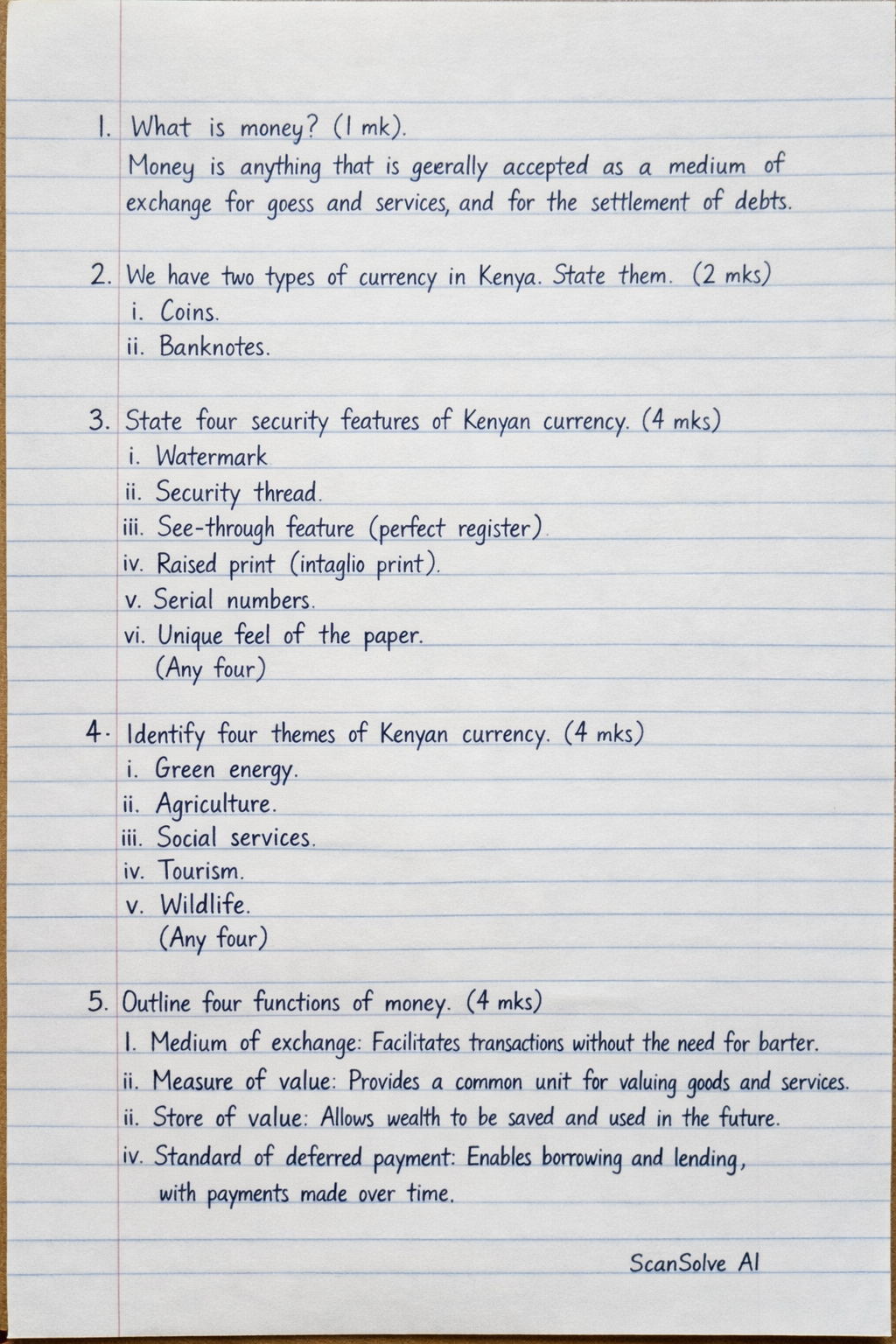
1. What is money? (1 mk)
Money is anything that is generally accepted as a medium of exchange for goods and services, and for the settlement of debts.
2. We have two types of currency in Kenya. State them. (2 mks)
i. Coins
ii. Banknotes
3. State four security features of Kenyan currency. (4 mks)
i. Watermark
ii. Security thread
iii. See-through feature (perfect register)
iv. Raised print (intaglio print)
v. Serial numbers
vi. Unique feel of the paper
(Any four)
4. Identify four themes of Kenyan currency. (4 mks)
i. Green energy
ii. Agriculture
iii. Social services
iv. Tourism
v. Wildlife
(Any four)
5. Outline four functions of money. (4 mks)
i. Medium of exchange: Facilitates transactions without the need for barter.
ii. Measure of value: Provides a common unit for valuing goods and services.
iii. Store of value: Allows wealth to be saved and used in the future.
iv. Standard of deferred payment: Enables borrowing and lending, with payments made over time.
6. List three motives for demand for money. (3 mks)
i. Transactions motive: Holding money for everyday purchases and expenses.
ii. Precautionary motive: Holding money for unforeseen emergencies or unexpected expenses.
iii. Speculative motive: Holding money to take advantage of future investment opportunities, especially in financial assets.
7. Outline four factors that determine supply of money in the economy. (4 mks)
i. Monetary policy of the Central Bank: Actions like setting interest rates or conducting open market operations.
ii. Commercial banks' lending activities: The extent to which banks create credit through loans.
iii. Government borrowing: When the government borrows from the Central Bank or commercial banks.
iv. Balance of payments: Surpluses or deficits can affect the amount of foreign currency and thus the money supply.
v. Public's desire to hold cash: If the public holds less cash, more money is available for banks to lend.
(Any four)
8. State two actions by the Central Bank that influence the amount of money in circulation. (4 mks)
i. Open Market Operations (OMO): Buying or selling government securities to inject or withdraw money from the economy.
ii. Changing the Cash Reserve Ratio (CRR): Adjusting the percentage of deposits that commercial banks must hold, affecting their lending capacity.
iii. Adjusting the Discount Rate (Bank Rate): Changing the interest rate at which commercial banks can borrow from the Central Bank, influencing their lending rates.
iv. Selective Credit Control: Directing commercial banks to lend or not lend to certain sectors.
(Any two)
9. State four ethical practices for financial transactions. (4 mks)
i. Transparency: Clearly disclosing all terms, conditions, and fees.
ii. Fairness: Treating all customers equitably and avoiding discriminatory practices.
iii. Confidentiality: Protecting sensitive customer information.
iv. Integrity: Acting honestly and avoiding conflicts of interest.
v. Accountability: Taking responsibility for actions and decisions.
(Any four)
10. What is a business goal? (1 mk)
A business goal is a specific, measurable objective that a business aims to achieve within a defined timeframe, guiding its operations and strategies.
11. Highlight four importance of goal setting in business. (4 mks)
i. Provides direction: Goals give a clear path for the business to follow.
ii. Motivates employees: Clear goals can inspire employees to work towards common objectives.
iii. Facilitates planning: Goals serve as a basis for developing strategies and action plans.
iv. Enables performance measurement: Goals provide benchmarks against which actual performance can be evaluated.
v. Improves decision-making: Goals help in prioritizing tasks and making informed choices.
(Any four)
12. Outline four factors that should be considered when setting business goals. (4 mks)
i. Resources available: Ensuring the business has the necessary financial, human, and physical resources.
ii. Timeframe: Setting realistic deadlines for achieving the goals.
iii. Market conditions: Considering the current economic climate, competition, and customer demand.
iv. Stakeholder interests: Aligning goals with the expectations of owners, employees, customers, and suppliers.
v. Legal and ethical considerations: Ensuring goals comply with laws and ethical standards.
(Any four)
13. State what each letter represents in SMART in relation to business goals. (5 mks)
i. S: Specific – Goals should be clear and well-defined.
ii. M: Measurable – Goals should have quantifiable criteria for tracking progress.
iii. A: Achievable – Goals should be realistic and attainable.
iv. R: Relevant – Goals should align with the overall business objectives.
v. T: Time-bound – Goals should have a defined start and end date.
14. Identify each motive for demand of money described below. (3 mks)
a. To cater for emergencies – Precautionary motive
b. To cater for daily expenses such as food – Transactions motive
c. To invest so as to earn interest – Speculative motive
15. State four factors that determine the amount of money demanded by a trader. (4 mks)
i. Level of income/sales: Higher income or sales generally lead to a higher demand for money for transactions.
ii. Interest rates: Higher interest rates on alternative assets may reduce the demand for holding money.
iii. Price level: Higher prices for goods and services increase the amount of money needed for transactions.
iv. Frequency of income receipts: Less frequent income receipts may lead to holding more money.
v. Availability of credit: Easy access to credit may reduce the need to hold large money balances.
(Any four)
16. Define the following terms. (4 mks)
a. Demand for money: The desire by individuals and businesses to hold money in liquid form rather than investing it in assets.
b. Supply of money: The total amount of currency and other liquid assets in an economy at a particular time.
c. Money balances: The amount of money that individuals or firms hold in their accounts or as cash at any given time.
17. State four unethical practices in business transactions. (4 mks)
i. Bribery: Offering or accepting something of value to influence a decision.
ii. Fraud: Deceiving others for personal gain, such as false advertising or misrepresentation.
iii. Insider trading: Using confidential information for personal financial advantage.
iv. Price fixing: Colluding with competitors to set prices at an artificial level.
v. Exploitation of labor: Underpaying workers, unsafe working conditions, or child labor.
vi. Environmental damage: Disregarding environmental regulations for profit.
(Any four)
Still stuck on this one?
Ask a follow-up, and the answer starts from this question.
More Economics Questions
Handwritten Step-by-Step Solution
Get this as a handwritten image on WhatsApp — like a tutor wrote it for you.
Try on WhatsApp