
We read your photo as:
Explain the three stages of production with a table and calculate AP and MP.
ScanSolve AI Answer
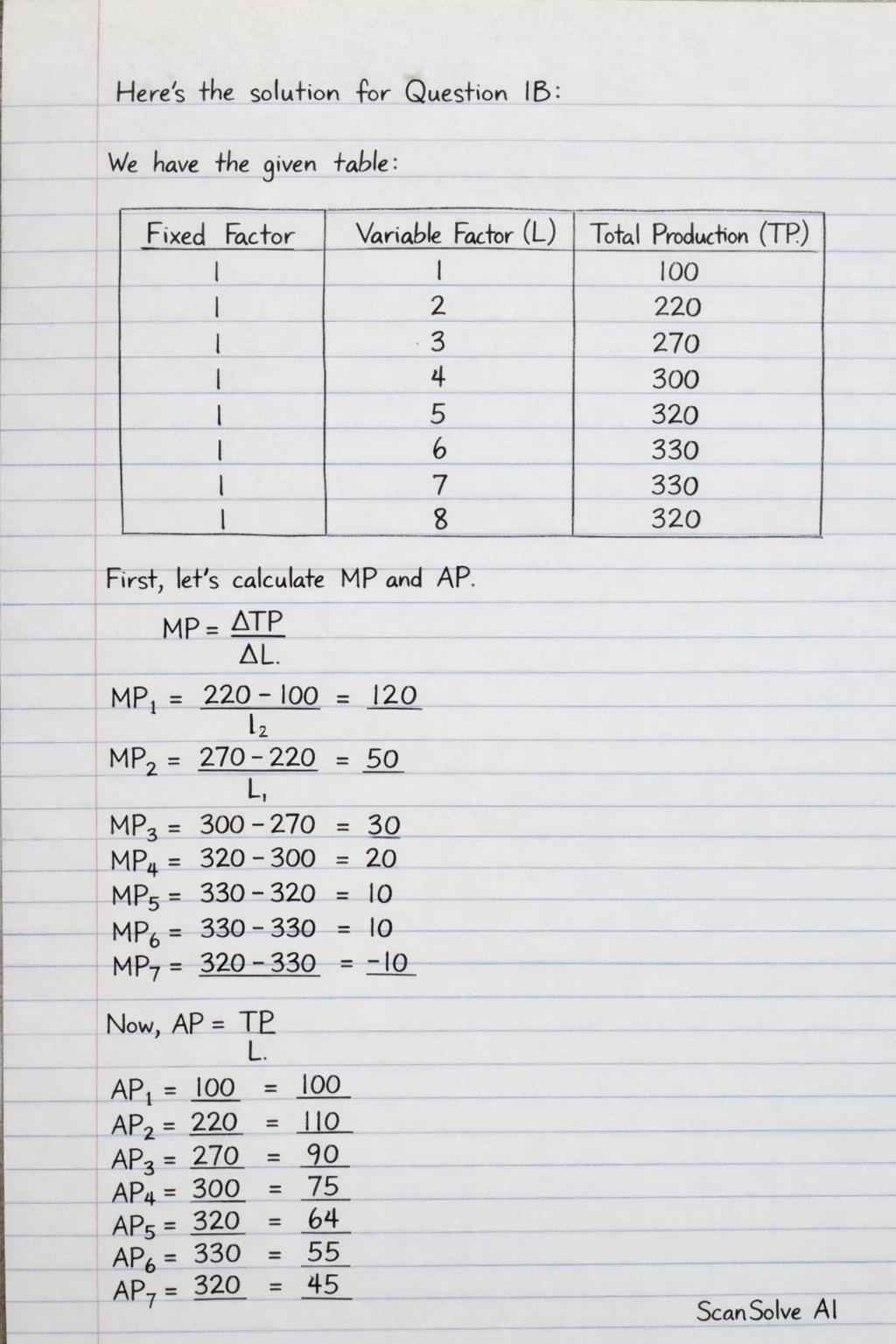
Here's the solution for Question 1B:
Q1B) The behavior of output when the varying quantity of one factor is combined with fixed quantity of other can be divided into three stages as reflected in the table below.
Given table:
| Fixed factor | Variable Factor (L) | Total Production (TP) |
|---|---|---|
| 1 | 1 | 100 |
| 1 | 2 | 220 |
| 1 | 3 | 270 |
| 1 | 4 | 300 |
| 1 | 5 | 320 |
| 1 | 6 | 330 |
| 1 | 7 | 330 |
| 1 | 8 | 320 |
Step 1: Calculate Average Product (AP) and Marginal Product (MP).
Average Product (AP) is calculated as .
Marginal Product (MP) is calculated as .
| Variable Factor (L) | Total Production (TP) | Average Product (AP) | Marginal Product (MP) |
|---|---|---|---|
| 1 | 100 | N/A | |
| 2 | 220 | ||
| 3 | 270 | ||
| 4 | 300 | ||
| 5 | 320 | ||
| 6 | 330 | ||
| 7 | 330 | ||
| 8 | 320 |
i) Average Product:
The calculated Average Product values are:
- L=1: 100
- L=2: 110
- L=3: 90
- L=4: 75
- L=5: 64
- L=6: 55
- L=7: 47.14
- L=8: 40
ii) Marginal Product:
The calculated Marginal Product values are:
- L=1: N/A (or 100 if considering the first unit's output from zero)
- L=2: 120
- L=3: 50
- L=4: 30
- L=5: 20
- L=6: 10
- L=7: 0
- L=8: -10
iii) Perspective three stages:
The three stages of production are defined by the behavior of Total Product (TP), Average Product (AP), and Marginal Product (MP).
-
Stage I: Increasing Returns In this stage, Total Product (TP) increases at an increasing rate. Marginal Product (MP) is increasing and is greater than Average Product (AP). Average Product (AP) is also increasing. This stage ends when AP reaches its maximum. Based on the calculations, Stage I occurs when the Variable Factor (L) is from 1 to 2. At L=2, AP is maximized at 110.
-
Stage II: Diminishing Returns In this stage, Total Product (TP) continues to increase, but at a decreasing rate. Marginal Product (MP) is positive but decreasing, and it is less than Average Product (AP). Average Product (AP) is decreasing. This stage is considered the rational stage of production for a firm, as MP is still positive. This stage ends when MP becomes zero. Based on the calculations, Stage II occurs when the Variable Factor (L) is from 3 to 7. At L=7, MP becomes zero, and TP is at its maximum (330).
-
Stage III: Negative Returns In this stage, Total Product (TP) begins to decrease. Marginal Product (MP) is negative. A firm would never operate in this stage because adding more variable input actually reduces total output. Based on the calculations, Stage III occurs when the Variable Factor (L) is 8 and beyond. At L=8, MP is -10, and TP decreases to 320.
Still stuck on this one?
Ask a follow-up, and the answer starts from this question.
More Economics Questions
Handwritten Step-by-Step Solution
Get this as a handwritten image on WhatsApp — like a tutor wrote it for you.
Try on WhatsApp