
Attempt any nine of the following short questions. Each question carries 4 marks. Solve the system of equations x - 4y = - 10 and 2x + 3y = 2 using Cramer's rule. ii. Simplify (sqrt(9x ^ 4 y ^ 2))/(root(27x ^ 6 y ^ 12, 3)) iii. Find the value of x from the equation log(x) = 3.8621 iv. Simplify the rational expression 1/(3x - 6) * (3x + 6)/(2x ^ 2 - 32) v. II 2x-1 is a factor of 24 + kx + 3 find the value of k. x + 1/x and vi. If x = sqrt(15) − 4 find the value of x ^ 2 + 1/(x ^ 2) vii. Find LCM of the polynomials x ^ 2 - 34 + 5x + 2 and x ^ 3 - 3x ^ 2 - x + 3 vii. Solve the radical equation sqrt(5x - 3) - sqrt(3x + 1) = 0 ix. Solve the inequality (3x)/4 + 2 >= (2x - 5)/3 and plot the solution on number line. x. Prove that the points A(1, 2) B(1, 8) and C(5,2) are the vertices of right angled triangle. xi. Prove that in any correspondence of two triangles, if three sides of one triangle are congruent to corresponding three sides of the other, the two triangles are congruent. xii. Prove that the line segment joining the midpoints of two sides of a triangle, is parallel to the third side and is equal to one half of its length. SECTION-C Mark NOTE: Attempt any four of the following questions. Each question carries 6 marks. 2. Prove that any point on the right bisector of a line segment is equidistant from its end points. 1 1+1- 3. Prove that if two sides of a triangle are unequal in length, the longer side has an angle of greater measure opposite to it. 1 + 1 + 4. Prove that if a line segment intersects the two sides of a triangle in the same ratio then it is parallel to the third side. 1 + 1 + 5. Prove that in a right angled triangle, the square of the length of hypotenuse is equal to the sum of the squares of the length of the other two sides. 1 + 1 + 6. Prove that parallelogram on the equal bases and having same altitude are equal in area. 1 + 1 + 7. Construct a quadrilateral ABCD such that m overline AB = 5cm m overline BC = 6cm . m angle A = 100 deg m angle B = 60 deg m angle C = 110 deg 1 + 1 +
English
ScanSolve AI Answer
Step-by-step solution
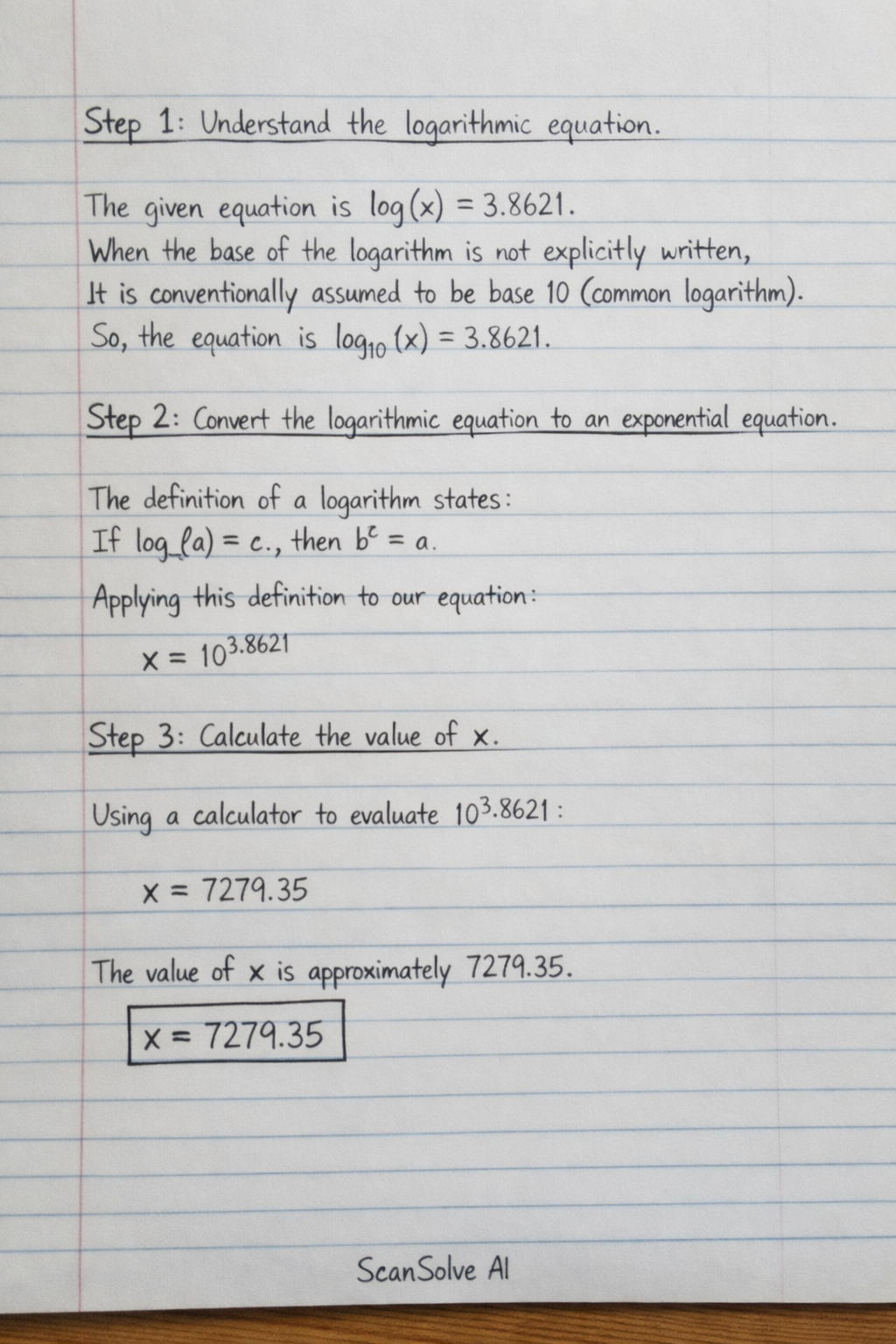
3 stepsUnderstand the logarithmic equation.
The given equation is . When the base of the logarithm is not explicitly written, it is conventionally assumed to be base 10 (common logarithm).
So, the equation is .Convert the logarithmic equation to an exponential equation.
The definition of a logarithm states that if , then .
Applying this definition to our equation:Calculate the value of .
Using a calculator to evaluate :
The value of is approximately 7279.35.
Was this helpful?
Still stuck on this one?
Ask a follow-up, and the answer starts from this question.
Got a different question?Ask your own question
More English Questions
QHere are 100 JAMB Mathematics practice questions in a clean, copyable format based on the official…QANSWER ANY FOUR Questions 1)Construct an Equilateral triangle ABC, given AB=50mm 2)Construct an…QShow that the points A(5,−6), B(−3,0) and C(−1,2) form an isosceles triangle. 2) Show that the…QProve the given geometry problems. Problem 1: In ABC, AE=EB and EF||BC. In ACD, FG||CD. Prove AG=GD…Q📚 WASSCE 2026 | CORE MATHEMATICS Paper 2 — 10 Practice Questions that may appear Section A…
Handwritten Step-by-Step Solution
Get this as a handwritten image on WhatsApp — like a tutor wrote it for you.
Try on WhatsApp