
We read your photo as:
Plot a graph of M against e on graph sheet
ScanSolve AI Answer
Step-by-step solution
2 stepsHere are the solutions to your questions.
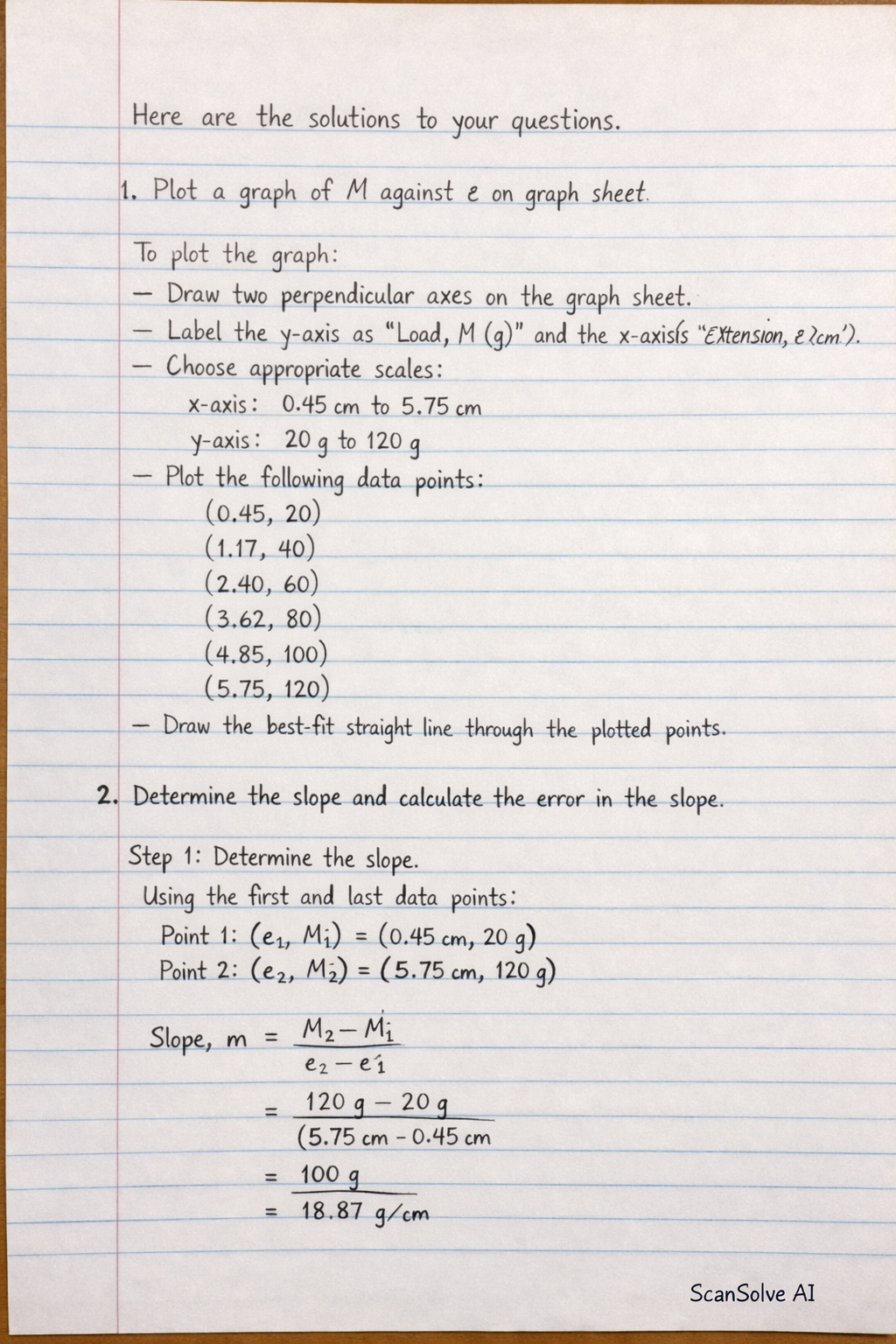
1. Plot a graph of M against e on graph sheet
To plot the graph:
- Draw two perpendicular axes on the graph sheet.
- Label the y-axis as "Load, M (g)" and the x-axis as "Extension, e (cm)".
- Choose appropriate scales for both axes to accommodate the range of values. For the x-axis (extension), values range from 0.45 cm to 5.75 cm. For the y-axis (load), values range from 20 g to 120 g.
- Plot the following data points:
- $(0.45, 20)$
- $(1.17, 40)$
- $(2.40, 60)$
- $(3.62, 80)$
- $(4.85, 100)$
- $(5.75, 120)$
- Draw the best-fit straight line through the plotted points.
2. Determine the slope and calculate the error in the slope
Determine the slope.
Using the first and last data points from the table for the best-fit line:
Point 1:
Point 2:The slope is calculated as:
Rounding to three significant figures:
The slope is .
Calculate the error in the slope.
The calculation of the error in the slope requires information about the uncertainties in the individual measurements of load (M) and extension (e). Since these uncertainties are not provided in the table or problem description, the error in the slope cannot be calculated.
3. State two precautions you took to ensure accurate result
Two precautions to ensure accurate results are:
- Avoid parallax error by ensuring the eye is level with the pointer when taking readings from the scale.
- Ensure the spring or wire is vertical and completely at rest (not oscillating) before taking any pointer readings.
4. Deduce from your graph the value of N
To deduce the value of N from the graph, the extension caused by the unknown mass N is required. This would involve knowing the "Initial reading of the pointer" (at 0g) and the "pointer reading" when mass N is alone on the hanger. This information is not provided in the problem statement or the table. Therefore, the value of N cannot be deduced from the given data.
Still stuck on this one?
Ask a follow-up, and the answer starts from this question.
More English Questions
Handwritten Step-by-Step Solution
Get this as a handwritten image on WhatsApp — like a tutor wrote it for you.
Try on WhatsApp