We read your photo as:

Answer the following in English showing all steps used

English

ScanSolve AI Answer

Answers

2 parts
a

507 g\text{507 g}

b

12.9 °C\text{12.9 °C}

Step-by-step solution

5 steps

Part a· 2 steps

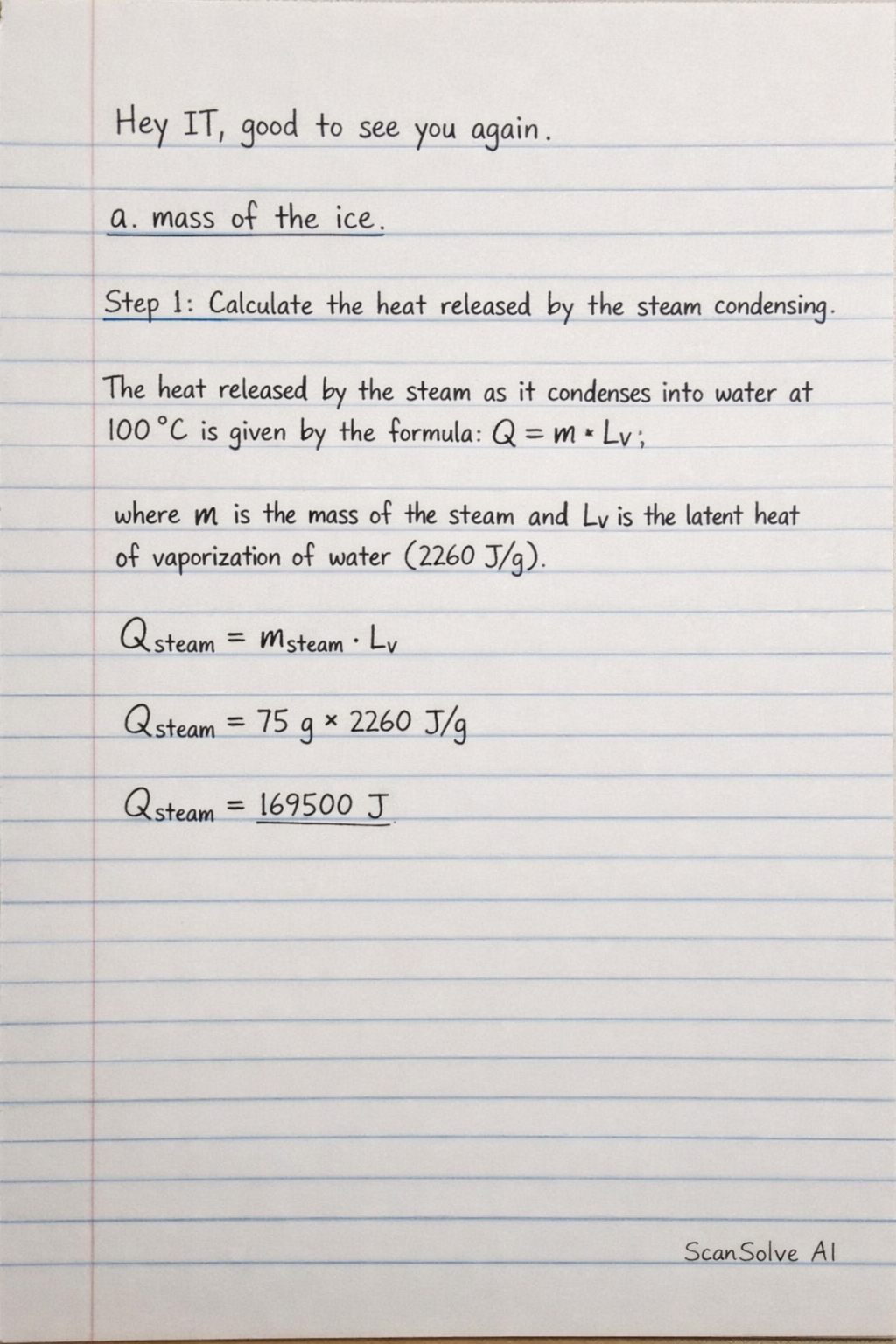
mass of the ice

  1. Calculate the heat released by the steam condensing.

    The heat released by the steam as it condenses into water at 100 °C100 \text{ °C} is given by the formula Q=m⋅LvQ = m \cdot L_v, where mm is the mass of the steam and LvL_v is the latent heat of vaporization of water (2260 J/g2260 \text{ J/g}).

    Qsteam=msteam⋅LvQ_{steam} = m_{steam} \cdot L_v Qsteam=75 g×2260 J/gQ_{steam} = 75 \text{ g} \times 2260 \text{ J/g} Qsteam=169500 JQ_{steam} = 169500 \text{ J}
  2. Calculate the mass of the ice using the heat absorbed for melting.

    The problem states that the heat released by the steam is just sufficient to melt the ice. The heat absorbed by the ice as it melts at 0 °C0 \text{ °C} is given by Q=m⋅LfQ = m \cdot L_f, where mm is the mass of the ice and LfL_f is the latent heat of fusion of ice (334 J/g334 \text{ J/g}).

    Qice=mice⋅LfQ_{ice} = m_{ice} \cdot L_f

    Since Qsteam=QiceQ_{steam} = Q_{ice}:

    169500 J=mice⋅334 J/g169500 \text{ J} = m_{ice} \cdot 334 \text{ J/g} mice=169500 J334 J/gm_{ice} = \frac{169500 \text{ J}}{334 \text{ J/g}} mice≈507.485 gm_{ice} \approx 507.485 \text{ g}

    Rounding to three significant figures:

    mice≈507 gm_{ice} \approx 507 \text{ g}

    The mass of the ice is 507 g\boxed{\text{507 g}}.

Part b

12.9 °C\text{12.9 °C}

equilibrium temperature of the mixture in the calorimeter

  1. Identify the components and their initial temperatures after the ice has melted.

    After the ice has completely melted, the system contains:

    • Water from condensed steam: ms=75 gm_s = 75 \text{ g} at 100 °C100 \text{ °C}.
    • Water from melted ice: mice≈507.485 gm_{ice} \approx 507.485 \text{ g} at 0 °C0 \text{ °C}. These two quantities of water will mix and reach an equilibrium temperature, TfT_f. The specific heat capacity of water (cwc_w) is 4.18 J/(g⋅°C)4.18 \text{ J/(g} \cdot \text{°C)}.
  2. Set up the heat exchange equation.

    In an insulated calorimeter, the heat lost by the hotter substance equals the heat gained by the colder substance.

    Qlost=QgainedQ_{lost} = Q_{gained} ms⋅cw⋅(Tinitial_steam_water−Tf)=mice⋅cw⋅(Tf−Tinitial_melted_ice_water)m_s \cdot c_w \cdot (T_{initial\_steam\_water} - T_f) = m_{ice} \cdot c_w \cdot (T_f - T_{initial\_melted\_ice\_water}) 75 g⋅cw⋅(100 °C−Tf)=507.485 g⋅cw⋅(Tf−0 °C)75 \text{ g} \cdot c_w \cdot (100 \text{ °C} - T_f) = 507.485 \text{ g} \cdot c_w \cdot (T_f - 0 \text{ °C})

    The specific heat capacity of water (cwc_w) cancels out from both sides:

    75⋅(100−Tf)=507.485⋅Tf75 \cdot (100 - T_f) = 507.485 \cdot T_f
  3. Solve for the equilibrium temperature, TfT_f.

    7500−75Tf=507.485Tf7500 - 75 T_f = 507.485 T_f 7500=507.485Tf+75Tf7500 = 507.485 T_f + 75 T_f 7500=(507.485+75)Tf7500 = (507.485 + 75) T_f 7500=582.485Tf7500 = 582.485 T_f Tf=7500582.485T_f = \frac{7500}{582.485} Tf≈12.876 °CT_f \approx 12.876 \text{ °C}

    Rounding to three significant figures:

    Tf≈12.9 °CT_f \approx 12.9 \text{ °C}

    The equilibrium temperature of the mixture is 12.9 °C\boxed{\text{12.9 °C}}.

Was this helpful?

Try one yourself

A new problem that tests the same skill.

Still stuck on this one?

Ask a follow-up, and the answer starts from this question.

Got a different question?Ask your own question
Handwritten step-by-step solution preview

Handwritten Step-by-Step Solution

Get this as a handwritten image on WhatsApp — like a tutor wrote it for you.

Try on WhatsApp