
This English question involves literary analysis, grammar, or writing skills. The detailed response below provides a well-structured answer with supporting evidence and clear explanations.
ScanSolve AI Answer
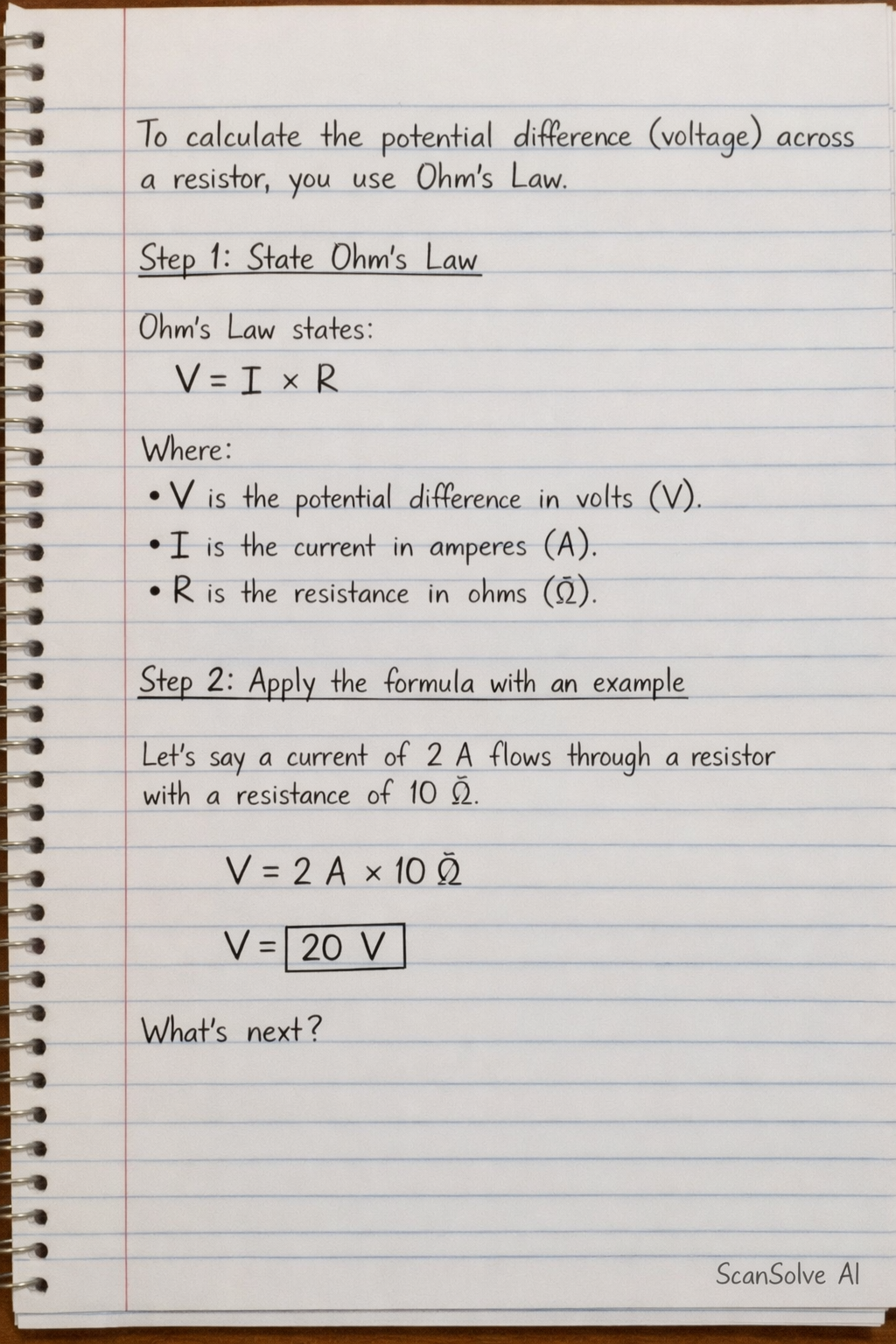
To calculate the potential difference (voltage) across a resistor, you use Ohm's Law. Step 1: State Ohm's Law Ohm's Law states that the potential difference (V) across a resistor is directly proportional to the current (I) flowing through it, and the resistance (R) of the resistor. V = I × R Where: • V is the potential difference in volts (V). • I is the current in amperes (A). • R is the resistance in ohms (). Step 2: Apply the formula with an example Let's say a current of 2 A flows through a resistor with a resistance of 10 . V = 2 A × 10 V = 20 V What's next?