
Calculate the potential difference of the 5 ohm and the 10 ohm resistors
ScanSolve AI Answer
Answer
Step-by-step solution
3 stepsCalculate the equivalent resistance of the parallel combination of the and resistors.
For two resistors in parallel, the equivalent resistance is given by the formula:
Substituting and :
Determine the current flowing through the parallel combination.
The parallel combination of the and resistors is in series with the and resistors. The ammeter indicates that the total current flowing from the source is . In a series circuit, the current is the same through all components.
Therefore, the current flowing through the parallel combination is .Calculate the potential difference across the parallel combination.
Using Ohm's Law, , where is the potential difference, is the current, and is the equivalent resistance of the parallel combination.
Since the and resistors are in parallel, the potential difference across each of them is the same as the potential difference across their equivalent resistance.
The potential difference across the resistor is .
The potential difference across the resistor is .
Try one yourself
A new problem that tests the same skill.
Still stuck on this one?
Ask a follow-up, and the answer starts from this question.
More Physics Questions
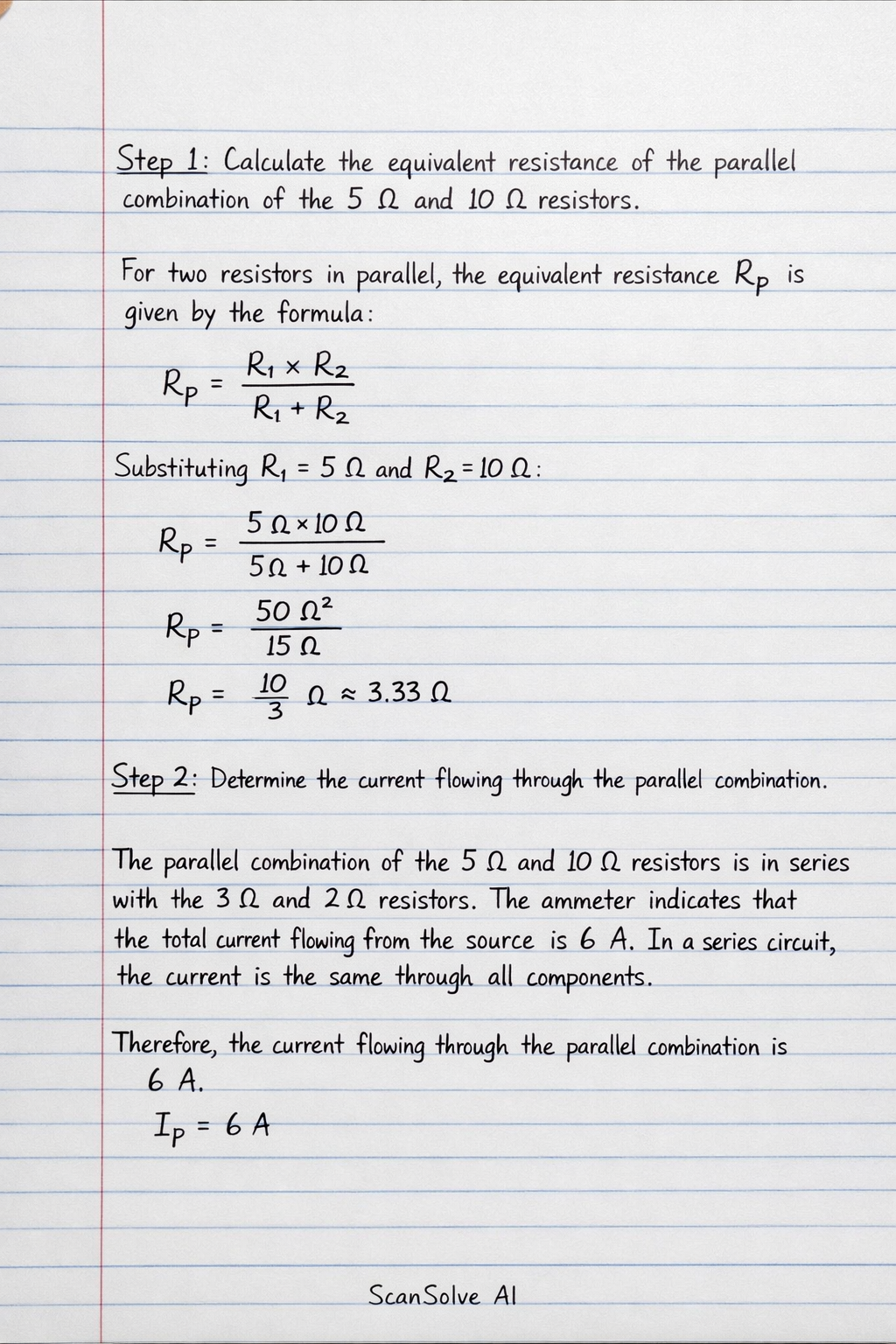
Handwritten Step-by-Step Solution
Get this as a handwritten image on WhatsApp — like a tutor wrote it for you.
Try on WhatsApp